

On this page
In a game of tug of war, the biggest, strongest team does not always win. It is a common misconception that victory comes from pulling the rope harder than the opponents. However, classical mechanics reveals a counterintuitive truth: the secret to winning actually lies beneath your feet.
Why does Newton's third law create a paradox?
When you watch a tug of war, it looks like a battle of pulling strength. But according to Newton's third law of motion, for every action, there is an equal and opposite reaction.
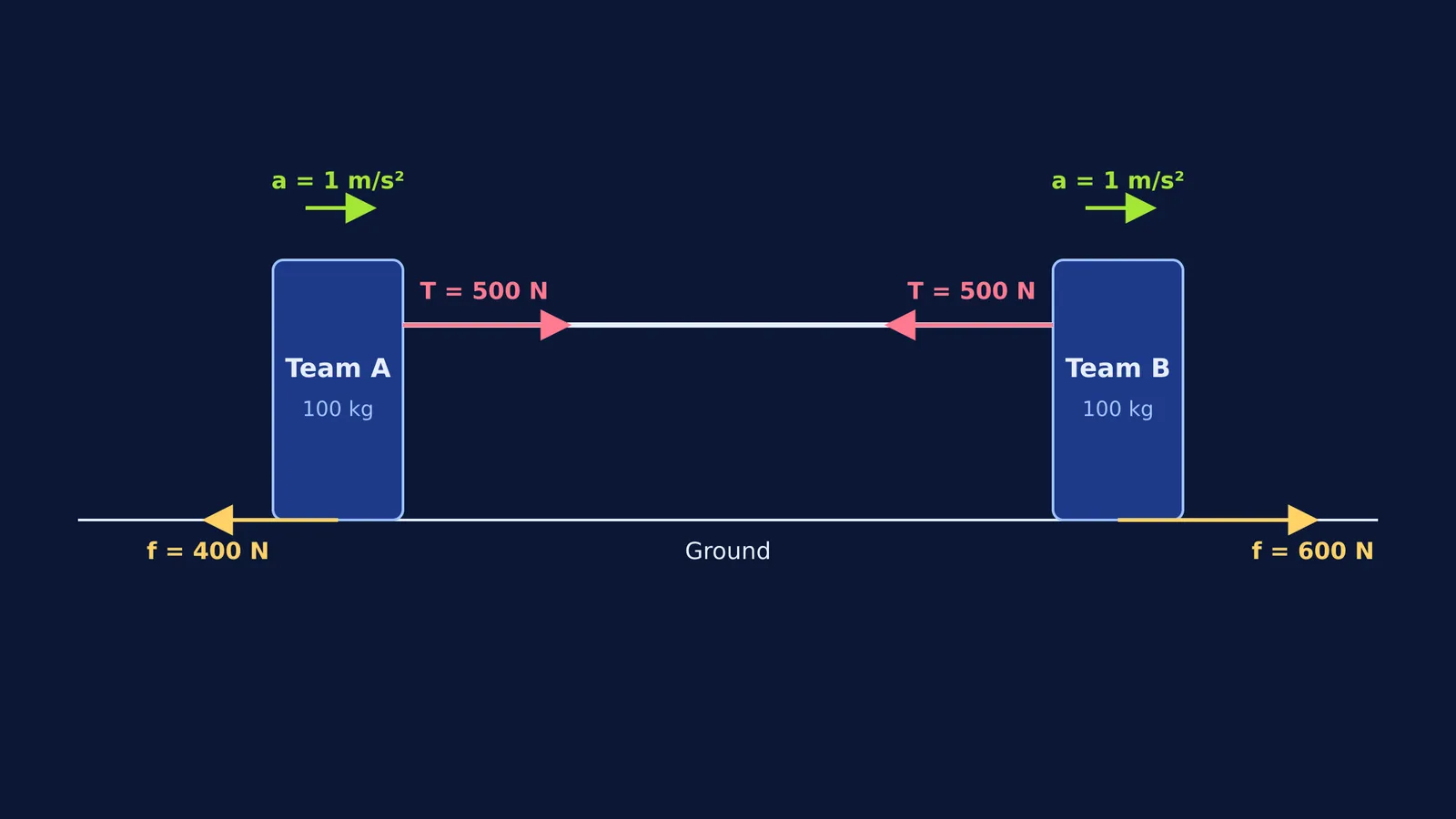
If Team A pulls the rope with a force of 500 newtons, the rope pulls back on Team A with 500 newtons. Simultaneously, the rope transmits that exact same force to Team B, and Team B pulls back on the rope with 500 newtons. Because the rope is simply a medium for transmitting force, the tension at any point along the string is identical for both teams.
This means both teams are pulled toward the centre with the exact same amount of force, regardless of their muscle mass. You cannot physically pull the rope "harder" than the other team pulls you. Every ounce of effort you put into pulling the rope is instantly matched by the tension pulling back against your hands.
How does friction decide the winner?
If the forces pulling on the rope are always equal, how does anyone ever move? The answer is the external force from the ground. To pull a rope, you must plant your feet and push forward against the ground.
According to Newton's third law, when you push the ground forward, the ground pushes back on you in the opposite direction. This opposing force is static friction. The team that can exert a greater horizontal force against the ground will receive a greater reaction force from the earth to overcome the rope's tension.
You do not win by pulling the rope; you win by pushing the ground. The rope simply connects the two teams so they can test their ground friction against one another. If you find it hard to picture how these competing forces balance out, you can set up a free-body diagram in the Fermi Simulation Lab, which provides interactive simulations for the ideas that are easier to see than to read.
Why do weight and shoes matter?
Because friction is the deciding factor, we have to look at the formula for maximum static friction: F = μN. The maximum friction depends on the coefficient of friction (μ) and the normal force (N).
Shoes and surface: The coefficient of friction is determined by the two surfaces in contact. Wearing spiked cleats on grass or rubber on a gym floor drastically increases your grip, giving you a massive advantage over an opponent in smooth-soled shoes. If you want to understand how materials change this coefficient, our guide to the angle of repose and angle of friction explains the mathematics behind surface grip.
Body mass: A heavier team exerts more downward force due to gravity, which increases the normal force pushing back up from the ground. A larger normal force directly increases the maximum possible static friction, making heavy teams much harder to drag across the field.
Posture: Leaning back allows you to convert more of your leg strength into a horizontal push against the ground. This is similar to calculating the minimum force to drag a block, where the angle of your push or pull dictates the efficiency of the movement.
What is a practical checklist for your next match?
If you want to guarantee a win at your next school sports day, you need to turn these physics principles into a physical strategy.
Check your footwear: Do not wear worn-out trainers. Choose shoes with deep treads or soft rubber soles that will bite into the playing surface.
Anchor the back: Place your heaviest team member at the very back of the line. Their high body mass creates a massive normal force, grounding the entire team.
Drop your centre of gravity: Tell your team to bend their knees and lean backward. If your chest is facing the sky, your legs are pushing horizontally into the dirt, maximizing your static friction.
Step in unison: If one person slips, the team's total friction drops instantly, and the opposing team's tension will pull you forward. Call out a rhythm so everyone pushes the ground at the exact same moment.


