

On this page
A glacial lake outburst flood (GLOF) happens when a natural dam of loose rocks and ice fails, suddenly releasing a massive volume of meltwater. A 2023 study published in *Nature Communications* found that 15 million people globally live in areas at risk of these floods, with India and Pakistan among the most exposed.
How does a glacial lake form?
As temperatures rise, glaciers in the Himalayas retreat. The melting ice leaves behind depressions that fill with water, forming new lakes. These pools of water are usually held back by a terminal moraine — a ridge of loose boulders, gravel, dirt and ice that the glacier bulldozed forward as it grew.
Unlike concrete dams built for hydroelectric power, a moraine is a natural, unconsolidated pile. It is structurally weak. As the glacier melts faster, the lake's volume expands, putting more pressure on this fragile barrier.
What triggers the outburst?
A glacial lake outburst flood happens when the moraine dam gives way. This failure can be triggered by several events:
Calving and avalanches: A large chunk of ice from the retreating glacier breaks off and plunges into the lake. This creates a massive displacement wave — a tsunami — that overtops the dam and erodes it from the top down.
Melting ice cores: The moraine itself often contains blocks of buried ice. If this "dead ice" melts, the dam loses its structural integrity and collapses.
Earthquakes: Seismic activity can shake the loose debris apart.
Heavy rainfall: Intense rain rapidly raises the water level until it overtops the dam.
When the dam breaks, the lake empties rapidly. The water mixes with mud, boulders and trees, turning into a fast-moving debris flow that wipes out everything in its path.
Why are the Himalayas so vulnerable?
The Himalayas combine rapid glacier melting with steep, active geology and growing downstream populations. A 2023 study published in *Nature Communications* found that 15 million people globally are exposed to the impacts of potential GLOFs.
The risk is heavily concentrated in High Mountain Asia, where approximately 1 million people live within just 10 km of a glacial lake. More than half of the globally exposed population lives in just four countries: India, Pakistan, Peru and China.
Why is a GLOF so destructive?
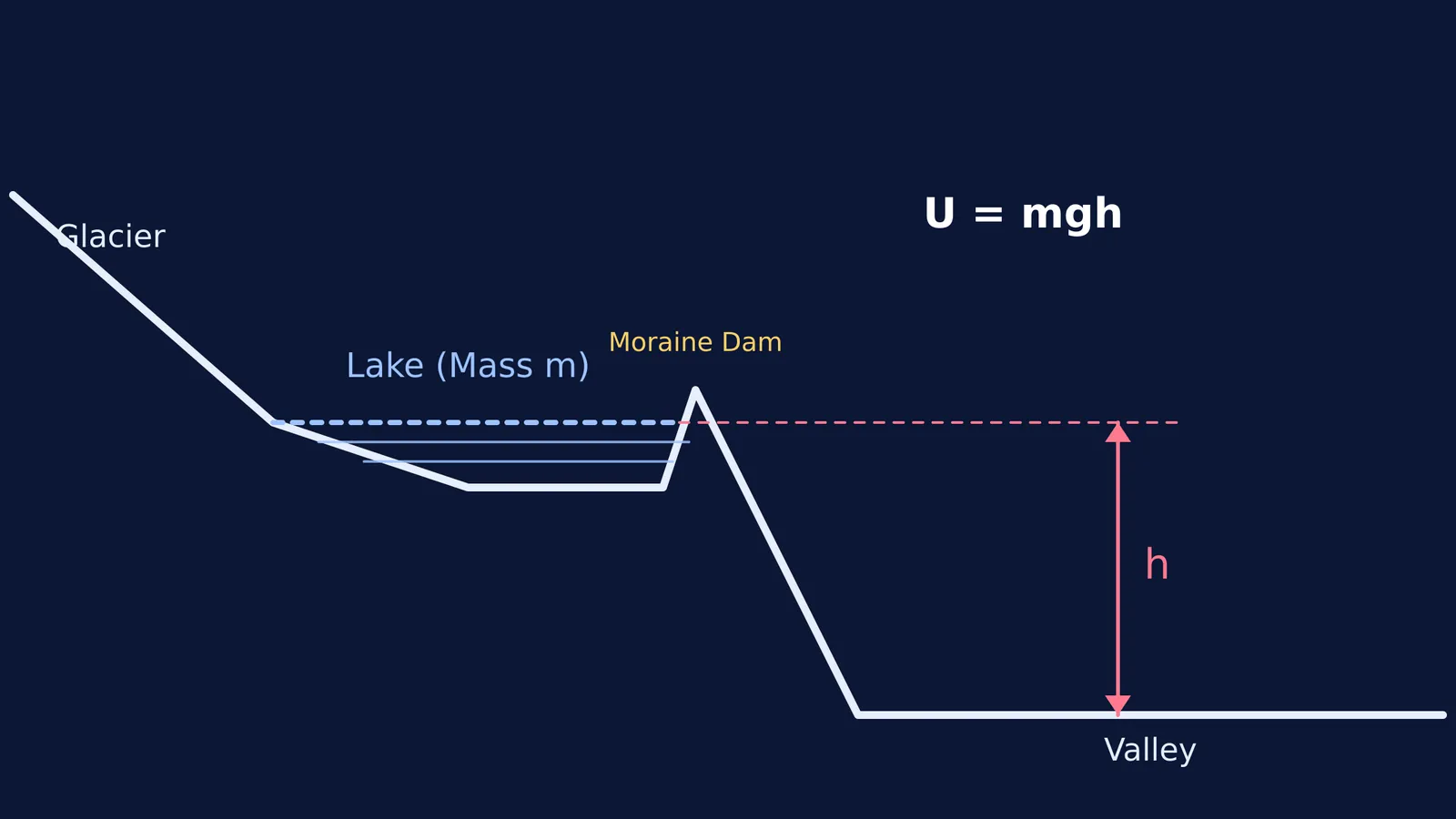
Why is a glacial lake outburst so destructive? The answer lies in the gravitational potential energy of the stored water. We can use a simple physics framework to estimate this energy.
Imagine a large Himalayan glacial lake containing 10 million cubic metres of water, sitting at an elevation 2,000 metres above a downstream valley.
Find the mass of the water:
The density of water is 1,000 kg/m³. Mass = Volume × Density m = 10,000,000 × 1,000 = 10¹⁰ kg
Calculate the potential energy:
The gravitational potential energy (U) relative to the valley floor is: U = mgh U = 10¹⁰ × 9.8 × 2000 = 1.96 × 10¹⁴ Joules
The energy released by this hypothetical lake dropping into the valley is 1.96 × 10¹⁴ Joules — all converting into kinetic energy that drives the flood down the mountain.
If you are practising for JEE or NEET, being able to work with different units (see Converting a quantity between unit systems using dimensions) and calculate stored energy—similar to finding the Elastic potential energy in a stretched wire—is a key skill.
If you are struggling to picture how these forces play out, the Fermi Simulation Lab has interactive simulations for the ideas that are easier to see than to read. For numerical practice on work, energy and power, the Fermi Problem Library provides worked problems with a step-by-step solver that explains the reasoning rather than printing an answer.


