

On this page
Ask any student preparing for CBSE Class 12 or JEE why dx appears in an integral, and many will say it acts like a closing bracket—a polite signal that the integrand is finished. In scratchpad work, many drop it entirely, scribbling ∫ x² = x³/3 and restoring dx only on the final answer sheet to avoid losing a presentation mark.
Yet dx is not decorative punctuation. In November 1675, when Gottfried Wilhelm Leibniz developed modern calculus notation, documented in the MacTutor History of Mathematics archive, he designed each symbol to convey arithmetic meaning. The elongated 'S' stood for *summa* (sum), while 'd' represented *differentia* (difference). The expression ∫ f(x) dx is not an empty container wrapped around f(x); it is an explicit instruction to multiply a varying quantity f(x) by an infinitesimal increment dx, and then sum all those tiny products across an interval. We explore these origins further in our look at Gottfried Leibniz's notation of calculus.
How does dx come from a Riemann sum?
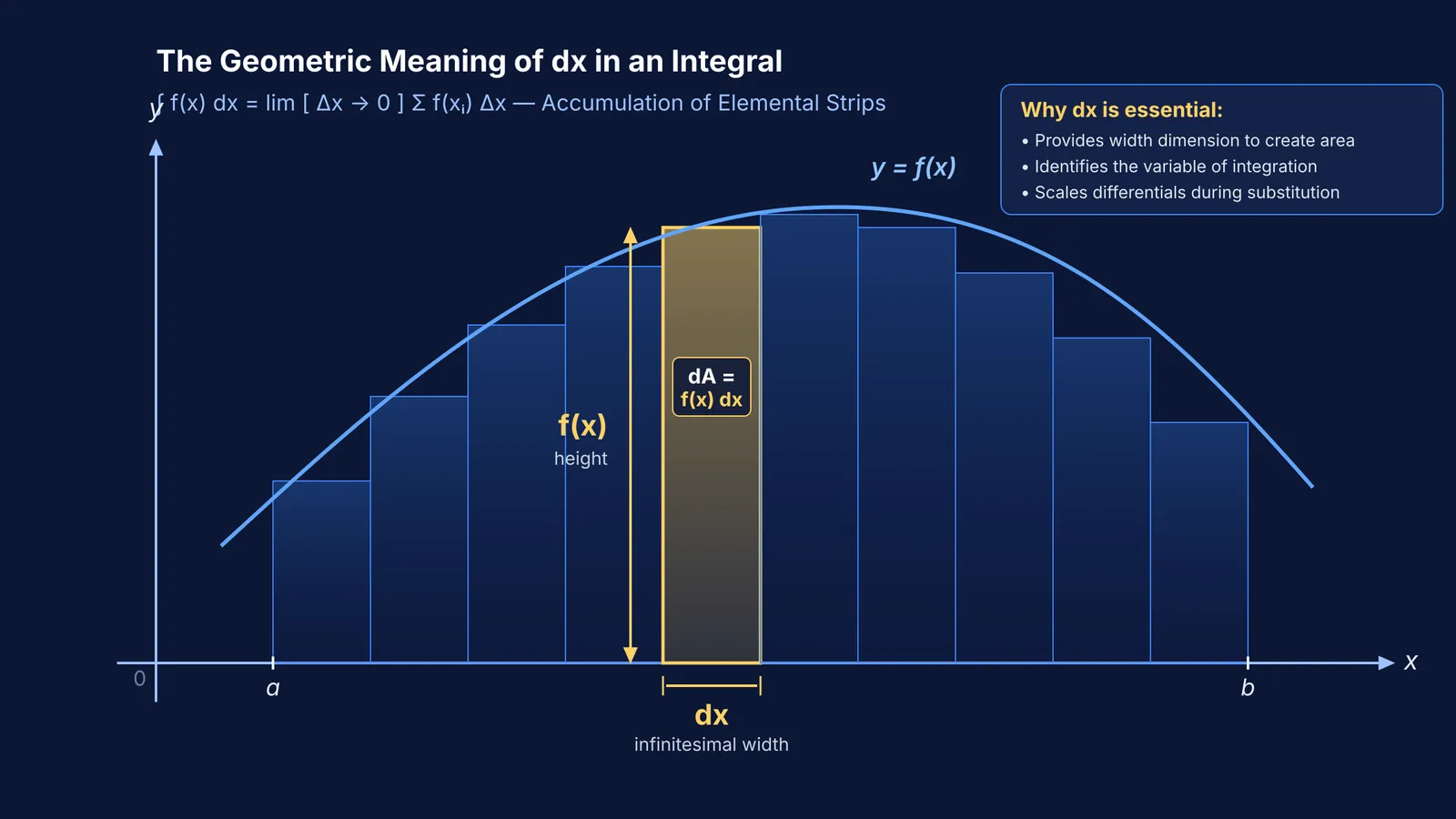
To understand why multiplication matters, look at the geometry of a Riemann sum. When finding the area under a curve y = f(x) from x = a to x = b, you divide the interval into n vertical slices. If each slice has width Δx = (b − a)/n, you approximate the slice at position xᵢ* as a rectangle with area f(xᵢ*) × Δx. Summing these rectangles gives:
Sₙ = Σ f(xᵢ*) Δx
As the number of slices approaches infinity, the width Δx shrinks toward zero. In this limit, the discrete sum Σ becomes the continuous integral sign ∫, the sample point xᵢ* becomes the coordinate x, and the finite width Δx becomes the infinitesimal width dx. The integral ∫ f(x) dx is simply the sum of infinitely thin rectangular strips, each having area f(x) dx.
In a study published in The Journal of Mathematical Behavior, education researcher Steven R. Jones examined how 150 calculus students conceptualised the definite integral. Jones found that students who viewed integration solely as "area under a curve" or an antiderivative algorithm struggled to set up integrals for applied problems. Conversely, students who adopted an "adding up pieces" model—explicitly multiplying a rate or height by an infinitesimal width dx—were far more capable of setting up correct integrals.
Why does an integral mean nothing without dx?
Dropping dx strips an integral of three essential properties:
It specifies the variable of integration. In an expression like ∫ (ax² + b), the differential tells you which quantity changes. Writing ∫ (ax² + b) dx gives ax³/3 + bx + C, while ∫ (ax² + b) da treats x as a constant and yields a²x²/2 + ba + C. Without the differential, the operation is ambiguous.
It protects physical dimensions. In physics, every integral must yield consistent units. If v(t) is velocity in metres per second (m/s) and dt is time in seconds (s), the product v(t) dt has units of (m/s) × s = metres (m). Omitting dt adds velocities rather than displacement. In an investigation in Physical Review Special Topics - Physics Education Research, researchers Dehui Hu and N. Sanjay Rebello observed that students who treated differentials as formal markers rather than physical quantities repeatedly failed to track units in physics problems.
It sets the direction of slicing. Slicing vertically means integrating strips of width dx with respect to x. In many curve problems, horizontal slicing with strips of width dy is simpler. See our guide on area using horizontal strips for examples where switching the differential eliminates tedious splits.
The Fermi Concept Library covers every concept in physics, chemistry, biology, mathematics and computing, each with its own lesson and its place in the map.
How do you track dx in substitution and physics problems?
In calculus, dx is an active algebraic term. In u-substitution, letting u = g(x) gives du/dx = g′(x), meaning dx = du / g′(x). As demonstrated in OpenStax Calculus Volume 1, ignoring dx skips dividing by g′(x), leading to incorrect scale factors. For transforming limits and differentials together, see our guide to integration by substitution.
To set up physical integrals reliably, use this four-step Strip Test:
Choose an axis and slice the object at coordinate x with infinitesimal width dx.
Express the elemental piece dQ = f(x) dx, confirming that the units of f(x) multiplied by dx give the units of dQ.
Write all variables in terms of x.
Integrate from the start to the end of the interval.
For a rod from x = 0 to 3 m with density λ(x) = (2x + 1) kg/m:
A slice of length dx has mass dm = λ(x) dx = (2x + 1) dx kg, since (kg/m) × m = kg.
Total mass M = ∫₀³ (2x + 1) dx = [x² + x]₀³ = (3² + 3) − 0 = 12 kg.
Each strip has a real physical thickness dx, guaranteeing that the accumulated sum has the right units. For guided practice with physics problems, the Fermi Problem Library provides worked problems with a step-by-step solver that explains the reasoning rather than printing an answer.


