

On this page
When you buy a 1-ton air conditioner, you are not buying a machine that weighs 2,000 pounds. Instead, you are buying a specific rate of heat removal. The "ton" in air conditioning measures cooling capacity, not physical weight.
Understanding where this unit comes from is a great way to see how thermodynamics concepts like latent heat and power connect to everyday life.
What does 1 ton mean in an air conditioner?
Before the invention of modern mechanical air conditioning, large buildings and businesses were cooled using massive blocks of ice harvested during the winter. When early mechanical refrigeration systems were introduced in the late 19th century, manufacturers needed a way to explain their cooling power to customers who were used to buying ice by the ton.
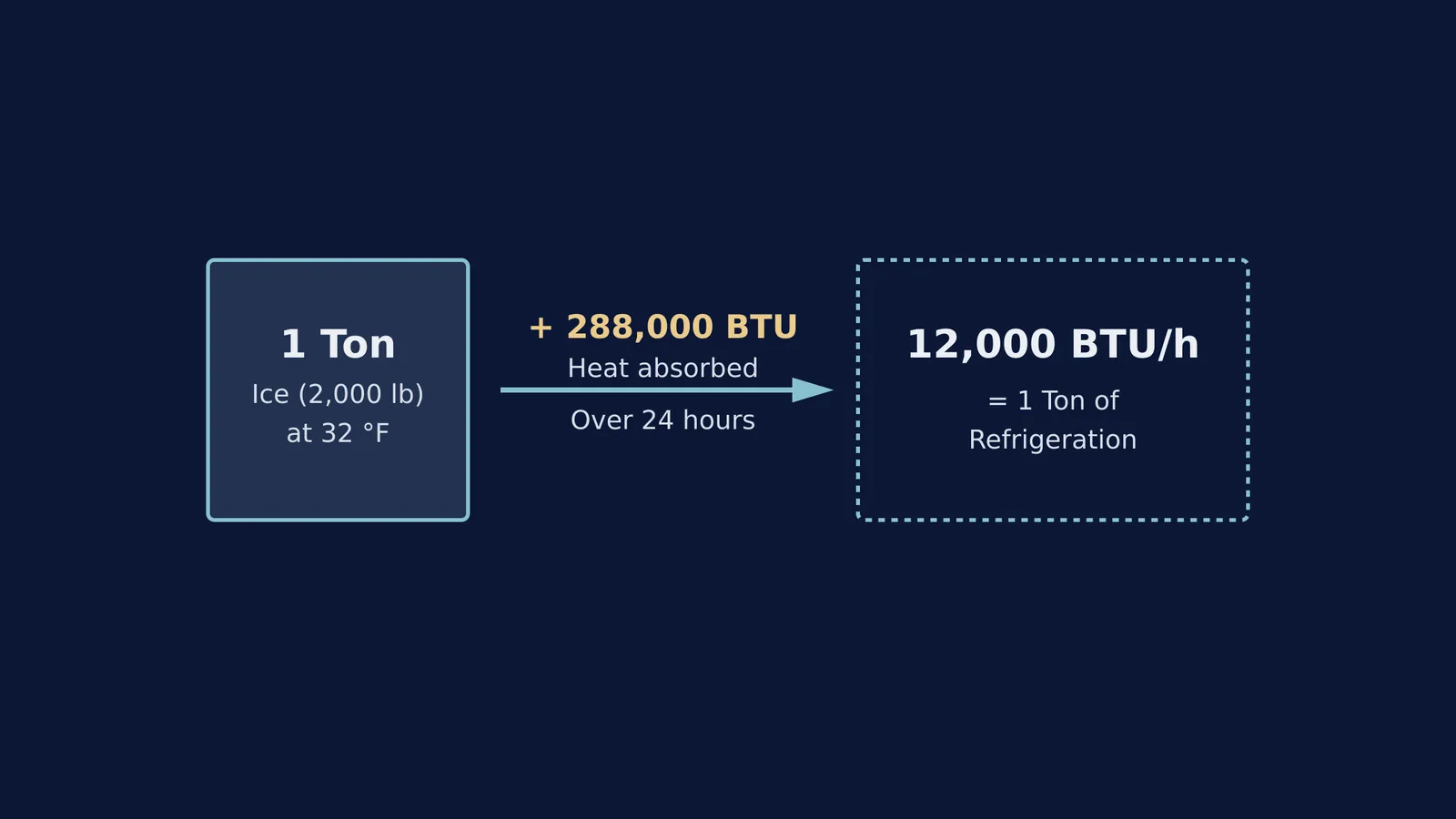
They decided to rate the new machines by how many tons of ice they could replace in a single day. A 1-ton air conditioner provides the same amount of cooling as melting one short ton (2,000 pounds) of pure ice at 32 °F (0 °C) over a 24-hour period, according to its historical definition.
To find out exactly how much heat that is, we need to look at the physics of melting ice.
What is the latent heat of fusion?
When ice melts, it absorbs heat without changing its temperature. The energy required to turn a solid into a liquid at its melting point is called the latent heat of fusion. (You can see how this compares to other state changes in our guide to enthalpies of atomisation, sublimation and phase change.)
For water, the latent heat of fusion is 144 British Thermal Units (BTU) per pound. This means it takes 144 BTU of heat energy to melt one pound of ice at 32 °F into water at 32 °F.
Since one short ton is 2,000 pounds, we can calculate the total heat absorbed by melting a ton of ice:
2,000 pounds × 144 BTU/pound = 288,000 BTU.
This melting happens over 24 hours. To find the hourly cooling rate, we divide the total heat by the time:
288,000 BTU / 24 hours = 12,000 BTU/hour.
According to the National Institute of Standards and Technology (NIST), a ton of refrigeration is officially defined as exactly 12,000 BTU/h. So, a 1.5-ton AC removes 18,000 BTU/h, and a 2-ton AC removes 24,000 BTU/h.
Does a 1-ton AC use 3.5 kW of electricity?
In the International System of Units (SI), power is measured in watts (Joules per second). Converting 12,000 BTU/h to watts gives us approximately 3,517 watts, or 3.52 kilowatts (kW) of cooling power.
However, an air conditioner does not consume 3.5 kW of electrical power to provide 3.5 kW of cooling.
An air conditioner is a heat pump. It does not create cold; it simply moves heat from the inside of your room to the outside. For a deep dive into measuring heat changes in closed systems, read our explanation of measuring ΔU with a bomb calorimeter.
The electrical energy goes into running the compressor and fans, not into cancelling out the heat. Because moving heat takes less effort than generating it, a typical 1-ton AC consumes only a fraction of its 3.5 kW cooling capacity in electrical power. The ratio of cooling power to electrical power is called the Coefficient of Performance (COP).
Sensible heat vs latent heat
When an air conditioner cools your room, it is actually doing two different types of thermodynamic work.
First, it removes sensible heat. Sensible heat is the energy that changes the temperature of the air, which you can feel and measure with a thermometer. When the room drops from 30 °C to 24 °C, the AC is removing sensible heat.
Second, it removes latent heat by condensing the water vapour in the air. Just as melting ice absorbs latent heat, condensing water vapour releases it. Your air conditioner has to extract this hidden heat to turn the humidity into liquid water, which then drips out of the drain pipe. In a humid climate, a large portion of a 1-ton AC's 12,000 BTU/h capacity is spent fighting this latent heat rather than simply dropping the air temperature. This is why a humid room takes much longer to cool down than a dry one.
Visualising heat and state changes
Thermodynamics is full of invisible processes, such as heat flowing through a compressor or a refrigerant changing state from gas to liquid. When you cannot see the energy moving, it is easy to get stuck on the formulas.
If you find it hard to picture how latent heat and phase changes work, the Fermi Simulation Lab lets you run interactive experiments. You can watch the temperature curve flatten out as a substance absorbs latent heat during melting or boiling, making the ideas easier to see than to read.
Next time you hear an air conditioner switch on, you can picture the invisible blocks of ice it takes to keep the room cool.


