

On this page
Does the speed of a wave depend on frequency or amplitude?
When you pluck a guitar string harder or speak in a higher pitch, you are changing the amplitude and frequency of the waves you produce. However, neither of these changes the wave's speed. As OpenStax explains, the speed of a wave depends exclusively on the properties of the medium it travels through.
Amplitude is determined by how much energy you put into the wave. Frequency is set by how fast the source is vibrating. But once the wave is in the medium—whether that is a stretched string or the air in a room—it travels at a speed dictated by that medium's own physical traits.
How is wave speed determined?
For any mechanical wave, the speed is set by a balance between two properties of the medium: its elasticity and its inertia.
Elastic property: How strongly the medium snaps back into place when disturbed.
Inertial property: How much the medium resists being moved, which usually depends on its density.
For a wave on a string, as OpenStax details, the elastic property is the string's tension (F), and the inertial property is its linear mass density (μ), measured in kg/m. The wave speed (v) is the square root of tension divided by linear mass density: v = √(F / μ). You can only change the speed by tightening the string (increasing tension) or switching to a thicker string (increasing density).
For sound waves in the air, the speed depends on the air's temperature and density. For example, the speed of sound in air at 20.0 °C is 343 m/s, according to OpenStax. As the air gets warmer, the gas molecules move faster and bump into each other more often, which allows the sound wave to travel faster. If you shout a high-pitched note and a low-pitched note, they both travel across the room at exactly 343 m/s. (To see how sound travels as both movement and pressure, read our guide to displacement and pressure waves in sound.)
What happens when you increase the frequency?
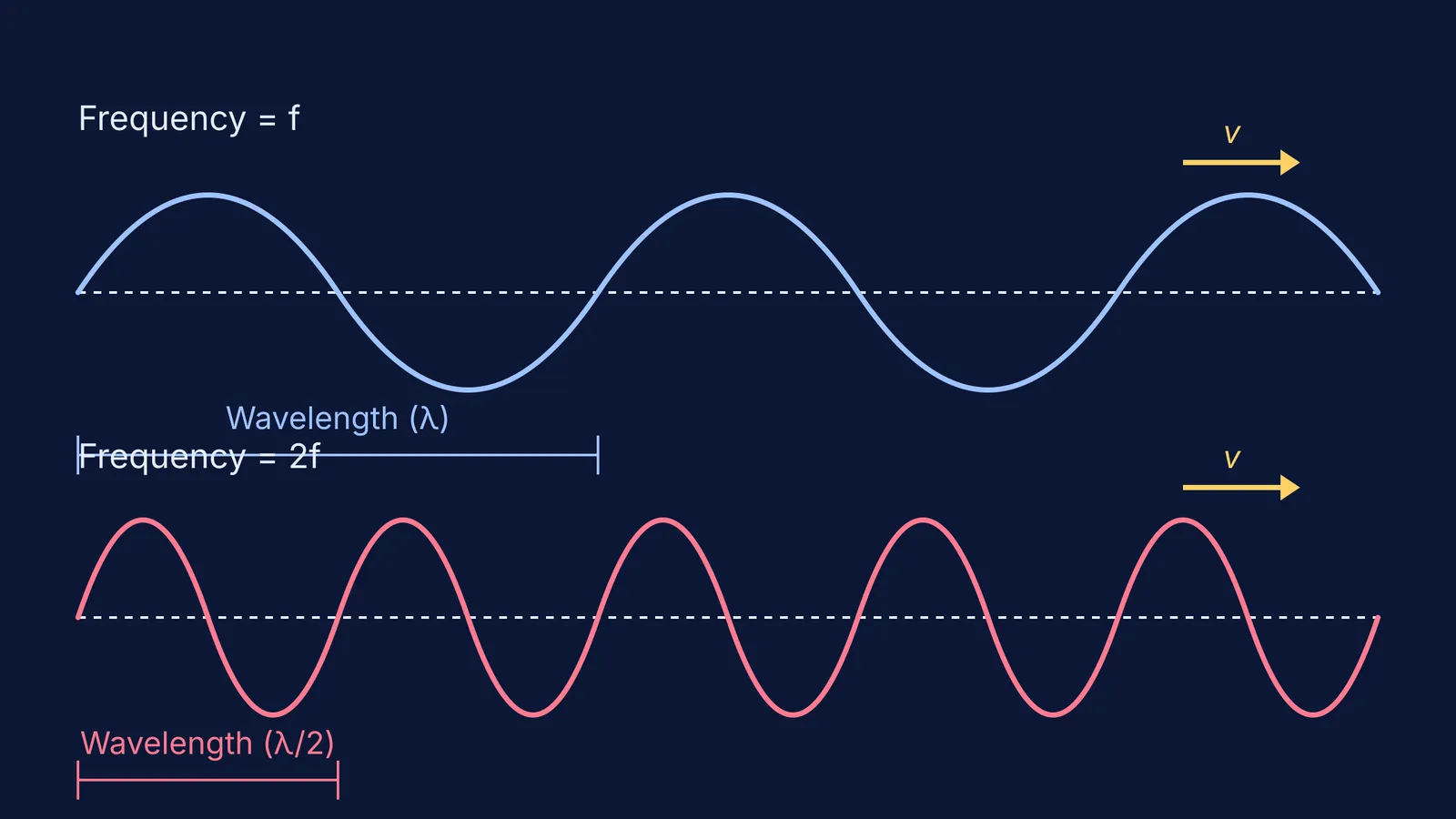
You might remember the wave equation: v = f × λ, where v is velocity, f is frequency, and λ (lambda) is wavelength. Because the velocity is locked by the medium, changing the frequency forces the wavelength to adapt.
If you double the frequency of a wave on a string, the wave still travels at the same speed. To make the math work, the wavelength must be cut exactly in half. The waves become shorter and more squished together, but they do not move down the string any faster.
When students learn this concept, they often misread v = f × λ as meaning that a bigger f leads to a bigger v. If you are dealing with concept gaps like this, the Fermi Concept Library covers every concept in physics, chemistry, biology, mathematics and computing, each with its own lesson and its place in the map.
How to check your understanding?
When faced with a wave problem, use this simple checklist:
Did the wave move into a new material? (Speed changes. See exactly how this works when light enters glass).
Did the material change temperature or tension? (Speed changes).
Did the source vibrate faster? (Frequency increases, wavelength decreases, speed stays the same).
Was more energy added? (Amplitude increases, speed stays the same).
By keeping the source and the medium separate in your mind, you can avoid the most common mistakes in wave physics.


