

On this page
In spectroscopy and quantum mechanics, we often need to measure how light interacts with matter. While you might be used to thinking about light in terms of wavelength (how long one wave is) or frequency (how many waves pass a point in one second), there is a third way: wave number.
Here is what wave number means, how to calculate it, and why chemists use it to read infrared spectra.
What is wave number in spectroscopy?
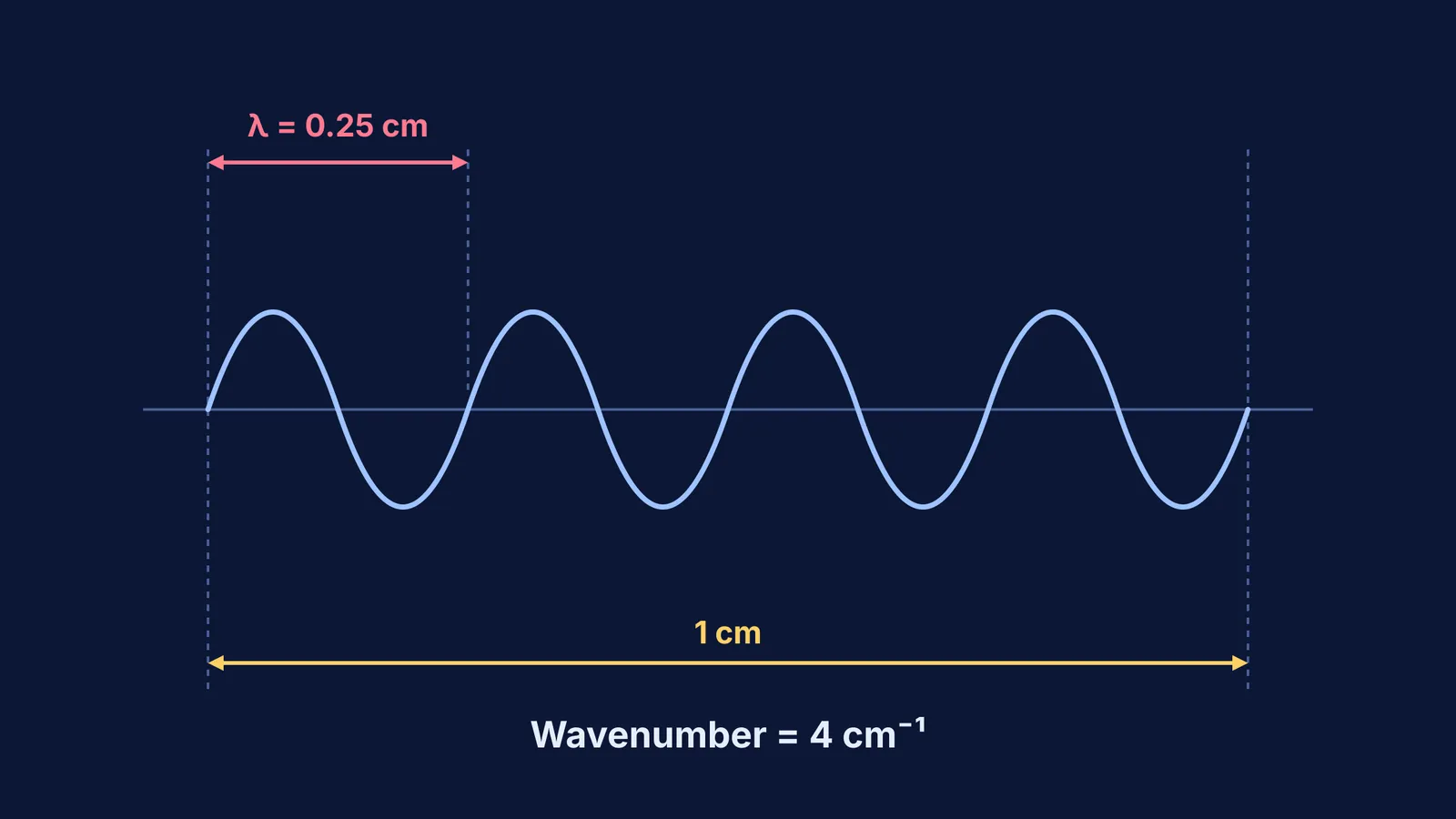
The spectroscopic wave number (written as ν̃, pronounced "nu tilde") is defined as the number of wavelengths per unit distance.
For example, if a wave has a length of 0.25 cm, then four of those waves will fit into 1 cm. The wave number is simply 4 cm⁻¹.
Mathematically, it is the reciprocal of the wavelength in a vacuum:
ν̃ = 1 / λ
Because it is 1 divided by a distance, its official SI unit is the reciprocal metre (m⁻¹). One reciprocal centimetre equals 100 reciprocal metres (1 cm⁻¹ = 100 m⁻¹).
Why is wave number used in IR spectroscopy?
In infrared (IR) spectroscopy, chemists shine light through a molecule to see which bonds absorb the energy. Different bonds stretch or bend at specific energies.
Wave number is directly proportional to a photon's energy (E = hcν̃) and frequency. Wavelength, on the other hand, is inversely proportional to energy. By plotting an IR spectrum using wave number, the horizontal axis becomes a convenient energy scale: higher wave numbers mean higher energy.
It also gives us manageable whole numbers. According to the Wikipedia correlation table for infrared spectroscopy, a saturated ketone's carbon–oxygen (C=O) double bond absorbs at around 1720 cm⁻¹. An oxygen–hydrogen (O–H) bond in an alcohol shows a broad stretch between 3200 and 3400 cm⁻¹. If we measured these in metres or hertz, we would be dealing with awkward exponents.
If you are studying for your exams and struggling to keep these numbers straight, the Fermi Concept Library covers every concept in physics, chemistry, biology, mathematics and computing, each with its own lesson and its place in the map.
How do you convert wave number to frequency and energy?
Because wave number (ν̃) is just frequency (ν) divided by the speed of light (c), converting between them is straightforward:
ν = c × ν̃
When doing this calculation, make sure your units match. If your wave number is in cm⁻¹, you must use the speed of light in centimetres per second (approximately 3 × 10¹⁰ cm/s) to get the correct frequency in hertz (s⁻¹).
To find the energy of a photon from its wave number, you multiply by Planck's constant (h) and the speed of light:
E = hcν̃
Again, unit matching is critical. The standard value of Planck's constant is 6.626 × 10⁻³⁴ J·s. If you use the speed of light in m/s (3 × 10⁸ m/s), you must convert your wave number to m⁻¹ before multiplying. The result will be the photon's energy in joules.
How do you use wave number in the Rydberg formula?
You will also use wave numbers when calculating the emission lines of a hydrogen atom. When a hydrogen atom emits a photon as an electron drops from a higher energy level (n₂) to a lower one (n₁), the Rydberg formula gives the wave number of the emitted light directly:
ν̃ = R_H × (1/n₁² - 1/n₂²)
The Rydberg constant for hydrogen (R_H) is approximately 1.09678 × 10⁷ m⁻¹. Notice that the constant is given in m⁻¹, so the formula outputs a wave number in m⁻¹. If a question asks for the answer in cm⁻¹, remember to divide your result by 100.
Worked example: calculating the H-alpha line
Let's calculate the wave number and wavelength for the first line of the Balmer series (when an electron drops from n₂ = 3 to n₁ = 2).
Set up the Rydberg formula
ν̃ = R_H × (1/2² - 1/3²) ν̃ = R_H × (1/4 - 1/9) ν̃ = R_H × (5/36)
Plug in the constant
Using R_H = 1.09678 × 10⁷ m⁻¹: ν̃ = (1.09678 × 10⁷) × (5 / 36) ν̃ = 1.5233 × 10⁶ m⁻¹
Convert to cm⁻¹
To find the wave number in reciprocal centimetres, divide by 100: ν̃ = 15,233 cm⁻¹
Find the wavelength
Since wave number is 1 / λ, we just take the reciprocal of our m⁻¹ value to find the wavelength in metres: λ = 1 / (1.5233 × 10⁶ m⁻¹) λ = 6.565 × 10⁻⁷ m
This is approximately 656.5 nm, which is the famous bright red H-alpha line visible in the hydrogen emission spectrum.


