

On this page
Water dissolves more substances than any other liquid, earning it the title of the "universal solvent" from bodies such as the U.S. Geological Survey (USGS). While it cannot literally dissolve everything, its unique chemistry drives the transport of nutrients in our bodies, the weathering of rocks, and countless industrial processes.
The secret to this ability lies in its molecular shape and the resulting electrical charges, which allow water to pull apart many salts, sugars, and gases, even while leaving oils, fats, and plastics untouched.
Why is water called the universal solvent?
The title is an informal one. Water does not dissolve every substance—if it did, it could not be stored in a container. However, it is called the universal solvent because it can dissolve a wider variety of chemical compounds than any other naturally occurring liquid on Earth.
This property is essential for life. As water moves through the water cycle and through the bloodstream, it carries vital minerals and nutrients. To understand why it works so well, we have to look at the molecule itself.
How do polarity and hydrogen bonding work?
A water molecule (H₂O) is held together by covalent bonds, but the sharing of electrons is not equal. The oxygen atom is more electronegative than the two hydrogen atoms, meaning it pulls the shared electrons closer to itself.
Because the molecule has a bent shape, this unequal sharing creates a polar molecule. The oxygen side of the molecule develops a partial negative charge (δ⁻), while the hydrogen ends take on a partial positive charge (δ⁺).
This polarity turns each water molecule into a tiny magnet. The slightly positive hydrogen of one molecule is drawn to the slightly negative oxygen of a neighbouring molecule. These attractions are called hydrogen bonds. While weaker than covalent bonds, hydrogen bonds give water its high boiling point and its tremendous ability to interact with other charged or polar substances.
How does water dissolve salts and sugars?
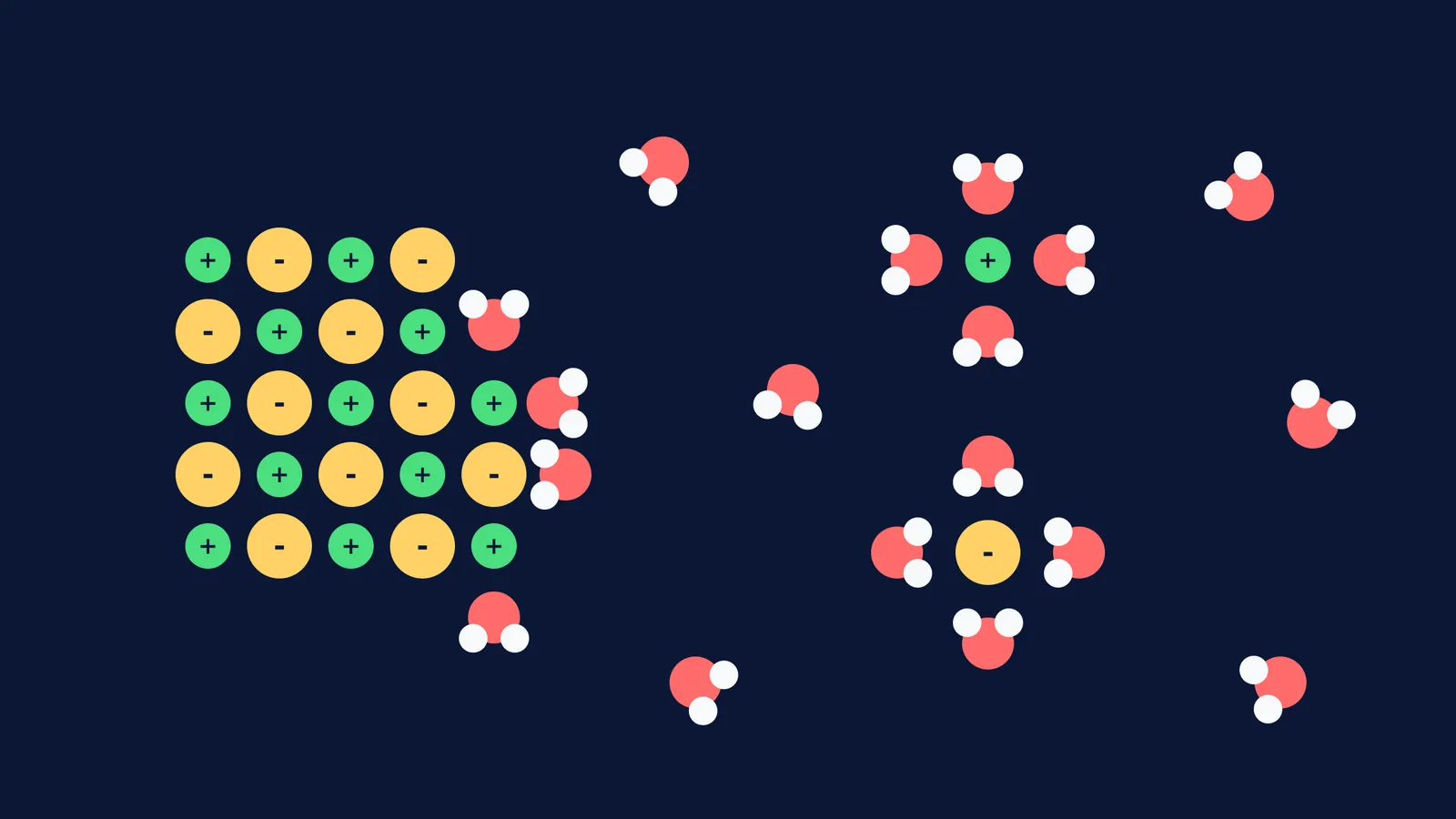
When you drop a salt, such as sodium chloride (NaCl), into water, the water molecules immediately attack the salt's rigid crystal lattice. The partially negative oxygen atoms are attracted to the positively charged sodium ions (Na⁺), while the partially positive hydrogen atoms align with the negatively charged chloride ions (Cl⁻).
These strong ion-dipole forces pull the ions away from the crystal and surround them in a "hydration shell," dispersing them evenly throughout the liquid. This process relies on a key property of water: its dielectric constant. The dielectric constant of pure water at 25 °C is approximately 78.3, according to measurements by the National Institute of Standards and Technology (NIST). This high value means water acts as an electrical insulator between the separated ions, reducing the attractive force between them to about 1/78th of what it would be in a vacuum, preventing them from snapping back together.
For sugars like sucrose or glucose, the mechanism is slightly different. Sugars are not ionic, but they are highly polar. They contain many hydroxyl (-OH) groups. Water molecules readily form hydrogen bonds with these groups, allowing the sugar molecules to mix into the water.
If you are studying these interactions for an exam, the Fermi Concept Library breaks down intermolecular forces and solvation step by step. Fermi's AI tutor lets you see exactly how the energy balance dictates solubility and checks your understanding as you go.
Why do oils, fats, and plastics not dissolve?
Despite its dissolving power, water is repelled by certain materials. Oils, fats, and most plastics (like the polyethylene used in water bottles) are non-polar hydrocarbons. They consist of long chains of carbon and hydrogen atoms that share electrons evenly, leaving no partial charges for water to grab onto.
Because they are non-polar, they cannot form hydrogen bonds. If a non-polar molecule is forced into water, the water molecules must form a highly ordered "cage" around it to maintain their own hydrogen-bonding network. This ordering decreases the entropy (disorder) of the system, which is thermodynamically unfavourable.
To minimise this disruption, the non-polar molecules clump together—a phenomenon known as the hydrophobic effect. This is why oil forms a separate layer on top of water, and why soaps need special structures called micelles to trap oil within a water-soluble shell.
What determines if a substance dissolves?
Whether a substance dissolves depends on a competition between energies:
Lattice energy: The energy required to break the solute apart (endothermic).
Hydration energy: The energy released when water molecules surround the solute particles (exothermic).
For a salt to dissolve easily, the hydration energy must be comparable to or greater than the lattice energy. If the bonds holding the crystal together are exceptionally strong, the water's pull is not enough, and the substance remains largely insoluble. Water's own chemical balance is also delicate and temperature-dependent; this explains why finding the pH of 10⁻⁸ M HCl involves considering water's own dissociation, and why a neutral pH is not always 7, as thermal energy alters the stability of its internal bonds.


