

On this page
If you have ever compared water and ethanol in a chemistry class, you might have noticed a paradox. Both molecules feature an –OH group, yet their acidities are different. Water acts as a standard neutral solvent, but it is actually a stronger acid than ethanol. Understanding why comes down to what happens to the molecule after it loses a proton, and how the rest of the structure handles the leftover charge.
Why is water more acidic than ethanol?
Acidity is determined by how readily a molecule donates a hydrogen ion (H⁺). We measure this using the acid dissociation constant, or pKₐ, where a lower number means a stronger acid.
According to chemical reference data, the pKₐ of ethanol is 15.9 [[1]](https://en.wikipedia.org/wiki/Ethanol), which is slightly higher than the commonly cited value of 15.7 for water. This tells us that water gives up its proton more easily than ethanol does.
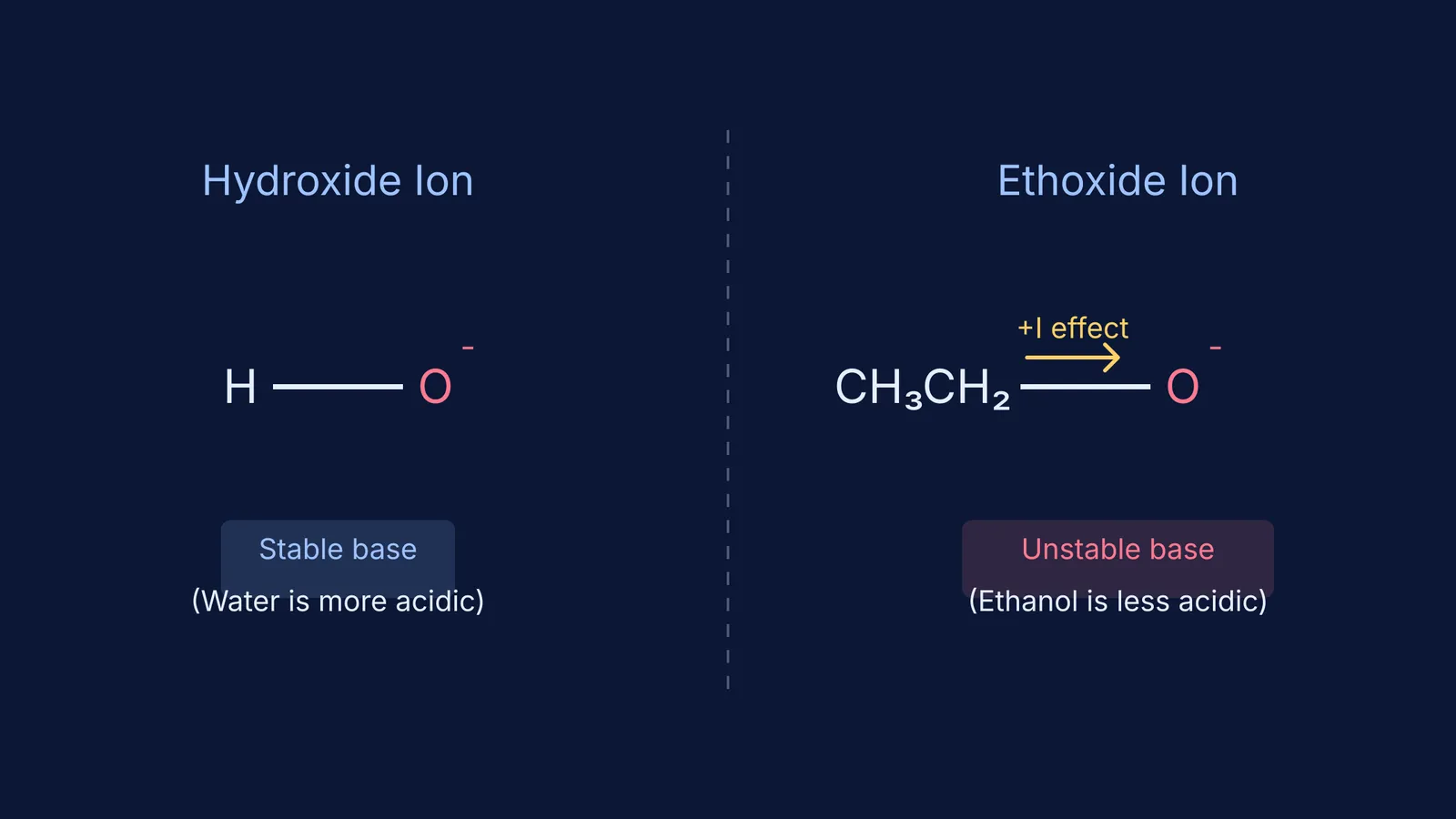
To see why, we have to look at their conjugate bases. When water (H₂O) loses a proton, it forms the hydroxide ion (OH⁻). When ethanol (CH₃CH₂OH) loses a proton, it forms the ethoxide ion (CH₃CH₂O⁻). The stability of these ions dictates the acidity of the original molecules. A more stable conjugate base means the molecule is more willing to part with its proton in the first place.
What is the +I effect in ethanol?
The only structural difference between water and ethanol is what is attached to the –OH group. Water has a simple hydrogen atom, while ethanol has an ethyl group (CH₃CH₂–).
Alkyl groups like the ethyl group are "electron-donating." They push their own electron density away from themselves and towards the adjacent atoms through the sigma bonds. This phenomenon is called the positive inductive effect, or the +I effect.
In ethanol, the ethyl group constantly pushes electron density towards the oxygen atom. In water, the lone hydrogen atom has no such inductive effect; it does not push extra electrons onto the oxygen.
For a deeper dive into the properties of these compounds, see our guide on Ethanol and ethanoic acid: Class 10 properties and reactions.
How does conjugate base stability affect acidity?
When ethanol loses its proton, the resulting ethoxide ion carries a full negative charge on its oxygen atom. However, because of the +I effect, the ethyl group continues to push even more electron density onto that already-negative oxygen.
This concentrates the negative charge in one place, making the ethoxide ion highly unstable. Because it is unstable, ethoxide acts as a very strong base—it desperately wants to grab a proton back to become neutral ethanol again. As a result, ethanol is very reluctant to lose its proton to begin with.
In the hydroxide ion, there is no alkyl group to push extra electrons onto the oxygen. The negative charge is not intensified, making hydroxide more stable than ethoxide. Because its conjugate base is more stable, water is a stronger acid.
If you are mapping out how electron donation changes reaction pathways across organic chemistry, the Fermi Concept Library holds interactive lessons on inductive effects, resonance and acid-base equilibria to help you visualize where the electrons go.
A framework for predicting alcohol acidity
You can use the inductive effect to compare the acidities of other alcohols without looking up their pKₐ values. The more electron-donating groups attached to the carbon holding the –OH group, the less acidic the molecule will be.
Primary alcohols (e.g., ethanol): Have one alkyl group pushing electrons. They are less acidic than water.
Secondary alcohols (e.g., propan-2-ol): Have two alkyl groups pushing electrons onto the oxygen. The conjugate base is even less stable, making them weaker acids than primary alcohols.
Tertiary alcohols (e.g., 2-methylpropan-2-ol): Have three alkyl groups. The massive +I effect makes the conjugate base highly unstable, making these the weakest acids of the three.
This pattern is a reliable tool for exam questions on acid strength. You can explore how these properties influence equilibrium constants in our article on Conjugate acid-base pairs: Ka × Kb = Kw and what it tells you.


