

On this page
If you have ever held a garden hose or stood under a powerful shower, you have felt the push of moving water. In fluid mechanics, calculating the exact force exerted by a water jet hitting a wall is a classic problem connecting momentum, velocity, and force into a single equation.
Whether you are preparing for Class 11 physics, studying for JEE Main, or curious about hydroelectric turbines, mastering this concept is essential.
What is the force exerted by a water jet hitting a wall?
To find the force of a fluid jet, we apply the principles of momentum. Linear momentum is defined as the product of an object's mass and velocity, as explained in OpenStax University Physics. Because fluid flows continuously, we consider a mass flow rate—the mass of water striking the wall each second—rather than a single solid block.
The force exerted by a liquid jet derives directly from Newton's second law of motion and the impulse-momentum equation, as documented by Virtual Labs at NITK Surathkal. According to this principle, force equals the time rate of change of momentum.
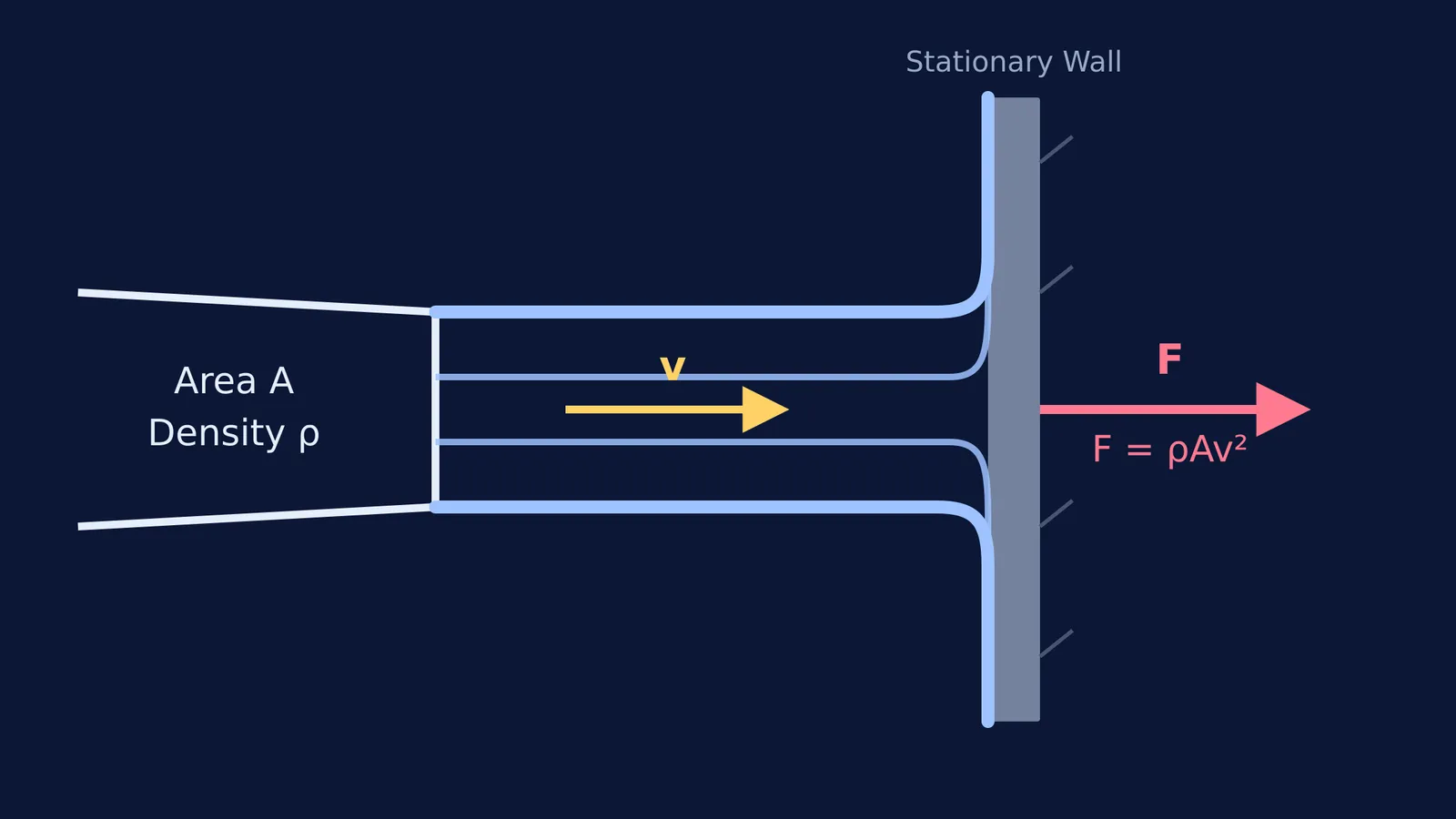
When a jet strikes a stationary vertical flat plate and splashes parallel to the surface, its forward velocity drops to zero, as shown in the Virtual Labs jet impact module. Because the water loses all forward velocity, the normal force F on the wall is:
F = ρAv²
Here is what each symbol represents:
ρ (rho): The density of the water.
A: The cross-sectional area of the jet.
v: The velocity of the jet.
Because velocity is squared (v²), doubling the speed quadruples the force. This quadratic relationship explains why high-pressure fire hoses require multiple firefighters to hold steady.
Why does the force double if the water bounces straight back?
The shape of the barrier makes a major difference. If you replace the flat wall with a curved surface, such as a hemispherical cup, the water turns around rather than simply spreading sideways.
When the jet strikes the centre of a hemispherical cup, it is deflected by 180°, as analyzed in fluid mechanics by Virtual Labs. Assuming negligible friction, water enters at velocity v and exits at −v. The total velocity change along the original axis is v − (−v) = 2v. Because the change in momentum is twice as large, the normal force doubles:
F = 2ρAv²
This principle drives the Pelton wheel, an impulse water turbine invented by Lester Allan Pelton that extracts kinetic energy using curved buckets. By turning the water through nearly 180°, the turbine extracts up to twice as much impulse from the same stream of water as a flat barrier would.
How much force does a typical fire hose jet exert?
Consider a fire hose spraying water directly at a flat concrete wall.
The maximum density of liquid water is approximately 1000 kg/m³, according to data compiled by Wikipedia. Suppose the nozzle has a cross-sectional area A = 0.005 m² and an exit velocity v = 20 m/s.
First, calculate the force on the flat wall: F = ρAv² F = 1000 × 0.005 × (20)² F = 5 × 400 = 2000 N
The jet exerts a steady push of 2000 newtons, roughly equal to the weight of a 204-kilogram object on Earth.
If the wall instead features a hemispherical cup that deflects the stream backward at 180°, the force doubles: F = 2ρAv² F = 2 × 2000 = 4000 N
How can you master fluid mechanics problems?
When tackling exam questions on fluid jets, two checks prevent common mistakes:
Check for moving plates: If a plate retreats from the jet at speed u, the impact velocity is the relative speed (v − u). The force on a single moving flat plate becomes F = ρA(v − u)².
Check the deflection angle: Resolve velocities along the normal axis. A 90° deflection on a flat wall yields F = ρAv², whereas a 180° reversal produces F = 2ρAv².
For ideas that are easier to see than to read, the Fermi Simulation Lab offers interactive simulations to help visualize how momentum transfers during an impact.
When working through calculation steps, the Fermi Problem Library offers worked problems with a step-by-step solver that explains the reasoning rather than printing an answer. To rebuild foundations, the Fermi Concept Library covers every concept in physics and mathematics, each with its own lesson and place in the map.
Mastering the F = ρAv² formula and vector momentum balances will prepare you for any fluid collision problem.
For more practice with related ideas, review Impulse and force-time graphs to understand impact duration, and see how to handle elastic and inelastic collisions in Collisions and momentum problems.


