

On this page
When you are asked to arrange letters so that vowels occupy odd places, the problem is testing your grasp of permutations under a strict position constraint. This is a staple of the Class 11 mathematics syllabus and a frequent pattern in JEE Main problems.
The framework for these questions is always the same: separate the letters into vowels and consonants, count the available target positions, and arrange the two groups independently.
How to arrange letters so that vowels occupy odd places?
The standard method has four steps that you can apply to any word:
Count the total number of letters in the word to determine the total number of positions in your arrangement.
Identify the odd positions (1st, 3rd, 5th, etc.) and count exactly how many there are.
Arrange the vowels in these odd positions using permutations. If the number of vowels equals the number of odd positions, use a simple factorial. If there are fewer vowels than odd positions, use the permutation formula ⁿPᵣ.
Arrange the remaining letters (the consonants) in all of the remaining positions.
Because the two arrangements are independent choices made one after the other, you simply multiply the two results together using the fundamental principle of counting.
How many ways to arrange the letters of the word ORDINATE?
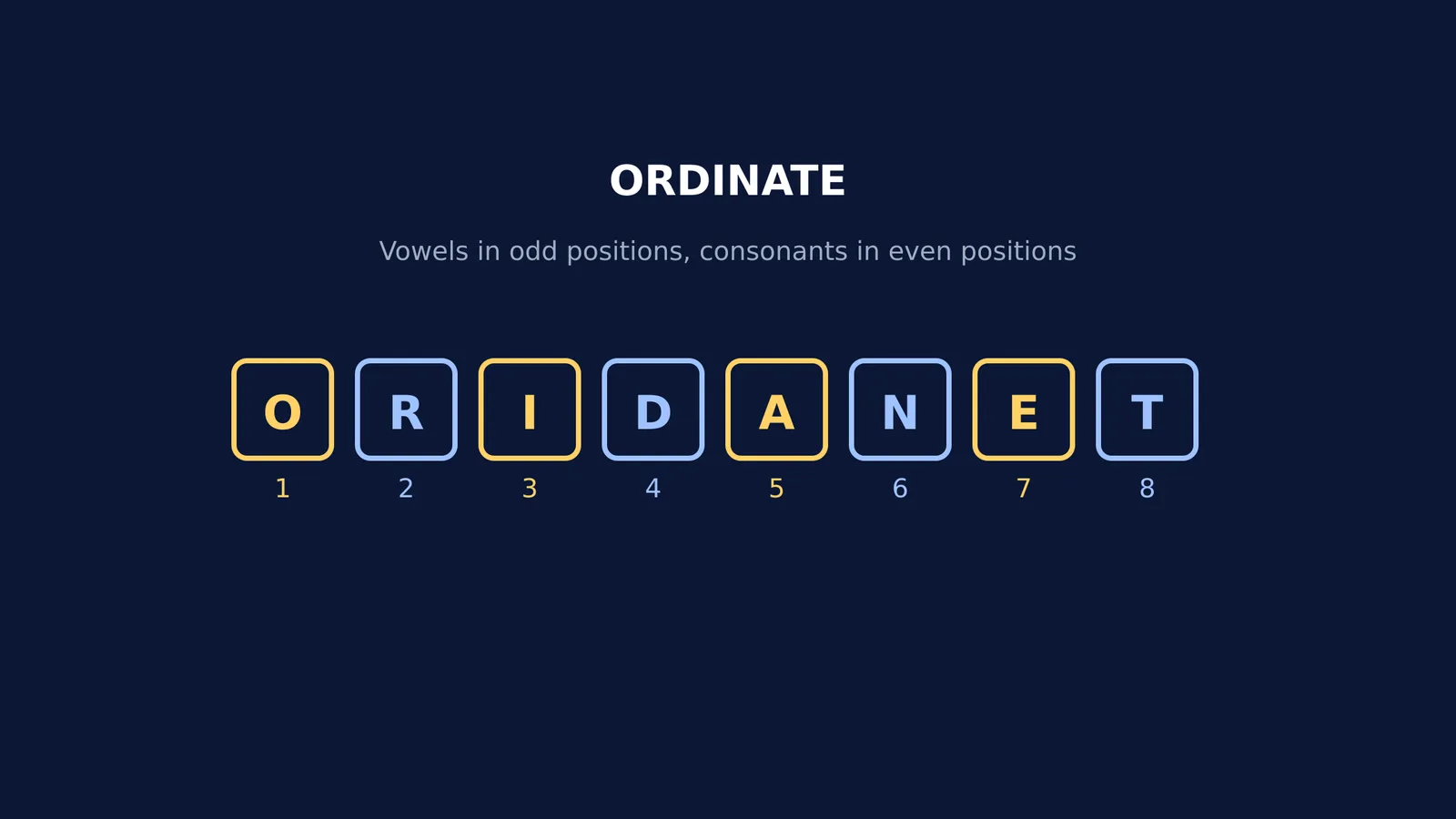
The word ORDINATE is a classic NCERT Exemplar example because its vowels perfectly match the available odd places, making the calculation straightforward.
The word has 8 letters in total.
Vowels: O, I, A, E (4 vowels)
Consonants: R, D, N, T (4 consonants)
In an 8-letter word, the positions are numbered 1 to 8. The odd positions are 1, 3, 5 and 7. This gives exactly 4 odd positions for the 4 vowels.
First, arrange the 4 vowels in the 4 odd positions. The number of ways is: 4! = 4 × 3 × 2 × 1 = 24 ways.
Next, arrange the 4 consonants in the 4 remaining even positions (2, 4, 6, 8). The number of ways is: 4! = 4 × 3 × 2 × 1 = 24 ways.
Multiply the two results together to find the overall combinations: 24 × 24 = 576 ways.
There are 576 different arrangements of the word ORDINATE where the vowels occupy odd places.
What if there are more odd places than vowels?
If the word has fewer vowels than odd positions, you cannot use a simple factorial for the vowels because you must also choose which odd positions to leave empty. Take the word REMAINS as an example.
REMAINS has 7 letters.
Vowels: E, A, I (3 vowels)
Consonants: R, M, N, S (4 consonants)
In a 7-letter word, the odd positions are 1, 3, 5 and 7 (4 positions in total).
First, arrange the 3 vowels in the 4 available odd positions. Because you are arranging 3 items in 4 spots, the number of ways is given by ⁴P₃: ⁴P₃ = 4 × 3 × 2 = 24 ways.
This leaves 1 odd position completely empty. The 4 consonants must now fill the 3 even positions (2, 4, 6) plus the 1 leftover odd position. That makes exactly 4 positions available for the 4 consonants, which gives: 4! = 24 ways.
The total number of arrangements is again found by multiplying the two intermediate results: 24 × 24 = 576 ways.
How to deal with repeating letters?
If the word you are given contains identical letters (like the two 'E's in DEGREE), you must adjust your final calculation to avoid overcounting. You divide your final arrangement number by the factorials of the repeat frequencies, just as you would when arranging letters with repeats in a standard unconstrained problem.
Similarly, if a question also demands that specific letters must be kept together, you treat those grouped letters as a single block. However, you will rarely see position-constraint problems (like "odd places") combined with bundle constraints in the same step, as the mathematical logic tends to clash in a way that makes finding a solution impossible.
Using Fermi to master combinatorics
Permutations and combinations can be tricky to learn because a small misreading of the constraints leads to a completely different numerical answer. When you get stuck on a homework problem, pasting it into the Fermi Problem Library gives you a step-by-step solver that explains the reasoning behind each choice of formula, rather than just printing the final number at the bottom of the screen.
If you find yourself repeatedly guessing whether to use a factorial or ⁿPᵣ, you can ask Fermi's AI tutor to break down the underlying logic. The tutor can work out what you already know and build a plan for the session, guiding you through similar position-constraint problems until the method permanently clicks into place.


