

On this page
In ICSE Class 10 Chemistry, numerical problems involving reacting gases look intimidating if you try to convert volumes to moles and grams. Under Gay-Lussac's law of combining volumes, when gases react, their combining volumes bear a simple whole-number ratio to one another and to gaseous products, provided all volumes are measured at the same temperature and pressure. As science historian M. P. Crosland documented in the Annals of Science, this volumetric regularity provided early chemistry with an experimental anchor before formulas were settled.
Why can you treat equation coefficients as gas volumes?
The foundation for using coefficients as volume ratios rests on Avogadro's law. Equal volumes of all gases under identical temperature and pressure contain equal numbers of molecules. Because 1 mole of any gas contains the Avogadro constant of particles (6.022 × 10²³ molecules), the molar ratios given by stoichiometric coefficients translate directly into volume ratios.
If an equation shows 1 molecule of gas reacting with 5 molecules of another, it also means 1 litre reacts with 5 litres, or 1 cm³ reacts with 5 cm³. You can solve gas reactions directly in cubic centimetres without converting through molar volume at standard temperature and pressure. For the historical emergence of this law, see our account of Joseph Gay-Lussac and the law of combining volumes.
How do you calculate oxygen needed to burn propane?
A classic ICSE board question asks for the volume of oxygen required for complete combustion of propane (C₃H₈). First, write the balanced equation:
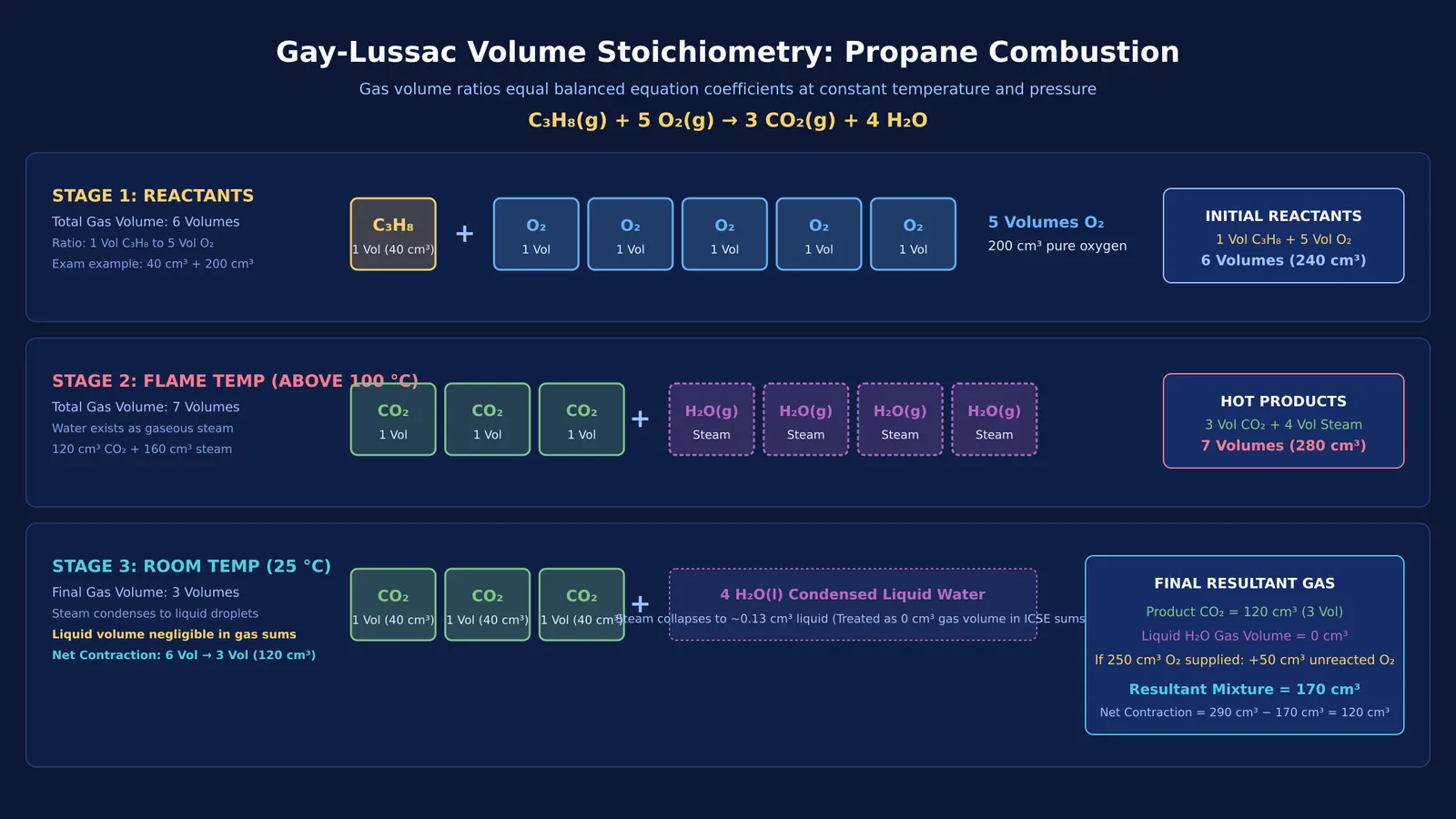
C₃H₈(g) + 5 O₂(g) → 3 CO₂(g) + 4 H₂O(l)
As detailed in OpenStax Chemistry 2e, these coefficients establish a direct volume ratio of 1 volume of C₃H₈ to 5 volumes of O₂, producing 3 volumes of CO₂. In their textbook example, reacting 2.7 L of propane requires 13.5 L of oxygen gas at identical conditions.
Consider an ICSE exam problem: "Calculate the volume of oxygen required for the complete combustion of 40 cm³ of propane, and the volume of carbon dioxide formed." You can solve it in three steps:
Write the volume ratio: 1 volume of C₃H₈ requires 5 volumes of O₂ and produces 3 volumes of CO₂.
Calculate oxygen needed: 40 cm³ × 5 = 200 cm³ of O₂.
Calculate carbon dioxide formed: 40 cm³ × 3 = 120 cm³ of CO₂.
How do you find the composition of leftover gases?
Board problems often introduce excess oxygen and ask for the final volume after cooling. Suppose 40 cm³ of propane is ignited with 250 cm³ of oxygen, and the resulting mixture is cooled to room temperature.
As shown in OpenStax Chemistry 2e, tracking leftover gases requires identifying which reactant limits the reaction:
Check the limiting reactant: 40 cm³ of C₃H₈ requires 200 cm³ of O₂. Because 250 cm³ of O₂ is supplied, propane is limiting and oxygen is in excess.
Find unreacted oxygen: 250 cm³ − 200 cm³ = 50 cm³ of leftover O₂.
Determine carbon dioxide produced: 40 cm³ × 3 = 120 cm³ of CO₂.
Account for water: Upon cooling, the 160 cm³ of steam condenses into liquid water with negligible volume.
Total resultant gas volume: 50 cm³ (leftover O₂) + 120 cm³ (formed CO₂) = 170 cm³.
Questions also ask for the contraction in volume. The initial gas volume was 40 cm³ + 250 cm³ = 290 cm³. The final volume is 170 cm³. The contraction in volume is 290 cm³ − 170 cm³ = 120 cm³. This systematic accounting prevents the mistakes discussed in our guide to common mole concept errors. For structured stoichiometry practice, the Fermi Problem Library offers worked problems with a step-by-step solver that explains the reasoning rather than printing an answer.
What common exam traps should you avoid in volume-volume calculations?
Pedagogical studies on gas volume demonstrations, such as work by Thomas H. Hazlehurst and R. D. Billinger in the Journal of Chemical Education, emphasize controlling experimental conditions. Keep this four-point checklist in mind:
Non-gaseous reactants: Gay-Lussac's law applies strictly to gases. If a reactant is solid carbon or liquid alcohol, ignore its volume in the ratio.
Condensation temperature: If the problem specifies 120 °C, water remains steam and contributes its full 160 cm³ volume. Once cooled to room temperature, omit water.
Supply limits: If 40 cm³ of propane is mixed with only 150 cm³ of oxygen, oxygen limits the reaction, leaving 10 cm³ of unreacted propane.
Constant pressure and temperature: Volume ratios equal molar coefficients only when environmental conditions remain identical throughout.
When concept gaps arise across gas laws and chemical stoichiometry, the Fermi Concept Library maps every concept in chemistry with its own lesson and its place in the map.


