

On this page
Geometric solids like spheres, cubes, and cones have neat mathematical formulas, but real lab specimens—irregular stones, mineral chips, machined brackets, or pieces of stopper cork—defy simple equations. The standard laboratory solution is the water displacement method. Rooted in Archimedes' discovery that a completely submerged object displaces fluid equal to its own volume, this technique converts complex boundaries into a direct change in liquid level. Whether in school practicals or advanced physics, mastering measuring cylinders, overflow cans, and sinkers ensures repeatable precision.
How do you measure irregular volume with a graduated cylinder?
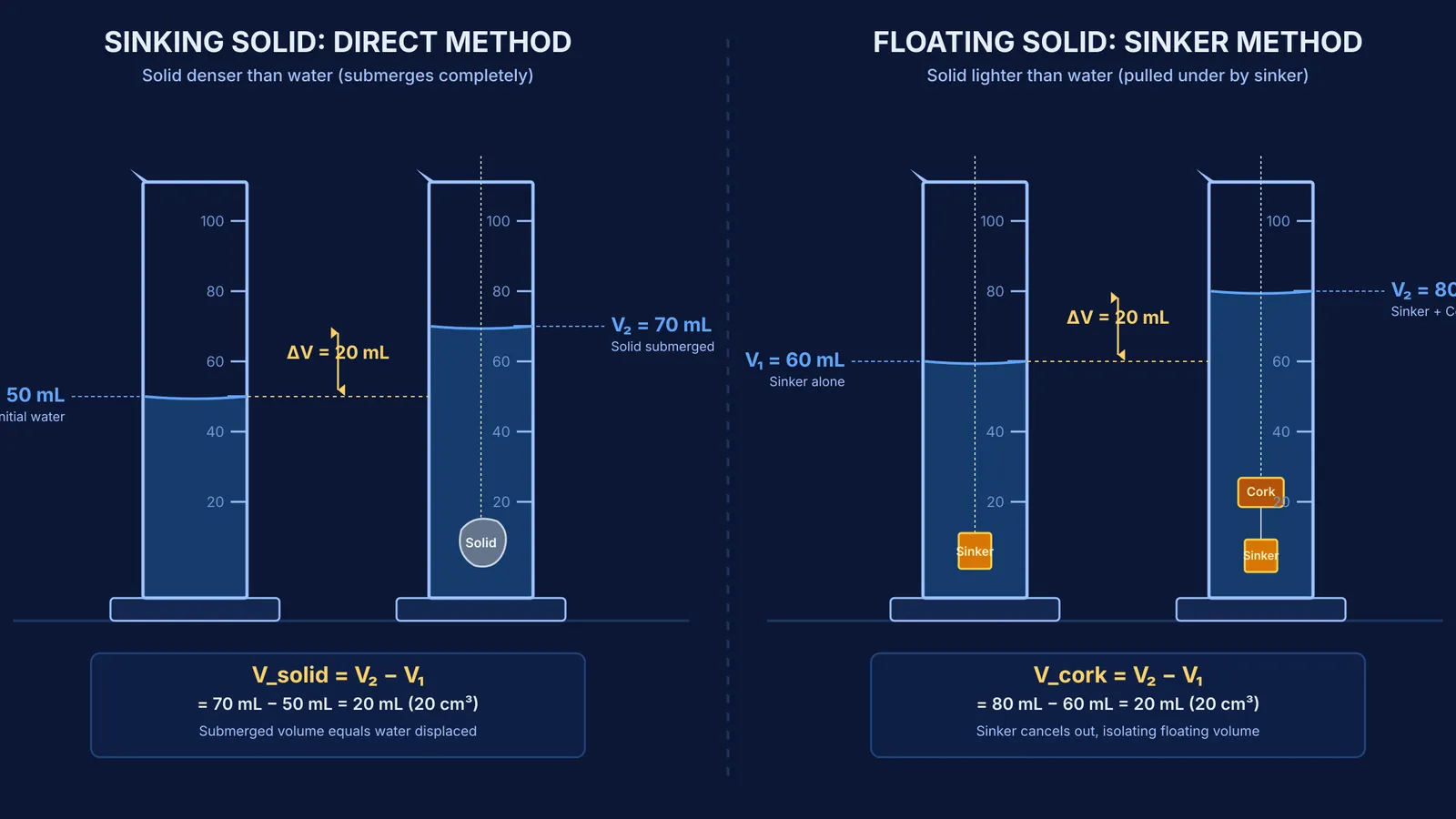
For small, dense solids that sink, a transparent graduated cylinder provides the fastest measurement. The direct displacement procedure takes three steps:
Record initial volume: Pour water into the cylinder so the object can submerge completely without overflowing. Note this baseline as V₁.
Submerge the solid: Tilt the cylinder and slide the solid down the glass wall with a thin thread, avoiding splashes. Note the new volume as V₂.
Calculate volume: Because water is virtually incompressible, the solid's volume is V = V₂ − V₁.
According to National Institute of Standards and Technology NISTIR 7383 guidelines, the most common experimental error is misreading the meniscus. Water curves upward against glass into a concave meniscus. Your line of sight must be in the horizontal plane tangent to the lowest point of the curve. Viewing from above overestimates volume, while viewing from below underestimates it.
When working through experimental uncertainty and numerical physics problems, the Fermi Problem Library provides worked problems with a step-by-step solver that explains the reasoning rather than printing an answer.
When should you use an overflow can instead?
When a solid is too wide for a narrow cylinder, an overflow can (or Eureka can) is the standard alternative. This metal or rigid vessel has a downward-sloping spout near its rim. To run the measurement:
Fill the can until water streams freely through the spout.
Wait until dripping stops, leaving water flush with the spout lip.
Place a clean, dry measuring cylinder under the spout.
Lower the suspended solid until fully submerged, catching the overflow in the cylinder.
Read the solid's volume directly from the collected runoff once dripping stops.
This mirrors Vitruvius's account of Archimedes and King Hiero's crown. Yet as historical records from the Galileo Project at Rice University show, Galileo Galilei argued in his 1586 treatise *La Bilancetta* that measuring spilled water invites surface tension errors when drops cling to the spout. In modern labs, touching the cylinder rim to the spout tip breaks this surface film and releases the final drops. For deeper background on fluid forces, see Archimedes' principles of buoyancy.
How do you measure the volume of an object that floats?
Objects less dense than water (1.0 g/cm³), such as cork or paraffin wax, float naturally. As explained in OpenStax University Physics, a floating solid displaces only a fraction of its volume equal to the ratio of its density to the liquid's density. Simply dropping it into water measures only its submerged fraction.
To measure total volume, use the sinker method:
Select a dense metal sinker that easily pulls the floating object under.
Submerge the sinker alone in a graduated cylinder, recording volume V₁.
Tie the floating solid to the sinker and submerge both fully, recording volume V₂.
Calculate volume as V_solid = V₂ − V₁. Because the sinker's displacement was already included in V₁, the difference represents the floating object alone.
Worked example: A dry cork weighs 4.8 g. With the sinker alone submerged, the water level reads V₁ = 62.0 mL. With both sinker and cork submerged, the level rises to V₂ = 82.0 mL. The volume is V = 82.0 mL − 62.0 mL = 20.0 mL (20.0 cm³). The density is ρ = 4.8 g / 20.0 cm³ = 0.24 g/cm³.
When visualizing buoyant forces and displacement in action, the Fermi Simulation Lab provides interactive simulations for the ideas that are easier to see than to read.
What are the most common laboratory errors and how do you avoid them?
Small laboratory oversights introduce systematic errors into displacement measurements. Keep this checklist in mind:
Parallax error: Read the lowest point of the concave meniscus at horizontal eye level.
Air bubbles: Air pockets trapped in rock crevices add fake volume. Dip and tap the solid to dislodge them.
String thickness: Thick string absorbs liquid and adds displacement. Use fine monofilament nylon thread.
Splashing: Slide the solid along the tilted wall so droplets do not stick above the meniscus.
Touching walls: Ensure the hanging mass floats freely and does not drag against the bottom or sides.
Just as when checking vernier calliper and screw gauge zero errors, experimental accuracy depends on identifying systematic errors early. For core concepts on buoyant upthrust, see Class 9 gravitation and buoyancy. To explore related mechanics topics systematically, the Fermi Concept Library includes every concept in physics, chemistry, biology, mathematics and computing, each with its own lesson and its place in the map.


