

On this page
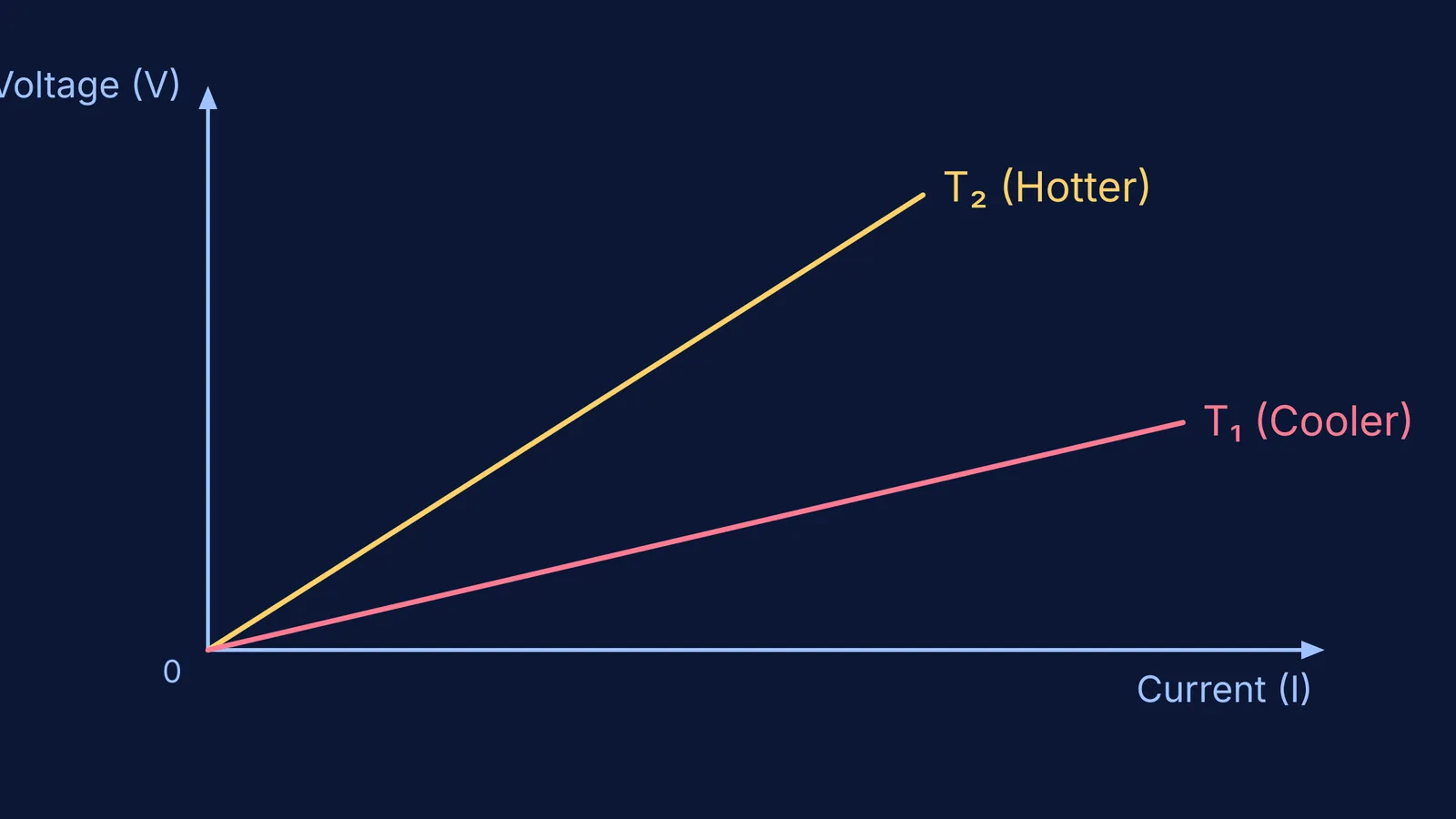
When you look at a V-I graph of a wire at two temperatures, which is higher? The answer lies in Ohm's law and what heat does to the electrons inside a metal.
How do you read a V-I graph of a wire at two temperatures?
By Ohm's law, voltage (V) equals current (I) multiplied by resistance (R). When you plot voltage on the vertical axis and current on the horizontal axis, the slope of the straight line equals the resistance of the conductor.
In mathematics, the slope of a line is defined as the change in the y-axis divided by the change in the x-axis. On a V-I graph, this means dividing the voltage by the current. A steeper line means a larger slope, which tells you the wire has a higher resistance. A shallower line, which lies closer to the current axis, indicates a lower resistance.
For any standard metallic wire, heating it up increases its resistance. Therefore, when you are presented with two lines on a V-I graph, the line with the steeper slope represents the wire at the higher temperature.
Why does resistance increase with temperature?
To understand why a hotter wire resists current more strongly, we must look at what happens on an atomic level. Inside a solid metal wire, an electric current is essentially a flow of free electrons. As these electrons drift through the metal from the negative terminal to the positive terminal, they do not travel in a perfectly straight line. They constantly collide with the much larger positively charged metal atoms that make up the material's lattice structure.
When the temperature of the wire rises, it adds thermal energy to the metal. These metal atoms absorb this energy and begin to vibrate more vigorously around their fixed positions. This intense vibration makes the lattice act like a moving obstacle course, making it much harder for the free electrons to pass through without bumping into them.
More collisions mean the electrons lose more energy and are slowed down more frequently, which translates directly to more electrical resistance. For example, annealed copper's resistance increases by about 0.39% for every degree Celsius it warms up. While this sounds small, it quickly adds up in a heating element or a circuit board operating at high power.
Because it is so common to lose marks on small conceptual steps in an exam, the Fermi Concept Library has a lesson for every concept in physics and its place in the map, so you can see how temperature, resistance and atomic collisions tie together.
What if the axes are reversed in an I-V graph?
You must always check the axis labels before answering the question. Examiners love to test whether you are paying attention by swapping the axes, changing a V-I graph into an I-V graph.
V-I graph: Voltage is on the y-axis. The slope is V/I, which equals R. A steeper line means higher resistance, which points to the higher temperature.
I-V graph: Current is on the y-axis. The slope is I/V, which equals 1/R (the conductance). In this case, a steeper line means *less* resistance. The *flatter* line represents the higher resistance and therefore the higher temperature.
If you mistakenly treat an I-V graph like a V-I graph, you will get exactly the wrong answer. Always read the labels before deciding which line is which. If you need help visualising what the electrons are doing when a metal heats up and how it changes the graph, the Fermi Simulation Lab has interactive simulations that let you adjust the temperature of a wire and watch the resistance change.
A checklist for graph problems
When a physics question asks you to compare slopes at different temperatures, follow this step-by-step routine to ensure you do not make a careless mistake:
Check the axes: Look carefully to see if it is a V-I or an I-V graph. Do not rush this step.
Find the slope: Write down whether the slope represents resistance (R) or conductance (1/R).
Link to the physics: Recall that for metals, a hotter wire means more atomic vibration and thus a higher resistance.
Match them up: Assign the higher temperature to the line that shows the higher resistance.
Understanding how different materials respond to heat and stress is crucial for mastering current electricity. For more on how materials behave, see our guides on how a stretched wire's resistance changes with length and how energy bands differ between conductors and insulators.


