

On this page
Every introductory physics student memorises the standard simple pendulum formula: T = 2π√(l/g). If you lengthen the string, the swing slows down. Double the length, and the period grows by a factor of √2. Lengthen it by four times, and the period doubles.
Naturally, a classic thought experiment follows: what happens if you make the string infinitely long? A quick glance at the standard formula suggests that as length l approaches infinity, the period T should also approach infinity. The bob would seemingly take forever to complete a single swing.
Yet in competitive physics exams like JEE Advanced, this is a famous conceptual trap. The true time period of an infinitely long pendulum on Earth is not infinite at all. It reaches a strict finite upper bound of approximately 84.4 minutes (around 5,065 seconds), calculated using planetary constants from NASA's Earth Fact Sheet. To understand why, you have to examine the hidden assumption that every classroom derivation quietly relies on: the direction of gravity.
Why does the standard pendulum formula fail for very long strings?
The standard simple pendulum formula works well for school laboratory experiments and everyday clocks, such as a seconds pendulum with a length of about 1 metre. In those setups, the string length is minuscule compared to the dimensions of the planet.
According to the NASA Earth Fact Sheet, Earth has a volumetric mean radius of 6,371.0 km (or 6,378.137 km at the equator) and a mean surface gravity of 9.820 m/s² (with standard gravity defined at 9.80665 m/s²). Because 1 metre is less than one-millionth of Earth's radius, we safely assume that the gravitational field lines pointing downward from the ceiling are completely parallel.
When you imagine a pendulum whose length l is hundreds or thousands of kilometres long, that flat-Earth assumption breaks down completely. Gravitational force lines are not parallel; they are radial lines that converge directly toward the centre of the Earth.
When a very long pendulum swings, its restoring force does not come solely from the angle of the string relative to the ceiling. It also receives an extra restoring pull because the local vertical direction of gravity tilts beneath the bob as it travels across Earth's curved surface.
How do you derive the time period when length is comparable to Earth's radius?
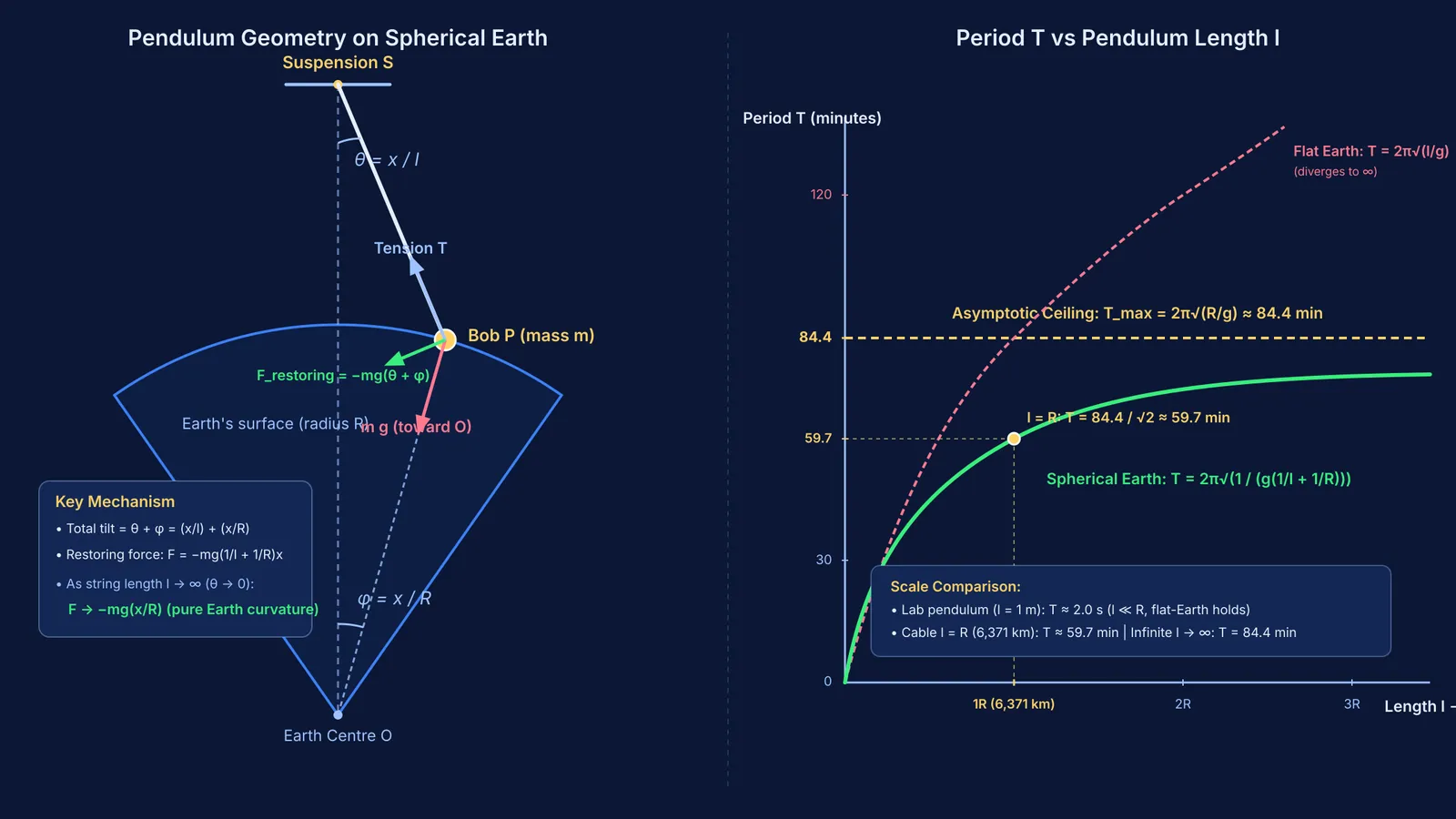
To find the exact restoring force, picture a pendulum of length l suspended from a fixed point S, hanging near Earth's surface where the radius is R and the centre of the planet is O.
In the equilibrium position, the suspension point S, the pendulum bob, and Earth's centre O lie along a single straight line. Now displace the bob horizontally along Earth's surface by a small linear displacement x:
The string swings through an angle θ at the suspension point S. For small displacements, θ ≈ x / l.
The bob moves across the surface of the planet, sweeping out an angle φ at Earth's centre O. For small displacements, φ ≈ x / R.
In the triangle formed by the suspension point S, the displaced bob P, and Earth's centre O, the total angle between the string line PS and the gravitational force line PO is θ + φ.
The string tension acts along the string toward S. The gravitational pull mg acts along the radial line toward O. Resolving the gravitational force along the direction perpendicular to the string (the direction of motion), the restoring force acting on the bob is:
F = −mg sin(θ + φ)
Because the displacement x is small compared to both l and R, the small-angle approximation sin(θ + φ) ≈ θ + φ holds:
F = −mg (θ + φ) = −mg (x/l + x/R) = −mg (1/l + 1/R) x
Equating this to Newton's second law, F = m a:
a = −g (1/l + 1/R) x
This is the standard equation of Simple Harmonic Motion, a = −ω² x. Therefore, the angular frequency ω and time period T are:
ω = √(g (1/l + 1/R))
T = 2π / ω = 2π √(1 / (g (1/l + 1/R))) = 2π √(l R / (g (l + R)))
When you need to verify whether an approximation holds across extreme boundary conditions, the Fermi Problem Library provides worked problems with a step-by-step solver that explains the reasoning rather than printing an answer.
What is the time period of a pendulum of infinite length?
Now take the mathematical limit of the general formula as the length l approaches infinity (l → ∞).
As l grows infinitely large, the reciprocal term 1/l vanishes toward zero:
lim(l → ∞) (1/l) = 0
Substituting this into the general expression gives:
T = 2π √(1 / (g (0 + 1/R))) = 2π √(R / g)
Using Earth's volumetric radius of 6,371,000 metres and standard gravitational acceleration g = 9.80665 m/s² from NASA's planetary data:
T = 2π √(6,371,000 / 9.80665) ≈ 2π √(649,661) ≈ 2π × 806.0 ≈ 5,064.5 seconds
Converting seconds to minutes:
5,064.5 / 60 ≈ 84.4 minutes
If you round Earth's radius to 6,400 km and take g = 9.8 m/s², the calculation gives 5,077.6 seconds, or approximately 84.6 minutes. In either convention, the period reaches a finite ceiling of around 84 minutes.
What happens when the pendulum length equals Earth's radius?
Another favourite problem in competitive physics tests asks what happens when the pendulum's length is set exactly equal to Earth's radius (l = R = 6,371 km).
Substitute l = R directly into the general formula, using Earth's dimensions from NASA's planetary data:
1/l + 1/R = 1/R + 1/R = 2/R
T = 2π √(1 / (g (2/R))) = 2π √(R / (2g)) = (1 / √2) × (2π √(R/g))
Because 2π√(R/g) is the 84.4-minute infinite limit:
T = 84.4 / √2 ≈ 59.7 minutes
When a pendulum's cable is as long as Earth's radius, it completes one full cycle in just under 60 minutes, or roughly one hour.
Here is how the period behaves across different length scales:
Ordinary lab pendulum (l = 1 m): T ≈ 2.0 seconds (l << R, so 1/R is negligible).
Continental cable (l = 1,000 km): T ≈ 31.1 minutes.
Earth-radius pendulum (l = 6,371 km): T ≈ 59.7 minutes.
Five Earth radii (l = 31,855 km): T ≈ 77.1 minutes.
Infinite length (l → ∞): T ≈ 84.4 minutes (the asymptotic upper bound).
If you struggle to map how physical approximations break down when parameters scale up, the Fermi Concept Library catalogs core ideas across physics and links each equation to its underlying physical assumptions.
Why does 84.4 minutes keep appearing across physics?
If you study advanced classical mechanics, you will notice that 84.4 minutes is not unique to hypothetical pendulums. It is a natural dynamic timescale that emerges whenever gravitational dynamics interact with Earth's size.
First, consider a satellite in a circular orbit skimming just above Earth's surface (neglecting atmospheric drag), using planetary dimensions from NASA's Earth Fact Sheet. The orbital speed is v = √(g R), and the orbital circumference is 2π R. Its orbital period is:
T_orbit = 2π R / v = 2π R / √(g R) = 2π √(R/g) ≈ 84.4 minutes
Second, as explored in classical mechanics and analyzed by Alexander R. Klotz in the *American Journal of Physics*, an object dropped through a frictionless tunnel bored straight through a planet of uniform density executes simple harmonic motion. Its round-trip period is exactly 2π√(R/g) ≈ 84.4 minutes, making a one-way trip through Earth take 42.2 minutes (or 38 minutes under realistic seismic density models). You can review the step-by-step forces for that scenario in our guide on oscillations through a tunnel across the Earth.
Third, in aviation and marine guidance, this period is known as the Schuler period. In a 1923 paper, German engineer Maximilian Schuler proved that an inertial navigation system or gyrocompass can be made completely insensitive to horizontal vehicle accelerations if its guidance loop is tuned to an oscillation period of 84.4 minutes. As William H. Baird explained in the *American Journal of Physics*, modern aircraft guidance systems electronically replicate this 84.4-minute pendulum tuning so that the vehicle's accelerations do not corrupt its sense of the true local vertical.
Whether you look at an infinitely long pendulum, a sea-level satellite orbit, an Earth-tunnel transit, or an aircraft's inertial navigation platform, the mathematics converges on the same fundamental constant: 2π√(R/g).


