

On this page
A classic kinematics question says a particle moves so that its velocity is proportional to the square root of its displacement, v = k√x, and asks for the acceleration. The tempting move is to differentiate with respect to time, which stalls because x is not given as a function of t. The answer surprises people: the acceleration does not depend on x at all. It is a constant, k²/2.
What is the acceleration if velocity is proportional to the square root of displacement?
Start from two definitions. Velocity is the derivative of position with respect to time, v = dx/dt (OpenStax University Physics, eq. 3.4). Instantaneous acceleration is the derivative of velocity with respect to time, a = dv/dt (OpenStax University Physics, eq. 3.9).
When v is given as a function of x, use the chain rule, dy/dx = (dy/du)(du/dx) (OpenStax Calculus Volume 1):
a = dv/dt = (dv/dx)(dx/dt) = v dv/dx
Now put in v = k√x. Then dv/dx = k/(2√x), so
a = k√x × k/(2√x) = k²/2
The √x cancels. Wherever the particle is, its acceleration is the same. That is uniform acceleration in disguise.
Why is this the same as v² = u² + 2as?
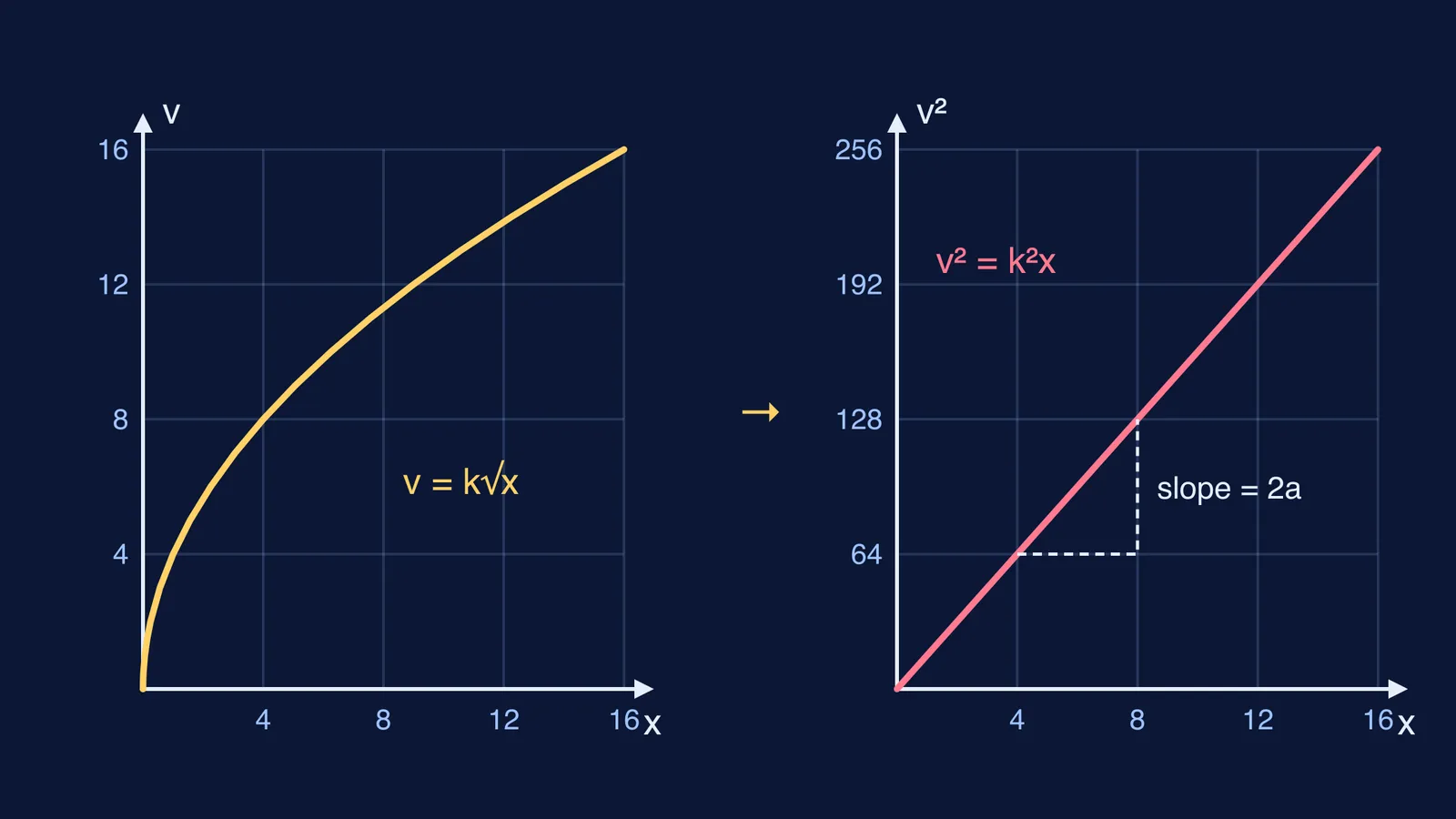
Square both sides of v = k√x and you get v² = k²x. Compare that with the constant-acceleration equation v² = v₀² + 2a(x − x₀), which the textbook marks "(constant a)" (OpenStax University Physics, eq. 3.14). For a particle starting from rest at x₀ = 0, the two match term by term: 2a = k², so a = k²/2.
A third check goes through time. Write dx/dt = k√x as dx/√x = k dt and integrate from x = 0 at t = 0: 2√x = kt, so x = k²t²/4. That is x = ½at² with a = k²/2 again. Three routes, one answer.
How do you spot disguised uniform acceleration in a problem?
Run this checklist whenever a question gives velocity as a function of position:
Square the expression for v.
Ask whether v² has the form A + Bx. If it does, a = B/2, a constant. A negative B means constant deceleration.
If v² has any other shape (x², 1/x, eˣ), the acceleration changes with position. Use a = v dv/dx directly.
Check units. In v = k√x, k has units of m^½ s⁻¹, so k² has units of m s⁻², which is what an acceleration needs.
Once a is constant, every uniform-acceleration equation is available to you, including x = x₀ + v₀t + ½at².
For contrast, here is what a = v dv/dx gives for some look-alike laws:
v = k√x gives a = k²/2 (constant)
v = k√(c − x) gives v² = k²c − k²x, so a = −k²/2 (constant braking)
v = kx gives a = k²x (grows with distance)
v = kx² gives a = 2k²x³
v = k/x gives a = −k²/x³
Only the square-root family makes v² linear in x, so only it gives a constant acceleration.
If you can spot the right idea but keep reaching for the wrong method, the Fermi Problem Library has worked problems with a step-by-step solver that explains the reasoning rather than printing an answer.
Worked example: v = 4√x
A particle starts from the origin and moves along a straight line so that v = 4√x, with x in metres and v in metres per second. Find its acceleration, the time it takes to reach x = 16 m, its speed there, and the distance it covers in the third second.
Acceleration: a = k²/2 = 4²/2 = 8 m/s².
Position against time: x = k²t²/4 = 4t². Setting 4t² = 16 gives t = 2 s.
Speed at x = 16 m: v = 4√16 = 16 m/s. Check with v = at: 8 × 2 = 16 m/s. They agree.
Third second: x(3) − x(2) = 36 − 16 = 20 m.
The diagram at the top of this post uses the same numbers: the curved v–x graph on the left becomes a straight v²–x line on the right with slope 16, which is 2a.
What should you practise next?
Take any kinematics question that gives v as a function of x and run the v² test before any calculus. Then write your own: pick a number B, set v = √(Bx), predict a = B/2, and confirm it with a = v dv/dx. If the chain-rule step itself feels shaky, the Fermi Concept Library covers every concept in physics, chemistry, biology, mathematics and computing, each with its own lesson.


