

On this page
When you pull a simple pendulum back slightly or stretch a spring, you are setting up simple harmonic motion (SHM). A defining rule of SHM is that the period of oscillation is strictly independent of the amplitude. Whether you pull the mass 1 cm or 2 cm, it takes the exact same time to complete one cycle.
But not all oscillations are simple harmonic. A common case in mechanics problems is a particle moving in a V-shaped potential, often written as U(x) = a|x|. In this system, the rules change entirely.
What makes a V-shaped potential different from SHM?
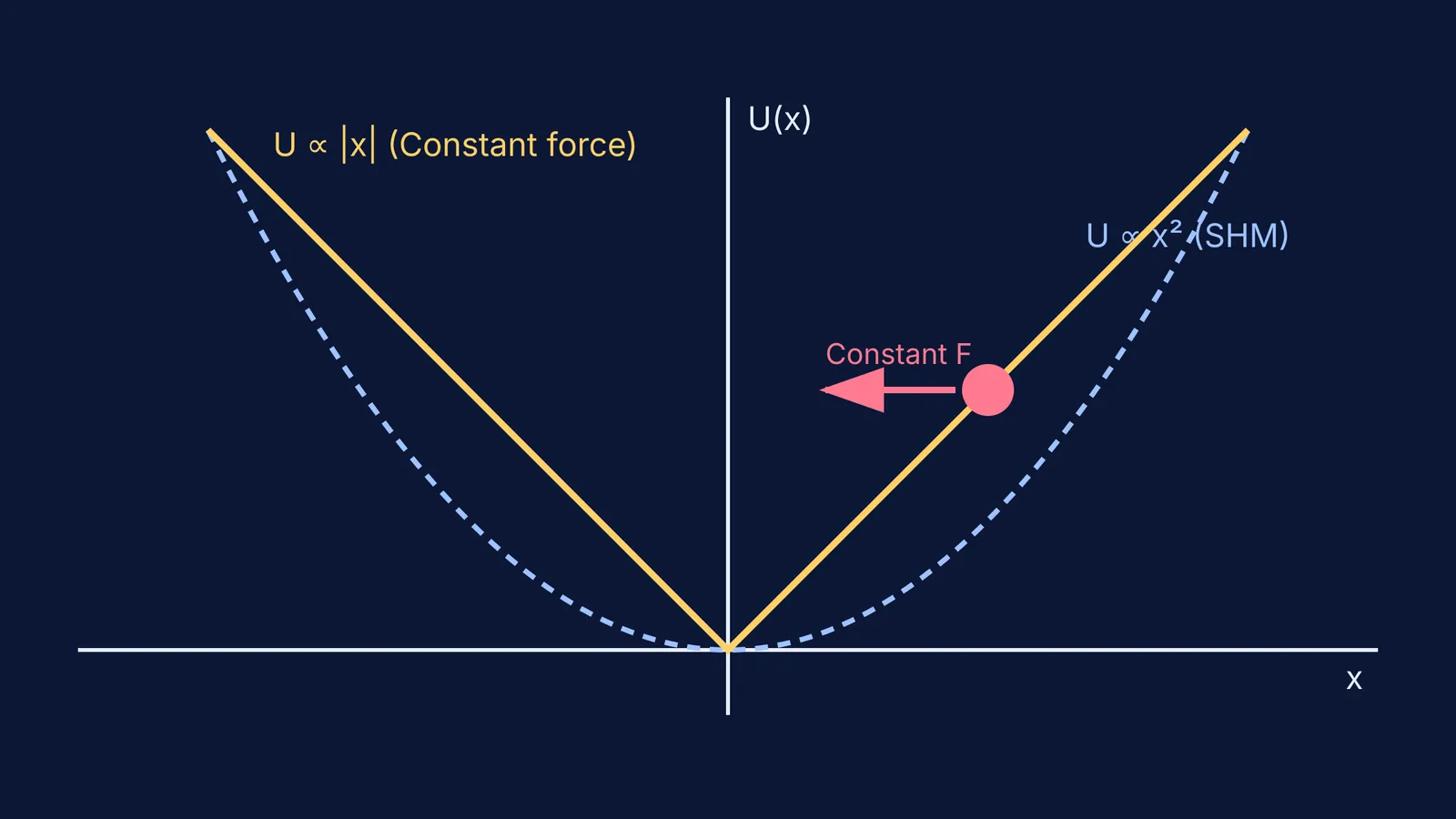
In any physical system, the force acting on a particle is the negative slope of its potential energy. For simple harmonic motion, the potential energy forms a parabola (U = ½kx²). As you move further from the equilibrium position, the slope gets steeper, meaning the restoring force grows stronger (F = −kx). This increasing force is exactly what allows the particle to cover a larger distance in the same amount of time.
In a V-shaped potential U(x) = a|x|, the graph of potential energy is two straight lines meeting at the origin. Because the slope is constant on each side, the magnitude of the restoring force is also constant (F = −a for positive x, and F = a for negative x). No matter how far the particle swings from the centre, it feels the exact same pull pushing it back.
How do you calculate the period of a V-shaped oscillator?
Because the force is constant, the motion on either side of the origin is simply uniform acceleration. We can find the time taken for a quarter of the cycle—the fall from the maximum amplitude A to the origin—using standard kinematics.
When the particle is released from rest at distance A, it accelerates towards the centre at a constant rate g = a/m. The distance covered under constant acceleration starting from rest is given by A = ½gt².
Rearranging this for the time t taken to reach the origin, we get t = √(2A/g). Since the particle makes four such trips in one full cycle (from A to 0, 0 to −A, −A to 0, and 0 back to A), the total period T is four times this value:
T = 4√(2mA/a)
Why does the period depend on the amplitude?
Looking at the formula, the period of oscillation grows with the square root of the amplitude (T ∝ √A).
This happens because the restoring force does not increase to "help" the particle cover the larger distance. If you double the amplitude, the particle has twice as far to travel, but it accelerates at the exact same rate. As a result, wider swings take more time to complete.
This contrasts sharply with standard pendulums, such as the seconds pendulum, where pulling a mass twice as far doubles the restoring force, perfectly compensating for the extra distance and keeping the period constant.
How does this appear in exam problems?
In exams like JEE Main and Advanced, a V-shaped potential might be disguised as a physical scenario rather than a given mathematical function. You can spot these problems by looking for a constant restoring force that flips direction at a central point.
Common examples include:
A ball rolling without friction in a V-shaped trough.
A block connected to a string that exerts a constant tension pulling it back whenever it crosses the origin.
A particle subjected to a constant gravitational force on two symmetric inclined planes.
If a problem asks you to find the period of an oscillator and you notice the force does not depend on x, you are dealing with a V-shaped potential. You can skip the standard SHM formula and instead use kinematic equations. This is conceptually different from cases like SHM through a tunnel across the Earth, where the force inside a uniform sphere naturally builds linearly with distance.
If you struggle to picture how different forces change the motion of an oscillator, the Fermi Concept Library can help you map out the connections between potential energy graphs, force vectors, and the resulting periodic motion.
To avoid being tricked on a test, always check the potential energy function. If it contains an |x| rather than an x², the period will depend on how far the particle swings.


