

On this page
If you throw a ball straight up in a vacuum, the trip is perfectly symmetrical. It takes precisely as long to reach its peak as it does to fall back into your hand. But step into the real world, and the symmetry breaks.
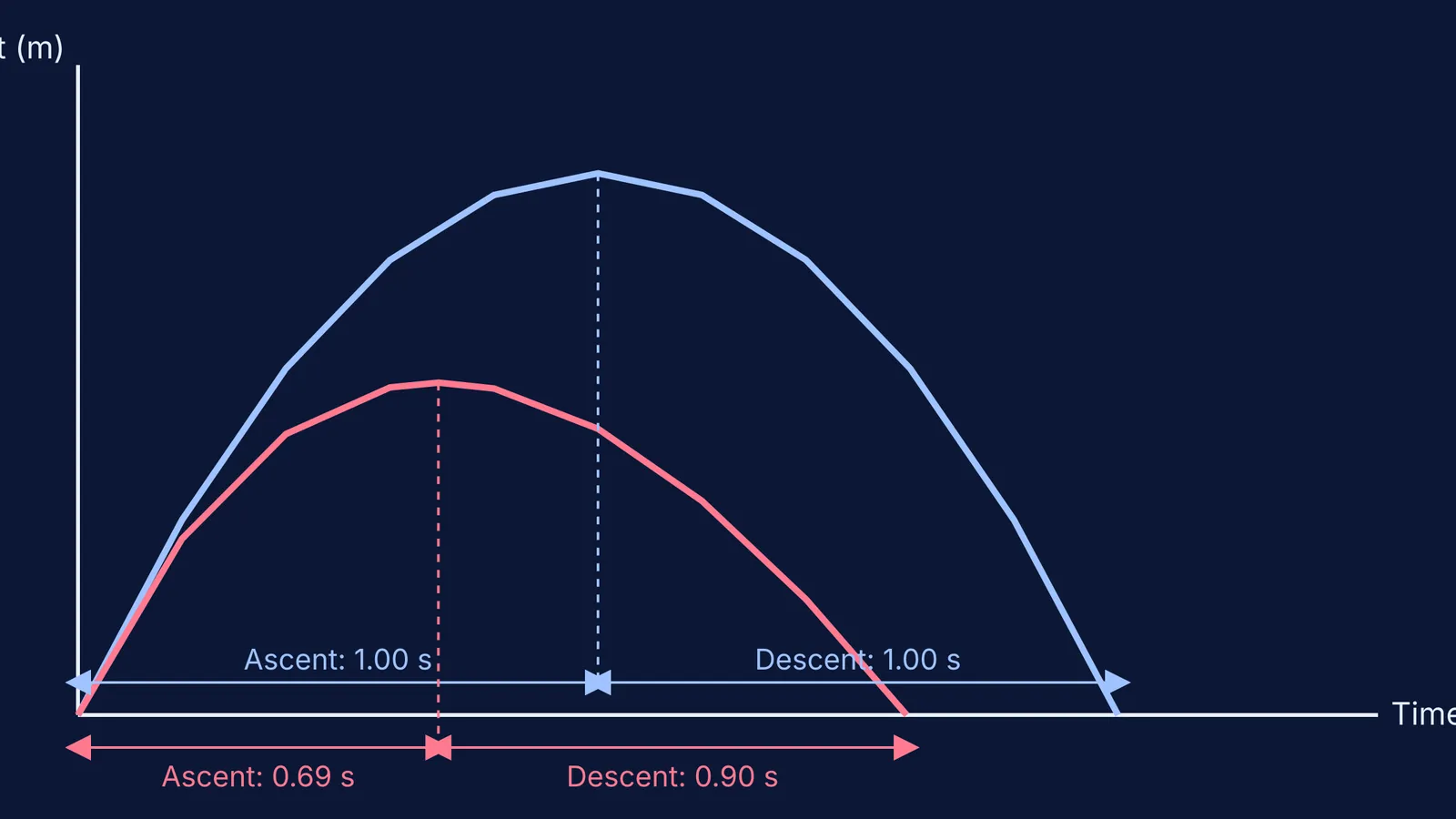
When a ball is thrown with air resistance, the descent always takes longer than the ascent. For students preparing for rigorous physics exams like JEE Main, JEE Advanced or NEET-UG, this is a common conceptual trap. Questions often ask you to compare these times, and your intuition might suggest they remain equal. Understanding exactly how air drag alters the time of flight will sharpen your instinct for kinematics and mechanics.
Why does time of ascent equal time of descent without air resistance?
In a perfect vacuum, the only force acting on the object is gravity. As the ball travels upward, gravity pulls it downward, slowing it at a constant rate of g. As the ball falls from its peak, gravity accelerates it downward at the exact same rate of g.
Because the distance travelled is identical in both directions and the constant acceleration is identical, the time taken must also match perfectly (t_ascent = t_descent). The initial launch velocity exactly equals the final impact velocity, and the entire downward journey is an exact mirror image of the upward journey in time.
Mastering these symmetrical motion concepts is essential for introductory physics, as they form the foundation for everything that follows. If you are struggling to picture how these displacement and velocity variables relate over time, the Fermi Concept Library gives every concept in physics its own lesson and its place in the map, letting you see exactly how these fundamental ideas interact.
Why does air resistance make the descent time longer?
Air resistance, or drag, is a friction force that always opposes the direction of the object's motion. This single fact destroys the symmetry of a vertical throw. Let's break down the forces during each half of the journey to see why the timing changes.
On the way up, the ball is moving upward, so the air drag pushes downward. Gravity is also pulling downward. These two forces work together to decelerate the ball very quickly. The net downward acceleration is g + a_drag. Because it is slowing down so fast, the ball reaches its maximum height in a relatively short amount of time.
On the way down, the ball is moving downward. Air drag now pushes upward, fighting against the downward pull of gravity. The net downward acceleration is now g − a_drag. Because the effective acceleration is weaker than gravity alone, it takes the ball longer to cover the distance back to the ground.
As a result, the time of descent is strictly greater than the time of ascent (t_descent > t_ascent).
The energy perspective
You can also think about this asymmetry through the lens of energy conservation. Air resistance is a non-conservative force, which means it continuously drains mechanical energy from the ball throughout the entire flight.
When you throw the ball, it starts with a certain amount of kinetic energy. As it rises, it loses some of that energy to air friction. It stops momentarily at its peak, starting the descent with less potential energy than the initial kinetic energy it had at launch.
As it falls, it loses even more energy to air resistance. By the time it returns to your hand, its final speed is much slower than its launch speed. Because it covered the exact same distance but at a significantly lower average speed on the way down, the return trip must take longer.
This energy loss rule applies whether the drag is linear (like a tiny particle moving through oil, at low Reynolds numbers such as Re < 1) or quadratic (like a baseball moving through the air, where 10³ < Re < 2 × 10⁵), as detailed in a 1999 review in the *American Journal of Physics*.
If you make a sign error setting up these opposing forces, you might find your calculated time of flight doesn't make physical sense. When you hit a wall in a long derivation, the Fermi Problem Library provides worked problems with a step-by-step solver that explains the reasoning rather than printing an answer.
Moving beyond 1D kinematics
The same rules about air resistance apply when the motion happens in two dimensions. If you launch a projectile at an angle, drag reduces both the maximum height and the horizontal range, and it causes the object to fall at a steeper angle than it was launched.
To expand your grasp of motion, compare these vertical cases with how objects behave when moving horizontally or in two dimensions:
Equation of trajectory of a projectile: finding u and θ from it
Horizontal projectile from a cliff: time, range and impact speed
Distance in the nth second: the sₙ formula and where it helps
Whether you are plotting a simple vertical throw or a complex parabolic arc, remember that air resistance always robs the system of energy, causing the object to take a slower, more leisurely trip back to Earth.


