

On this page
We all learn that the SI unit of force is the Newton. But physics problems—especially in Indian classrooms—often throw in a different unit: the kilogram-force (kgf).
The CISCE Class 10 physics syllabus uses kgf extensively in its chapters on machines and turning forces. So what exactly is the difference between kgf and Newton, and why do we still use both?
What is a kilogram-force (kgf)?
One kilogram-force is the force with which the Earth attracts a mass of 1 kilogram. The National Institute of Standards and Technology (NIST) defines 1 kgf as exactly 9.80665 Newtons.
Unlike the Newton, which is an absolute SI unit defined as 1 kg·m/s², the kgf is a gravitational unit. Its meaning relies on Earth's gravity. If you took a 1 kg block to the Moon, its mass would still be 1 kg. But the force it exerts downwards would no longer be 1 kgf, because the local gravity is much weaker.
Why do spring balances read in "kg"?
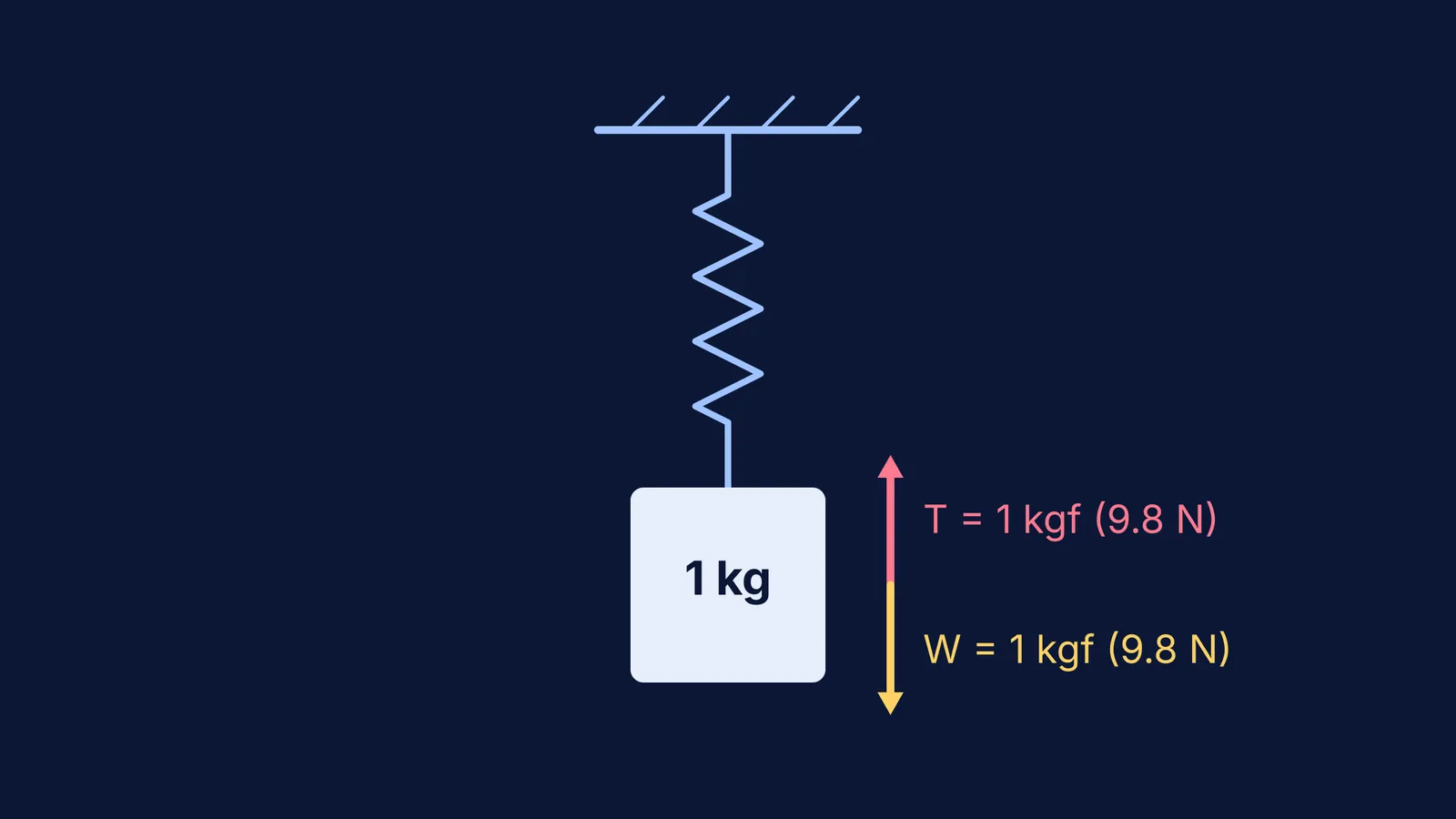
A spring balance does not measure mass; it measures the tension force in its spring.
When you hang a 1 kg sack of potatoes from it, the spring stretches because a force of 1 kgf (or 9.8 N) is pulling it down. Manufacturers simply label that specific stretch mark as "1 kg".
This is a clever shortcut. By measuring a gravitational force (kgf) behind the scenes, the scale gives you the mass directly. It works perfectly, as long as you stay on Earth.
Why does the ICSE syllabus still use kgf?
While international scientific bodies have deprecated the kgf in favour of the Newton, the CISCE board keeps it in the curriculum for a practical reason: it makes mechanical problems intuitive.
When you study levers and pulleys, you are dealing with real-world objects. If a pulley is lifting a 50 kg bucket, the downward force (load) is 50 kgf. Calculating the mechanical advantage—the ratio of load to effort—is much simpler when you do not have to multiply every single mass by 9.8 to convert it into Newtons. The 9.8 cancels out of the ratio anyway.
A worked example: converting kgf to Newtons
Let's look at a classic torque problem, similar to those found when Finding the mass of a metre scale with the principle of moments.
Question: A boy of mass 40 kg sits 1.5 m from the fulcrum of a seesaw. What is his moment of force in SI units?
Step 1: Find the weight in gravitational units. The mass is 40 kg, so the force is 40 kgf.
Step 2: Calculate the moment of force in gravitational units. Moment = Force × perpendicular distance = 40 kgf × 1.5 m = 60 kgf·m.
Step 3: Convert to SI units. We know 1 kgf = 9.8 N. 60 kgf·m × 9.8 = 588 N·m.
If you prefer to work entirely in vectors, you might enjoy our guide to calculating Torque as r × F: finding torque about a point with vectors.
If you find yourself repeatedly getting tangled in unit conversions, the Fermi Problem Library has worked problems with a step-by-step solver that explains the reasoning rather than just printing an answer. If you calculate a weight but forget to multiply by *g*, Fermi's AI tutor will catch the unit mismatch and prompt you to correct it. To explore exactly why gravitational units behave this way, you can trace the definitions in the Fermi Concept Library.


