

On this page
When you first study the electric field in physics, you learn it as force per unit charge, giving the unit Newton per Coulomb (N/C). Later, when calculating potential differences, the field suddenly appears as Volt per metre (V/m). Memorising two different units for the same physical quantity can feel like an unnecessary hurdle.
But these are not two different units. They are exactly the same. The electric field is a single physical reality, and depending on whether you are looking at forces or energies, you arrive at N/C or V/m. For example, during fair weather, the Earth's natural downward electric field is about 100 V/m. This means there is a 100-Volt potential difference between the ground and a point one metre above your head. You could also say the Earth's field is 100 N/C, meaning a 1-Coulomb charge feels 100 Newtons of downward force.
How is the electric field defined?
The electric field tells you how much force a charge will feel at a given point in space. If you place a test charge (q) in a field, it experiences an electric force (F). The strength of the field (E) is simply the force divided by the charge: E = F / q.
Since force is measured in Newtons (N) and charge is measured in Coulombs (C), this formula directly gives the unit N/C. This is the most intuitive way to think about the field: it is the literal push or pull on a single Coulomb of charge. If you are calculating the work to assemble point charges, you are dealing with these direct forces in action, evaluating how much effort it takes to bring charges together against that push.
Where does Volt per metre come from?
The second unit arises from the energy needed to move a charge through a field. If you push a positive charge against an electric field, you do work. The work done per unit of charge is called the electric potential, measured in Volts (V).
If you have a uniform electric field, like the one between two parallel metal plates, the field strength (E) is the voltage difference (V) divided by the distance (d) between the plates: E = V / d. Because potential difference is measured in Volts and distance in metres, this calculation gives the unit V/m. This approach is highly practical for circuits and capacitors, which is why finding the electric field from a potential gradient is a common exam topic in high school and university physics.
Why are N/C and V/m the same?
To prove these units are identical, we only need the basic definitions of work and energy from the BIPM SI standards.
Work is force multiplied by distance. Therefore, 1 Joule = 1 Newton × 1 metre.
Voltage is work done per unit charge. Therefore, 1 Volt = 1 Joule / 1 Coulomb.
If we substitute the first rule into the second, we find that: 1 Volt = (1 Newton × 1 metre) / 1 Coulomb.
Now, take the unit V/m and replace the "Volt" with our new expanded definition: 1 V/m = (1 Newton × metre / Coulomb) / metre.
The "metre" on the top and the "metre" on the bottom cancel out perfectly, leaving us with: 1 V/m = 1 N/C.
Which unit should you use?
Because the units are mathematically interchangeable, your choice depends entirely on the information given in the problem.
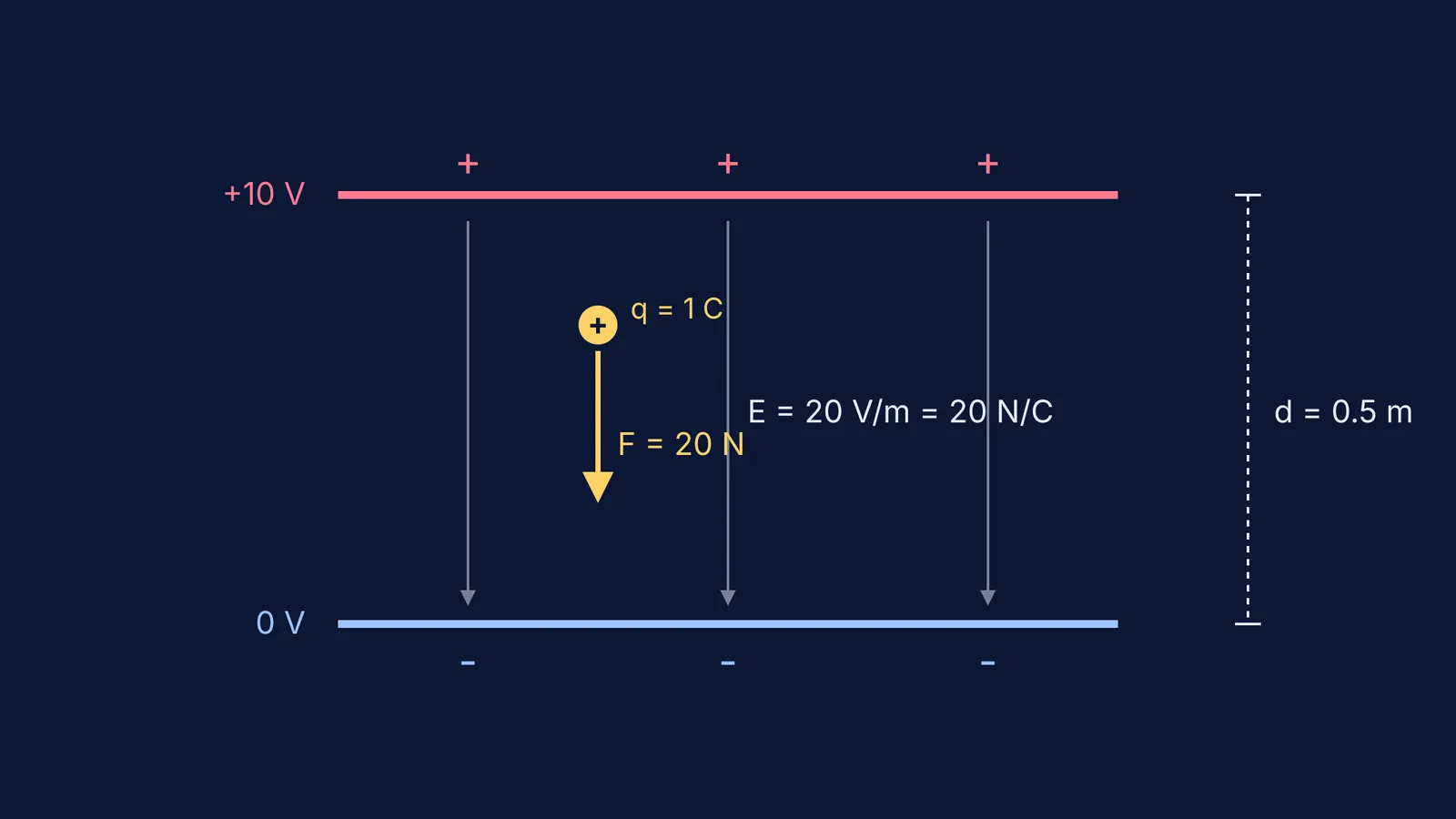
Let's look at a worked example. Suppose you have two parallel plates separated by 0.5 metres, connected to a 10-Volt battery.
Using the voltage formula, the electric field is E = V / d = 10 V / 0.5 m = 20 V/m.
Now, suppose you place a 1-Coulomb test charge between those plates. How much force does it feel? Since we know 20 V/m is exactly 20 N/C, we can use the force formula F = qE.
F = 1 C × 20 N/C = 20 Newtons.
You find the force instantly because the unit values are identical.
Use N/C when the problem describes point charges, electric forces, or Coulomb's law. It reminds you that multiplying by charge gives you a force.
Use V/m when the problem involves parallel plates, capacitors, batteries, or energy density in an electric field. It reminds you that multiplying by distance gives you a voltage.
If you find yourself stuck deciding which formula to apply to a new problem, the Fermi Concept Library maps every concept in physics, chemistry, biology, mathematics and computing, each with its own lesson and its place in the map, so you can trace the line from force to energy.
The next time you see a field of 100 V/m, remember it is exactly 100 N/C. Try sketching a simple parallel plate capacitor and calculating both the force on a charge and the voltage across the gap to see the equivalence in action.


