

On this page
Uncertainty principle numericals look scary because of all the powers of ten, but nearly every one is the same three-line calculation. Here are the formula, two worked examples, the unit traps that cost marks, and a cricket ball comparison.
What does Δx·Δp ≥ h/4π actually say?
Werner Heisenberg published the idea in 1927 in the journal Zeitschrift für Physik (Heisenberg, 1927). The OpenStax Chemistry 2e textbook puts it like this: "It is fundamentally impossible to determine simultaneously and exactly both the momentum and the position of a particle."
OpenStax writes the principle as Δx · Δp ≥ ħ/2. The reduced Planck constant ħ equals h/2π (NIST), so ħ/2 is the same thing as the h/4π in your textbook.
Momentum is mass times velocity, so Δp = mΔv. That gives the working equation for almost every numerical: Δx · m · Δv ≥ h/4π.
These are the constants you need:
The Planck constant h is exactly 6.626 070 15 × 10⁻³⁴ J s (NIST CODATA).
h/4π therefore works out to about 5.273 × 10⁻³⁵ J s.
The electron mass is 9.109 × 10⁻³¹ kg (NIST CODATA).
How do you find the uncertainty in velocity from position?
Worked example 1. An electron's position is known to within 0.1 nm. Find the minimum uncertainty in its velocity.
That is roughly the size of an atom: the Bohr radius of hydrogen is 5.29 × 10⁻¹¹ m (NIST), so 0.1 nm is about one atom across.
Convert the position. One nanometre is 10⁻⁹ m (NIST SI prefixes), so Δx = 1.0 × 10⁻¹⁰ m.
Rearrange: Δv ≥ h / (4π · m · Δx).
Substitute: Δv ≥ 5.273 × 10⁻³⁵ / (9.109 × 10⁻³¹ × 1.0 × 10⁻¹⁰).
The denominator is 9.109 × 10⁻⁴¹, so Δv ≥ 5.79 × 10⁵ m/s.
That is about 580 kilometres every second. This is why it makes no sense to picture an atom's electron running along a sharp, fixed track.
How do you find the uncertainty in position from velocity?
Worked example 2. An electron moves at 600 m/s, and its speed is measured with an accuracy of 0.005%. Find the minimum uncertainty in its position.
Turn the percentage into a velocity first: Δv = 600 × 0.005/100 = 0.03 m/s.
Rearrange: Δx ≥ h / (4π · m · Δv).
Substitute: Δx ≥ 5.273 × 10⁻³⁵ / (9.109 × 10⁻³¹ × 0.03), using the NIST electron mass.
The denominator is 2.733 × 10⁻³², so Δx ≥ 1.93 × 10⁻³ m, about 1.9 mm.
Why doesn't the uncertainty principle matter for a cricket ball?
Under Law 4.1, a new men's cricket ball must weigh between 155.9 g and 163 g (MCC Laws of Cricket, 2017 Code). MCC's 2026 edition renamed it the Size 1 ball but left it unchanged (MCC summary of 2026 changes).
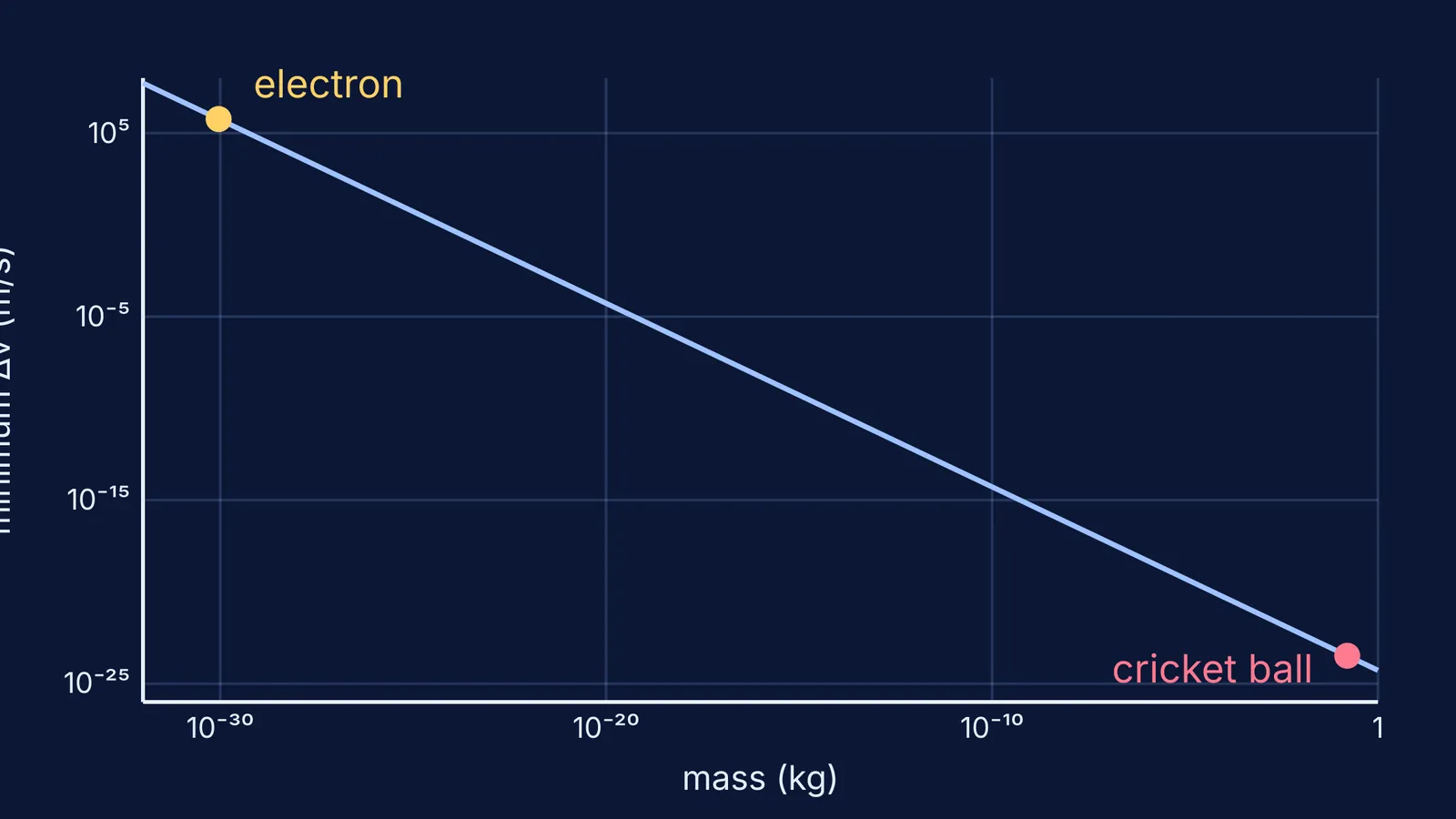
Take 160 g, which is 0.16 kg, and pin the ball to the same 0.1 nm as the electron:
Δv ≥ 5.273 × 10⁻³⁵ / (0.16 × 1.0 × 10⁻¹⁰) = 3.3 × 10⁻²⁴ m/s.
At that speed the ball would take about 3 × 10²⁰ seconds to drift one millimetre. The electron's answer is bigger by 0.16 / 9.109 × 10⁻³¹, or about 1.8 × 10²⁹, which is exactly the ratio of the two masses. That is because Δv is inversely proportional to mass. OpenStax makes the same point with a baseball: its uncertainty is "too insignificant to observe," while an electron's mass is small enough for the uncertainty to be "large and significant."
Which mistakes cost marks in uncertainty numericals?
Grams instead of kilograms. The electron mass is 9.109 × 10⁻³¹ kg (NIST). If a question gives a mass in grams, divide by 1000 before substituting.
Length prefixes. One picometre is 10⁻¹² m and one nanometre is 10⁻⁹ m (NIST SI prefixes).
h/2π instead of h/4π. Using the wrong one changes your answer by a factor of 2, so check which form the question uses.
Percentages. Turn a percentage accuracy into a speed before you divide.
"Δx equals Δp" questions. Here Δp² = h/4π, so Δp = √(h/4π) and Δv = Δp/m.
Equals versus at least. The result is a minimum uncertainty, so write ≥.
If you keep landing on the wrong power of ten, the Fermi Problem Library has worked problems with a step-by-step solver that explains the reasoning rather than printing an answer, so you can see which line went wrong. If the idea itself still feels slippery, the Fermi Concept Library gives each concept in physics and chemistry its own lesson and its place in the map.
Once these feel routine, the same unit habits carry over to de Broglie wavelength problems for electrons and protons and hydrogen spectrum problems with Bohr energy levels. For the story behind the formula, read Werner Heisenberg and the uncertainty principle, explained.


