

On this page
If a question shows two benzene rings joined by a single bond and asks how to make them, two name reactions should come to mind: the Ullmann reaction (copper) and the Fittig reaction (sodium). They give the same kind of product, so questions often test whether you can keep them apart.
What is the Ullmann reaction?
The Ullmann reaction couples two aryl halides into a biaryl using copper metal and heat, as Name Reaction's summary puts it. Fritz Ullmann and Jean Bielecki described it in 1901 in *Berichte der deutschen chemischen Gesellschaft*, in a paper titled "Ueber Synthesen in der Biphenylreihe" ("On syntheses in the biphenyl series").
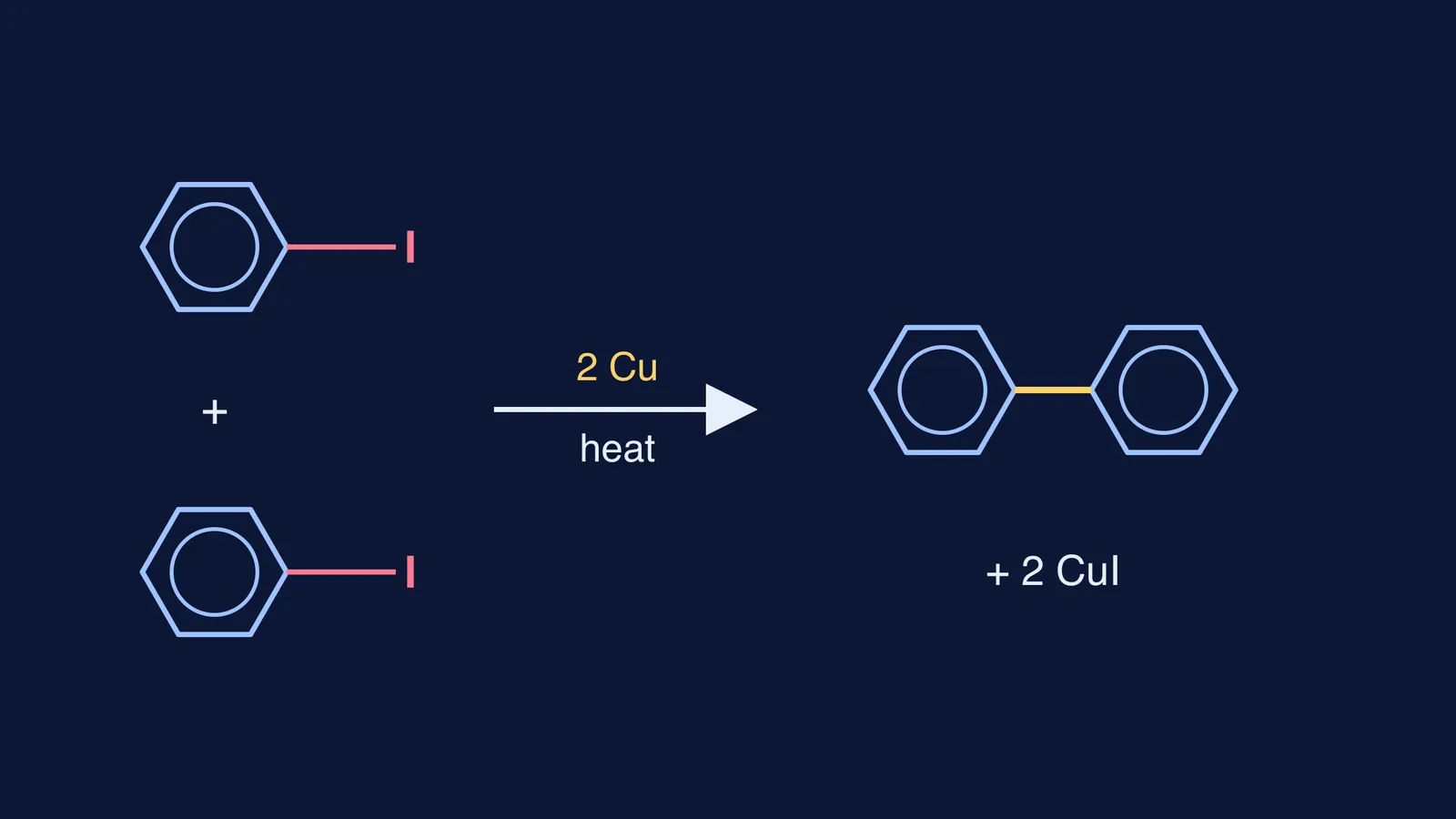
The textbook example is iodobenzene:
2 C6H5I + 2 Cu → C6H5–C6H5 + 2 CuI
Two iodobenzene molecules lose their iodine atoms to copper, which ends up as copper(I) iodide, and the two phenyl rings join to give biphenyl (Vedantu's Ullmann reaction notes). The same notes explain that aryl iodides react most readily because the C–I bond is weaker than the C–Br and C–Cl bonds.
What conditions does the Ullmann reaction need?
The classic recipe heats an aryl halide with copper powder at high temperature to give a symmetrical biaryl, according to Thermo Fisher's guide to the Ullmann reaction. The same guide says temperatures above 100 °C are needed to start the coupling, and that specially activated copper lets chemists work at lower temperatures.
The traditional version uses a full equivalent of copper rather than a catalytic amount, needs harsh conditions, and is limited to electron-deficient aryl halides (Wikipedia: Ullmann reaction). A standard example from that page is ortho-chloronitrobenzene, which couples on a copper-bronze alloy to give 2,2′-dinitrobiphenyl and copper(I) chloride. The nitro group pulls electron density out of the ring, which is why this chloride couples even though plain chlorobenzene is sluggish.
The mechanism is still debated; one proposal involves an organocopper intermediate (Wikipedia). For school and JEE purposes, you need the reagents and the product.
How is the Ullmann reaction different from the Fittig reaction?
The Fittig reaction couples two aryl halides with sodium metal in dry ether to give a biaryl (Vedantu's Wurtz-Fittig notes). It grew out of Charles Adolphe Wurtz's sodium coupling of alkyl halides, which Wilhelm Rudolph Fittig extended to aryl halides in papers from the 1860s (Wikipedia: Wurtz–Fittig reaction). That article notes that side reactions, including rearrangements and eliminations, limit how useful the sodium coupling is.
Here is the comparison you can write in an answer:
Metal: Ullmann uses copper powder or bronze; Fittig uses sodium.
Medium: Ullmann is a high-temperature reaction; Fittig runs in dry ether, because sodium reacts with water.
Typical halide: Ullmann works best with aryl iodides and with rings carrying electron-withdrawing groups such as nitro.
By-product: Ullmann leaves copper(I) halide; Fittig leaves sodium halide.
Product: both give a symmetrical biaryl, such as biphenyl, when one aryl halide is used.
If you want the sodium family side by side, our post on Wurtz-Fittig and Fittig reactions covers aryl–alkyl coupling too. And if you are wondering why aryl halides need such forcing conditions at all, see why haloarenes resist nucleophilic substitution.
How do you spot which reaction a question wants?
Use this four-step check on any conversion question:
Read the reagent. Cu, copper powder or Cu-bronze with heat means Ullmann. Na with dry ether means Fittig, or Wurtz-Fittig if an alkyl halide is also present.
Count the rings in the product. Two aryl rings joined directly means a biaryl coupling. An aryl ring plus an alkyl chain means Wurtz-Fittig.
Check the halogen. An aryl iodide, or an electron-poor aryl chloride such as 2-chloronitrobenzene, fits the Ullmann pattern.
Watch for two different aryl halides. Heating iodobenzene and 4-iodotoluene together with copper can pair the rings three ways, so expect a mixture of biphenyl, 4-methylbiphenyl and 4,4′-dimethylbiphenyl rather than one clean product.
Worked example. "Convert 2-chloronitrobenzene into 2,2′-dinitrobiphenyl." The product has two identical rings joined where chlorine was, and the substrate is electron-deficient. Answer: heat with copper (Ullmann coupling), and CuCl is the by-product.
Where can you practise biaryl coupling questions?
Try a few conversions yourself and check the reasoning, not just the final structure. The Fermi Problem Library has worked problems with a step-by-step solver that explains the reasoning rather than printing an answer. If the gap is in the basics, such as why the C–I bond breaks more easily than C–Cl, the Fermi Concept Library gives each concept in chemistry its own lesson.
When you revise the Ullmann reaction, write the iodobenzene equation from memory, then the Fittig version underneath it, and circle the two things that differ: the metal and the condition.


