

On this page
Valence Bond Theory tells us that a covalent bond forms when atomic orbitals on two atoms overlap, allowing them to share a pair of electrons. But bringing two orbitals together in space does not guarantee a chemical bond.
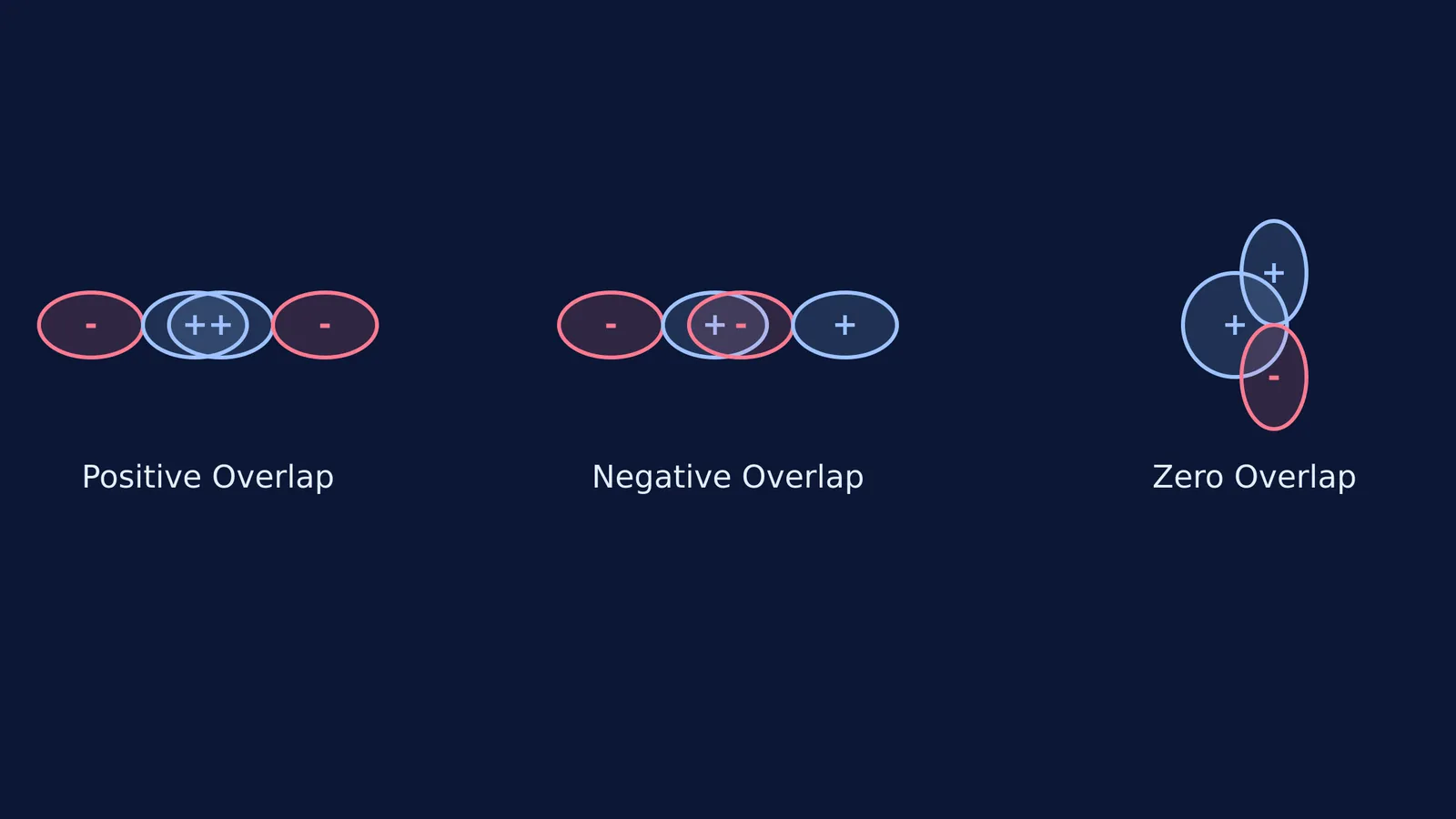
Because electrons behave as waves, their mathematical wave functions have a phase—usually marked with a positive (+) or negative (–) sign. When two orbitals meet, their phases determine whether they will successfully form a bond. Depending on their alignment and their mathematical signs, the overlap can be positive, negative, or zero.
What do the positive and negative signs mean?
When you look at textbook diagrams of p-orbitals or d-orbitals, you will often see the lobes labelled with + and – signs. These signs have nothing to do with electrical charge. An electron always carries a negative electrical charge, regardless of the lobe it occupies.
Instead, the signs represent the phase of the electron's wave function. Just as a physical wave on a pond has a crest (above the surface) and a trough (below the surface), an electron wave has regions of positive and negative mathematical amplitude. When you square the wave function, you calculate the probability of finding an electron, which is always positive. However, the phase itself dictates how two different electron waves will interact when they collide. For two electron waves to add together and build a strong bond, their phases must perfectly match.
How does positive overlap create a bond?
Positive overlap, often called in-phase overlap, happens when the interacting lobes of two atomic orbitals have the same sign. This means either a + lobe meets a + lobe, or a – lobe meets a – lobe.
This matching phase causes constructive interference. Just as two water waves meeting crest-to-crest will build a larger wave, the two electron waves add together. This increases the overall electron density in the space directly between the two nuclei. This concentrated negative charge pulls the two positively charged atomic nuclei together, creating a stable, lower-energy state known as a covalent bond.
Common examples of positive overlap include:
s–p overlap: A spherical s-orbital (which only ever has one phase) meeting the matching-phase lobe of a p-orbital head-on. This occurs when hydrogen bonds with fluorine to form hydrogen fluoride.
p–p axial overlap: Two p-orbitals meeting head-on with matching phases, forming a strong sigma (σ) bond.
p–p sidewise overlap: Two parallel p-orbitals meeting side-by-side with matching phases, forming a pi (π) bond.
What happens during negative overlap?
Negative overlap, also known as out-of-phase overlap, occurs when the overlapping lobes of two orbitals have opposite signs. In this scenario, a + lobe is forced to meet a – lobe.
When opposite phases overlap, they cancel each other out through destructive interference, just as a crest meeting a trough flattens a water wave. This cancellation leaves a specific region between the two nuclei with exactly zero electron density, which is known as a node.
Without a dense cloud of electrons to hold the nuclei together, the atoms strongly repel each other due to the exposed positive charges of their nuclei. This creates an antibonding interaction, meaning no chemical bond is formed. In molecular orbital theory, this out-of-phase combination corresponds to an antibonding molecular orbital, which sits at a higher energy level than the isolated atoms and actively destabilises the molecule if electrons are forced into it.
Why do some orbitals show zero overlap?
Zero overlap happens when the geometric orientation of the two orbitals prevents them from interacting meaningfully, even if they are physically close together.
This usually happens when any positive overlap in one region of space is exactly cancelled out by an equal amount of negative overlap in another adjacent region. Because the net mathematical overlap integrated over all space adds up to zero, there is absolutely no change in the electron density between the nuclei, and no net bond forms. The orbitals simply ignore one another.
Common examples of zero overlap include:
Perpendicular orientation: An s-orbital approaching a p-orbital exactly along its nodal plane (perpendicular to its primary axis). The s-orbital overlaps equally with the + lobe and the – lobe, perfectly cancelling out the interaction.
Mismatched axes: A p_x orbital approaching a p_y orbital along the z-axis. Because they sit at right angles to each other in 3D space, their lobes cannot possibly align for either head-on or side-on overlap.
If you struggle to picture how orbitals align in three-dimensional space, or if you keep making mistakes on bonding and hybridisation questions, try the Fermi Concept Library. It has every concept in physics, chemistry, biology, mathematics and computing, each with its own lesson and its place in the map.


