

On this page
What is the difference between diagonal, scalar and identity matrices?
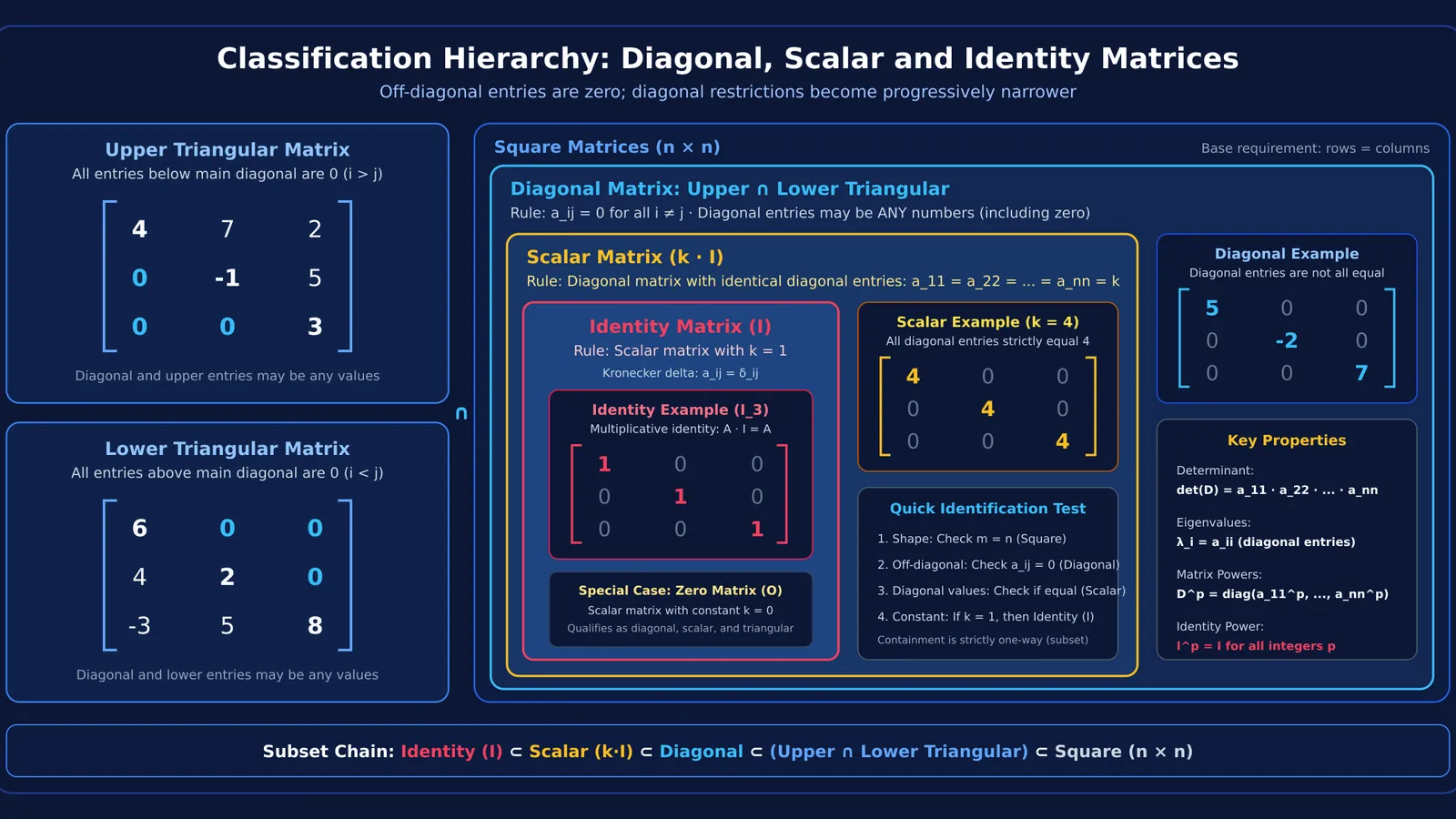
Diagonal, scalar, and identity matrices form a strict subset hierarchy: every identity matrix is a scalar matrix, every scalar matrix is a diagonal matrix, and every diagonal matrix is a square matrix.
To classify an n × n square matrix A = [a_ij], examine where zeros and non-zero numbers appear:
A diagonal matrix has all off-diagonal entries equal to zero (a_ij = 0 whenever i ≠ j). As documented by Wolfram MathWorld's entry on diagonal matrices, entries on the main diagonal may be any numbers, including zero. For example, a 3 × 3 matrix with diagonal entries 5, -2, and 0 and zeros everywhere else is a diagonal matrix.
A scalar matrix is a diagonal matrix whose main diagonal entries are all identical (a_11 = a_22 = ... = a_nn = k). According to Wolfram MathWorld's entry on scalar matrices, every scalar matrix equals k · I, where k is a scalar constant and I is the identity matrix of the same order.
An identity matrix is a scalar matrix whose diagonal entries are strictly 1. As noted in Wolfram MathWorld's entry on identity matrices, its entries satisfy the Kronecker delta: a_ij = 1 for i = j and a_ij = 0 for i ≠ j. It acts as the multiplicative identity: A · I = I · A = A for any conformable square matrix A.
Because each definition introduces a stricter rule, containment is one-way: Identity ⊂ Scalar ⊂ Diagonal ⊂ Square. A matrix with diagonal entries 2 and 5 is diagonal but not scalar; a matrix with diagonal entries 3 and 3 is scalar but not identity.
How do triangular matrices fit into the hierarchy?
Triangular matrices form the geometric boundary for diagonal matrices:
An upper triangular matrix has all entries below the main diagonal equal to zero (a_ij = 0 for all i > j).
A lower triangular matrix has all entries above the main diagonal equal to zero (a_ij = 0 for all i < j).
According to Wolfram MathWorld's entry on triangular matrices, these definitions leave the diagonal and the chosen triangle unrestricted. When a matrix satisfies both conditions at once, all elements off the main diagonal must be zero. Thus, a matrix is diagonal if and only if it is both upper triangular and lower triangular.
For both triangular and diagonal matrices, the determinant equals the product of the main diagonal entries, and the eigenvalues are simply the diagonal entries themselves.
Why do students make classification errors in matrix questions?
Classification errors usually stem from treating matrix types as separate categories rather than nested subsets.
In a 2012 study of 60 first-year undergraduate mathematics students published in *Procedia - Social and Behavioral Sciences*, Nilgün Aygör and Hülya Özdağ examined student difficulties in linear algebra and identified six primary conceptual misconceptions, concluding that learners often over-generalize elementary rules instead of applying structural definitions. In matrix classification problems, this reliance on surface patterns frequently produces three common errors:
Assuming diagonal entries cannot be zero: The definition of a diagonal matrix restricts only off-diagonal entries (a_ij = 0 for i ≠ j). A matrix such as diag(3, 0, 5) remains strictly diagonal.
Treating scalar and identity matrices as mutually exclusive: An identity matrix does not cease being a scalar matrix; it represents the specific scalar case where k = 1.
Overlooking the zero matrix: A square null matrix qualifies as diagonal, scalar with k = 0, and both upper and lower triangular.
Grasping this hierarchy simplifies subsequent topics, including finding matrix powers, analyzing symmetric and skew-symmetric matrices, and mastering matrices and determinants for JEE.
To see where matrix classifications fit into the wider syllabus, the Fermi Concept Library covers every concept in physics, chemistry, biology, mathematics and computing, each with its own lesson and its place in the map. For structured practice on classification problems, the Fermi Problem Library provides worked problems with a step-by-step solver that explains the reasoning rather than printing an answer.
What is a quick checklist to identify any special matrix?
Use this four-step decision ladder to classify any matrix in an exam:
Check the shape: Count rows and columns. If m ≠ n, the matrix is rectangular; it cannot be diagonal, scalar, identity, or triangular.
Check off-diagonal entries: If all entries below the diagonal are zero, it is upper triangular. If all entries above are zero, it is lower triangular. If all off-diagonal entries are zero, classify it as diagonal.
Check diagonal uniformity: If diagonal entries are identical (a_ii = k), classify it as scalar. If they differ, it is diagonal only.
Check the scalar value: If k = 1, it is the identity matrix (I). If k = 0, it is the zero matrix (O).
Consider four quick classifications:
Matrix [2, 0; 0, -3] has off-diagonal zeros with unequal diagonal entries: diagonal, but not scalar.
Matrix [-5, 0; 0, -5] has off-diagonal zeros and equal diagonal entries: scalar and diagonal, but not identity.
Matrix [1, 0; 0, 1] has diagonal entries of 1: identity, scalar, and diagonal.
Matrix [4, 7; 0, 2] has zero only below the diagonal: upper triangular, but not diagonal.
Evaluating shape first, off-diagonal zeros second, and diagonal values last resolves any matrix classification within seconds.


