

On this page
When you first step into algebra, letters suddenly mix with numbers, and the rules of arithmetic seem to change. One of the most common early stumbles is confusing x + x with x × x. You might write x + x = x² or think x × x = 2x.
Is x plus x equal to x squared?
No. Adding two identical variables combines them into a multiple, so x + x = 2x. Multiplying a variable by itself increases its exponent, so x × x = x².
The root of this confusion runs deep. The Concepts in Secondary Mathematics and Science (CSMS) project found that beginners naturally try to treat algebraic letters as physical objects. If you think of x as an "apple," then x + x makes perfect sense as two apples, or 2x. However, when you try to multiply an apple by an apple (x × x), the object model breaks down. Because students lack a better framework for multiplication, they often guess the only other algebraic form they have seen, leading them to mistakenly write 2x instead of x². This is sometimes called the 'fruit salad' misconception, where variables are treated as labels rather than as unknown numbers.
Furthermore, using the number 2 as a quick test case creates an arithmetic trap. If you substitute 2 for x, you find that 2 + 2 = 4 and 2 × 2 = 4. This coincidence makes it easy to falsely conclude that addition and multiplication do the same thing to a variable.
How do algebra tiles show the difference?
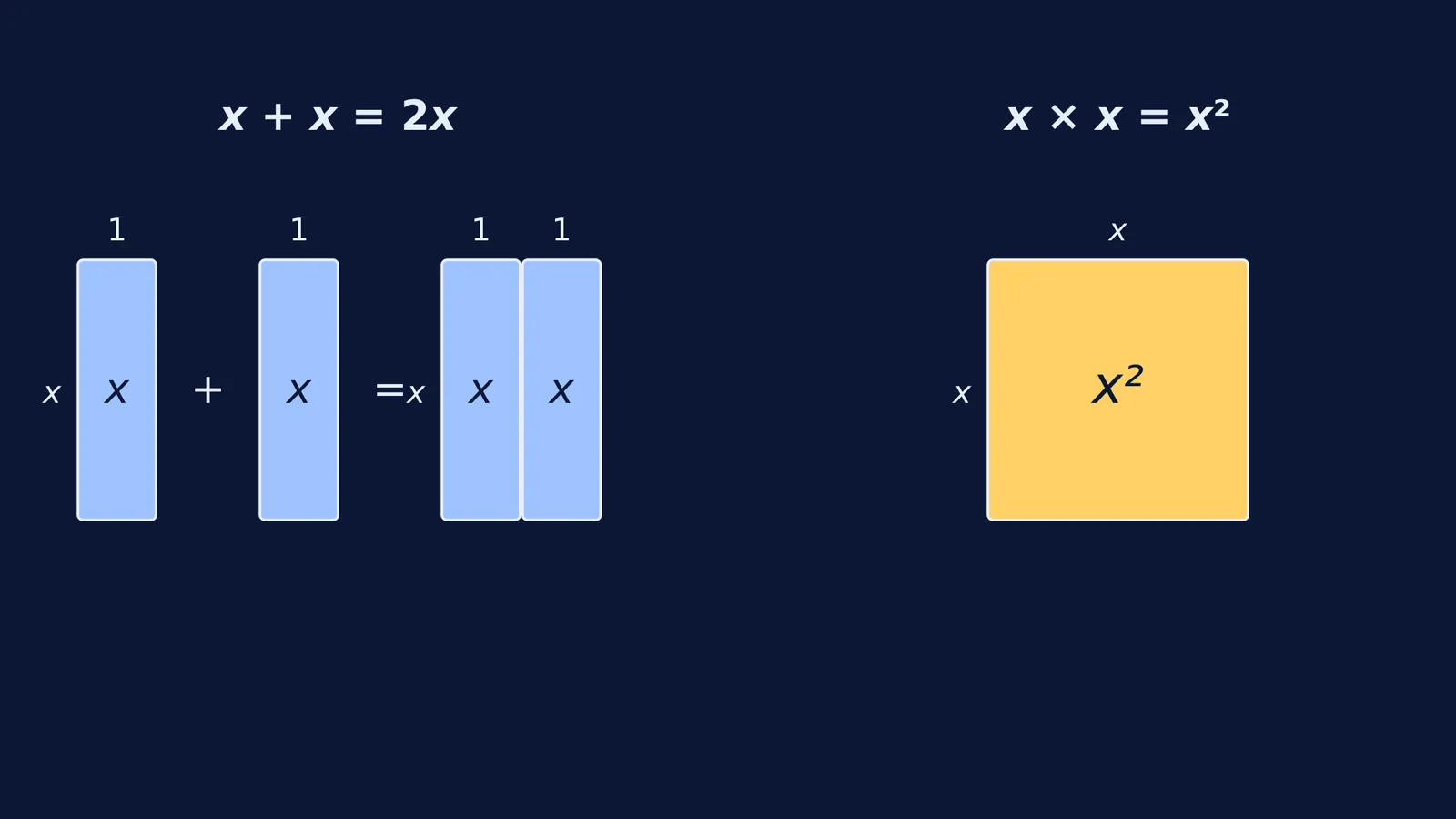
To break the habit of treating letters like physical objects, educators recommend using algebra tiles, a tool that relies on a geometric area model (Algebra tile - Wikipedia). Visualising variables as geometric shapes makes the difference obvious.
The linear model (x + x): Imagine a rectangular tile that is 1 unit wide and x units long. If you take one x tile and place another identical x tile next to it, you now have two of these rectangles. You have not changed their shape; you just have twice as many. This is 2x.
The area model (x × x): Multiplication in geometry creates an area. If you draw a rectangle with a width of x and a length of x, you have drawn a square. The area of that square is x².
A long rectangle (2x) and a large square (x²) are completely different shapes, proving that the two algebraic terms cannot be swapped.
The Number Test: how do you check your work?
If you are ever unsure whether an algebraic rule is correct, swap the variable for a number other than 2 or 1. The numbers 1 and 2 often mask algebraic errors because 1 × 1 = 1 and 2 + 2 = 2 × 2 = 4. Let us try plugging in 3 to see the difference clearly.
For addition (x + x = 2x): Substitute x = 3. The left side is 3 + 3 = 6. The right side is 2 × 3 = 6. The equation holds true.
For multiplication (x × x = x²): Substitute x = 3. The left side is 3 × 3 = 9. The right side is 3² = 9. The equation holds true.
But what happens if you make the common slip and write x + x = x²?
Substitute x = 3. The left side is 3 + 3 = 6. The right side is 3² = 9.
Since 6 does not equal 9, you know immediately that x + x and x² are not equivalent.
By substituting a test number like 3 or 4, you force yourself to treat the variable as a genuine number rather than just a letter or an object.
How does Fermi's AI tutor help fix algebraic slips?
It takes time to rewire your brain for algebra, and having someone guide you through the stumbles makes all the difference. When you bring your maths homework to Fermi, the Fermi Problem Library provides worked problems with a step-by-step solver that explains the reasoning rather than printing an answer.
If you accidentally make this mistake, Fermi does not just mark it wrong. The AI tutor teaches rather than answers: it holds a line of reasoning across a session, notices where you are stuck, and decides whether to explain, ask, or show. It works out what you already know and builds a plan for the session, drawing the figure or writing on a board to ensure you have a solid grasp of the concepts before moving on. If you need a refresher on the basics, the Concept Library contains every concept in physics, chemistry, biology, mathematics and computing, each with its own lesson and its place in the map.
Once you have the basics down, you can tackle more advanced equations, such as Quadratic word problems in Class 10: speed, age and area, or explore When two quadratics share a root: the condition and its use.


