

On this page
When you solve exam problems on simple harmonic motion (SHM), you will often encounter a classic scenario: two identical particles executing SHM along the same line cross paths. They share the same amplitude and frequency, but they are out of sync.
Finding the exact phase difference when two particles in SHM cross each other is straightforward if you move away from the trigonometric equations and use the reference circle instead.
Why does phase difference matter?
In simple harmonic motion, the position of a particle over time is typically modelled as x(t) = A cos(ωt + φ), where A is the amplitude, ω is the angular frequency, and φ is the phase constant. The phase constant dictates where the particle was in its cycle at the initial moment t = 0.
When two particles share the same path and frequency but cross each other, they must have different phase constants. Their phase difference (Δφ) remains constant over time. If you try to find it purely by equating A cos(ωt + φ₁) = A cos(ωt + φ₂), you might end up wrestling with trigonometric identities and multiple solutions.
Instead, physicists model SHM as the shadow (or projection) of a point moving in uniform circular motion. By plotting both particles on this "reference circle", the phase difference becomes a simple geometric angle.
Setting up the reference circle
Imagine a circle with a radius equal to the amplitude A. A point P moves counter-clockwise around this circle with angular velocity ω. The shadow that P casts on the x-axis perfectly matches the back-and-forth motion of a particle in SHM.
If two particles are executing SHM, we place two points, P₁ and P₂, on our reference circle.
The angle each point makes with the positive x-axis represents its total phase (ωt + φ).
The angle between P₁ and P₂ on the circle is their phase difference (Δφ).
Because they have the same frequency, P₁ and P₂ rotate at the exact same speed. The angle between them never changes.
What is the phase difference when two particles in SHM cross?
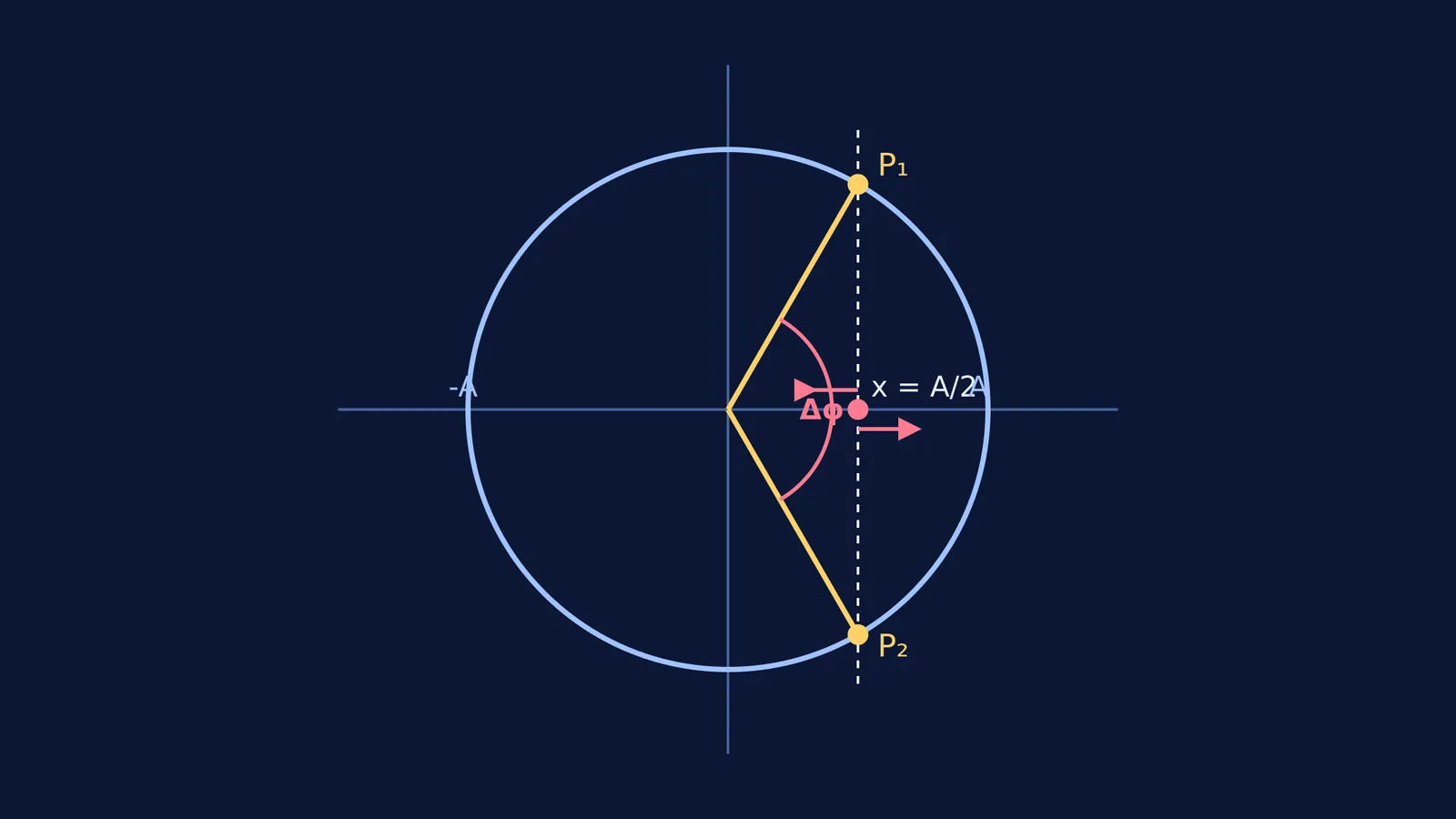
"Crossing each other" means the two particles are at the exact same displacement x at the exact same time. On the reference circle, this means P₁ and P₂ cast the same shadow on the x-axis. They must lie on the same vertical line.
For this to happen while they move in opposite directions, one point must be on the top half of the circle (moving left, with a negative velocity) and the other on the bottom half (moving right, with a positive velocity).
Let's look at the most common exam variations:
1. Crossing at the mean position (x = 0)
If they cross at the center, their shadows are exactly at x = 0. One point must be at the very top of the circle (an angle of 90° or π/2), moving left. The other must be at the very bottom (270° or 3π/2), moving right.
The angle between them is 180° (or π radians). They are completely out of phase.
2. Crossing at half amplitude (x = A/2)
This is the most frequent exam question. The particles cross at a displacement exactly halfway to the extreme position.
Their shadows are at x = A/2.
The radius of the circle is A.
For both points, forming a right-angled triangle with the x-axis gives cos(θ) = (A/2) / A = 1/2.
The angles that give a cosine of 1/2 are 60° (in the top right quadrant) and -60° (or 300°, in the bottom right quadrant).
The phase difference is the gap between 60° and -60°, which is 120° (or 2π/3 radians).
3. Crossing at x = A/√2
If the particles cross at x = A/√2, we solve cos(θ) = 1/√2. The corresponding angles on the top and bottom halves of the circle are 45° and -45°.
The gap between them is 90° (or π/2 radians).
How do you use the reference circle in exams?
When you face a crossing SHM problem, you do not need to write out the full wave equations or use sine addition formulas. Follow this script instead:
Identify the crossing position x as a fraction of the amplitude A.
Ask yourself: "What angle θ gives a cosine of that fraction?"
Double that angle. That is your phase difference.
If you struggle to remember which quadrant corresponds to which velocity direction, the Fermi Concept Library holds a complete lesson on the reference circle, helping you map out phase step by step.
Visualising the circle turns abstract trigonometry into a shape you can literally see. Once you map the crossing point to a vertical line on the circle, the phase gap is simply the wedge between the top and bottom intersections.
Related reads:


