

On this page
When you whirl a single mass on the end of a string across a frictionless table, the tension is uniform throughout the entire length. But if you tie a second mass halfway down that same string, the physics changes entirely. The string does not snap evenly under pressure — the segment closest to your hand takes the brunt of the force.
To understand why, you have to look at how circular motion demands forces from every object in the system. Because the entire setup is supported by a frictionless horizontal table, we can ignore gravity and focus purely on the horizontal forces acting along the string.
Why does the inner string carry more tension?
Every mass moving in a circle requires a centripetal force pulling it toward the centre of rotation. Without this continuous inward pull, inertia would cause the mass to fly off in a straight line tangent to the circle. As the OpenStax textbook on University Physics notes, this centripetal force is calculated as F = mrω².
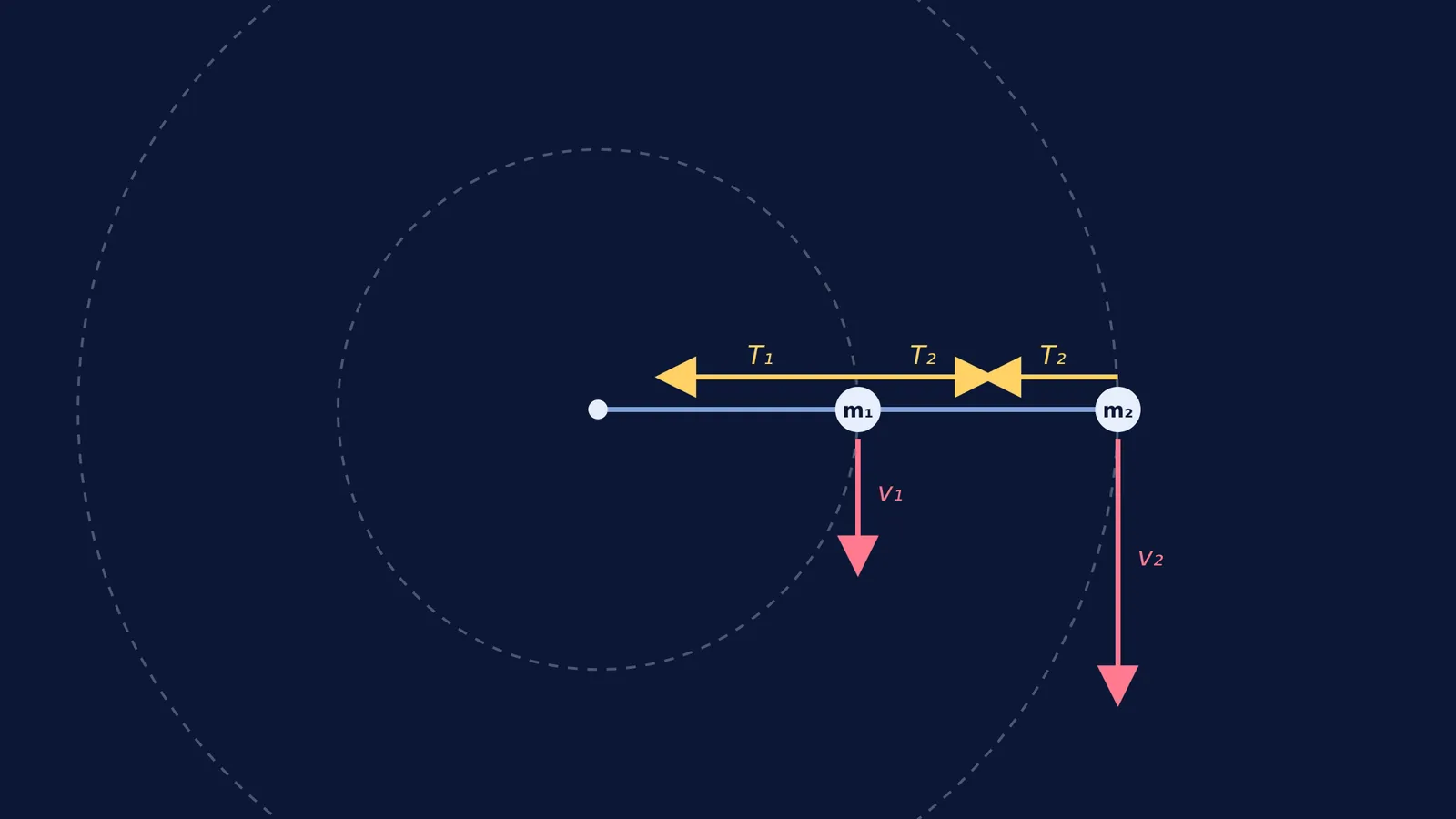
Imagine two masses on a string: mass m₁ is at an inner radius r₁, and mass m₂ is at an outer radius r₂. You spin them together at a constant angular velocity ω. They complete one full revolution in the exact same amount of time, which means ω is identical for both objects.
For the outermost mass (m₂), the only horizontal force pulling it toward the centre is the tension from the outer segment of the string. But for the inner mass (m₁), the situation is a physical tug-of-war. The outer string segment pulls it outward (because m₂ is resisting the turn due to its inertia), while the inner string segment pulls it inward.
Therefore, the inner string must pull inward hard enough to do two things simultaneously: provide the necessary centripetal force for m₁, and counteract the outward pull from m₂.
How to find the tension in string segments with two masses whirled in a circle?
When solving mechanics systems with multiple linked objects, you should always start from the outside and work your way in. This avoids having too many unknowns in your first equation and simplifies the algebra.
Step 1: The outer mass
The outer mass (m₂) is at a distance r₂ from the centre. The only horizontal force acting on it is the tension from the outer string segment, T₂. Because this tension is the only force, it provides the entire centripetal force for m₂:
T₂ = m₂r₂ω²
Step 2: The inner mass
The inner mass (m₁) is at a distance r₁. It experiences two horizontal forces: T₁ pulling it towards the centre, and T₂ pulling it away. The net force towards the centre must exactly equal the required centripetal force for m₁:
T₁ − T₂ = m₁r₁ω²
Now, substitute the value of T₂ we just found into this equation:
T₁ = m₁r₁ω² + m₂r₂ω²
T₁ = ω²(m₁r₁ + m₂r₂)
This final equation proves the core principle: the inner string segment is supplying the necessary centripetal force for both masses combined. This logic builds directly from finding velocity and acceleration vectors for motion in a plane, where you must break complex movements down into individual components.
A worked example: Equal masses and string lengths
Examiners in competitive tests frequently strip this problem down to a specific, symmetrical case. Suppose both masses are identical (m₁ = m₂ = m), and the two string segments have the exact same length L.
This means the inner mass is at radius r₁ = L, and the outer mass is at radius r₂ = 2L. Because both masses share the same angular velocity, we can directly compare the tensions.
Let us apply our formulas to find the tension in each segment:
Outer tension: T₂ = m(2L)ω² = 2mLω²
Inner tension: T₁ = m(L)ω² + 2mLω² = 3mLω²
The ratio of the inner tension to the outer tension (T₁ : T₂) is therefore exactly 3:2.
Once you master horizontal circles, you will also need to consider vertical circles, such as calculating the simple pendulum string tension at any angle, where gravity constantly changes the force required at the top and bottom of the loop.
Where can you practise rotational mechanics?
Understanding the theory of circular motion is straightforward, but applying it to complex systems with multiple bodies requires structured practice. If you find yourself forgetting to include the outward pull on the inner mass, Fermi's AI tutor can help keep your problem-solving structured.
When you work through these questions in the Fermi Problem Library, the AI does not just give you the final formula. It watches how you set up your free-body diagrams, notices if you forget the tension pulling away from the centre, and guides you to correct your own equations. If you want to see how these forces interact visually across all concepts in physics, the Fermi Concept Library places this derivation directly in the wider map of mechanics.


