

On this page
When you connect a heating coil to a power supply to boil a kettle of water, the coil converts electrical energy into thermal energy. According to the principles of electric power, the power P dissipated by a resistor is given by P = V²/R, where V is the voltage of the supply and R is the electrical resistance of the coil.
The amount of heat energy H required to bring a specific mass of water from room temperature to its boiling point is a fixed constant, dictated by the specific heat capacity of water. Because energy equals power multiplied by time (H = P × t), we can rearrange the equation to find the time t it takes to boil the water: t = (H × R) / V².
Assuming the mains voltage V stays constant and no heat is lost to the surroundings, the time taken is directly proportional to the resistance of the circuit. A higher resistance means lower power, which stretches out the time needed to deliver the required heat.
Why do series and parallel coils take different times?
The key to understanding the difference lies in how resistance behaves when you connect components together. Every heating coil is essentially a resistor. When you change how these resistors are connected, you change the total resistance of the circuit. In a household context, or in laboratory experiments, voltage is typically a constant value supplied by the mains or a battery.
Because the time to boil t is directly proportional to the resistance R, any change in the circuit's total resistance directly scales the time it takes to heat the water. Connecting coils in series forces the current to push through both coils one after the other, increasing the total resistance. This increased resistance restricts the flow of electrons, which means less electrical energy is converted into heat every second. Connecting them in parallel gives the current two independent paths to flow through simultaneously, decreasing the total resistance. With more paths available, more total current flows from the source, leading to a much higher rate of heat production.
If you are stuck on circuit problems and need to trace where the energy goes, Fermi's AI tutor can work out what you already know and build a plan for the session, guiding you through the reasoning step by step.
How long do coils in series take to boil water?
When two coils with resistances R₁ and R₂ are connected in series, the same current flows through both, and their total equivalent resistance is simply the sum of the two: R_s = R₁ + R₂.
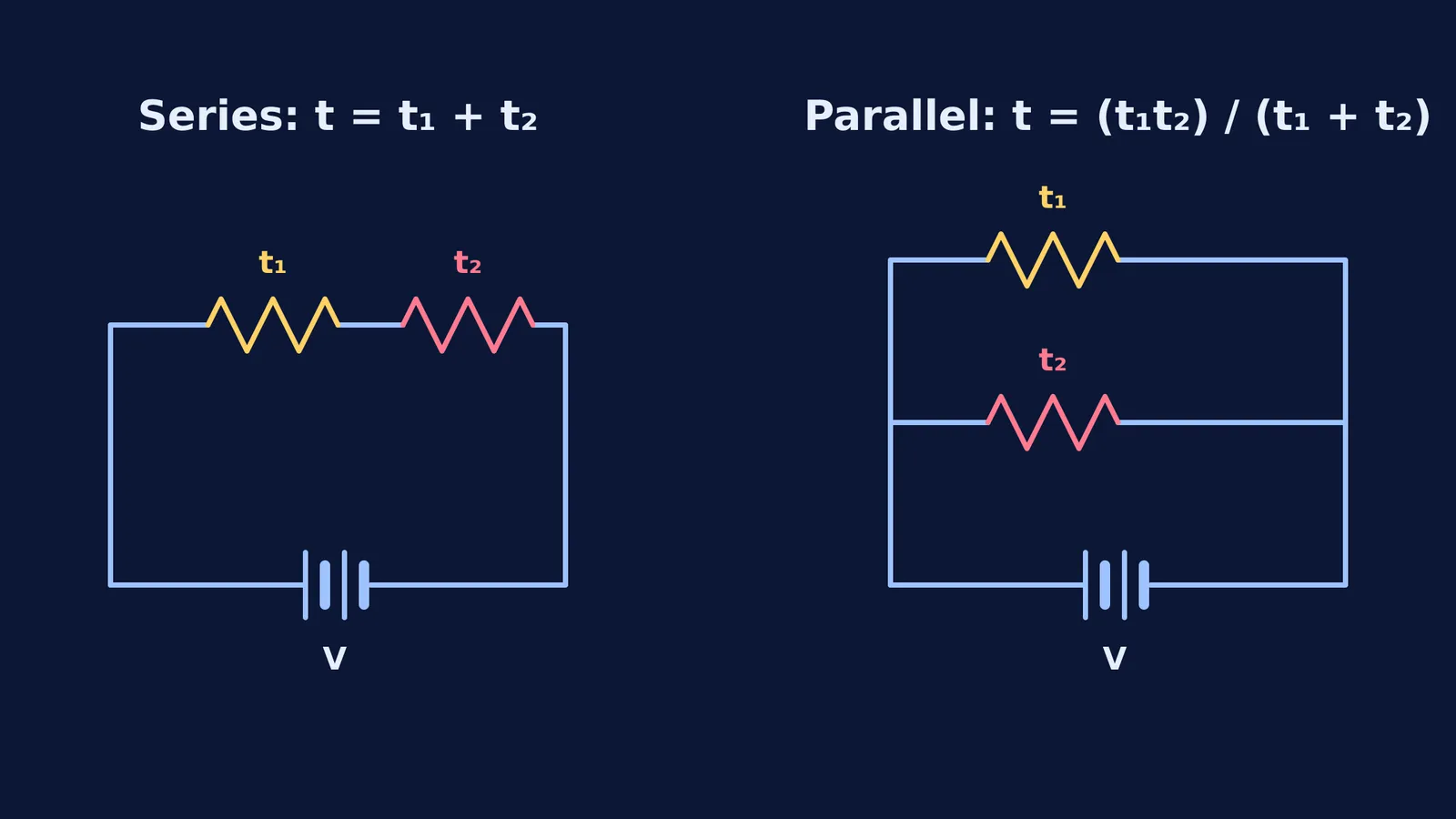
Because the time taken to boil water is proportional to the resistance, the total time t_s is the sum of the individual times. The series connection creates a bottleneck: it increases the total resistance, which chokes the current and lowers the overall power output of the circuit. A lower power output means energy is delivered at a slower rate, so it takes considerably longer to boil the water. You can think of it as trying to drink a thick milkshake through two straws connected end-to-end; the resistance is much higher than using just one straw.
The formula for the time in series is: t_s = t₁ + t₂
For more on combining components in circuits, check out our guide to the node potential method or explore the Fermi Concept Library for lessons on electricity and voltage drops.
How long do coils in parallel take to boil water?
When the same two coils are connected in parallel, each coil is exposed to the full voltage of the power supply. The formula for the total equivalent resistance in a parallel circuit is 1/R_p = 1/R₁ + 1/R₂.
A lower total resistance draws more total current from the voltage source, pushing the combined power output higher. Because both coils are operating at their full individual capacities at the same time, they deliver heat to the water much faster. It is analogous to having two separate heaters operating independently in the same kettle. As a result, the total time t_p is significantly shorter than the time taken by either coil working alone. In fact, it will always be less than the time taken by the fastest individual coil.
Because the boiling time is proportional to resistance, the relationship for time perfectly mirrors the parallel resistance formula: 1/t_p = 1/t₁ + 1/t₂
By finding a common denominator, this rearranges to the standard parallel time formula: t_p = (t₁ × t₂) / (t₁ + t₂)
A worked example with two coils
Imagine you are in a laboratory testing two different electric heating coils connected to a power supply. Connected individually to the mains, Coil A takes 10 minutes to boil a specific beaker of water. Coil B has a lower resistance, so it draws more power and takes only 5 minutes to boil the exact same amount of water. You need to know exactly how long they will take if you combine them in different configurations.
If you connect them in series: The total resistance increases. They will take t_s = 10 + 5 = 15 minutes. The high combined resistance severely restricts the current, dropping the power output to a level lower than either coil alone.
If you connect them in parallel: The total resistance decreases. They will take t_p = (10 × 5) / (10 + 5) = 50 / 15 ≈ 3.33 minutes. Both coils draw full current simultaneously, delivering a massive amount of heat and boiling the water rapidly.
In competitive exams like JEE Main or NEET-UG, this concept frequently appears in multiple-choice questions because it tests your understanding of both electric power and resistor combinations without requiring a calculator. Remembering that time scales linearly with resistance is the fastest way to the answer. It is a reliable shortcut that saves valuable time when every second counts.
If you want to practice more thermodynamics and electricity problems, the Fermi Problem Library has worked problems with a step-by-step solver that explains the reasoning rather than printing an answer. You can also read our breakdown of how a stretched wire's resistance changes to see how physical changes affect electrical properties in other common exam scenarios.


