

On this page
Imagine a family with two children. You are told that at least one of the children is a boy. What is the probability that both children are boys?
Most people immediately answer 1/2. The intuitive reasoning sounds straightforward: since one child is known to be a boy, the other child seems to have an independent, equal chance of being male. Yet in formal probability theory, the correct mathematical answer is 1/3.
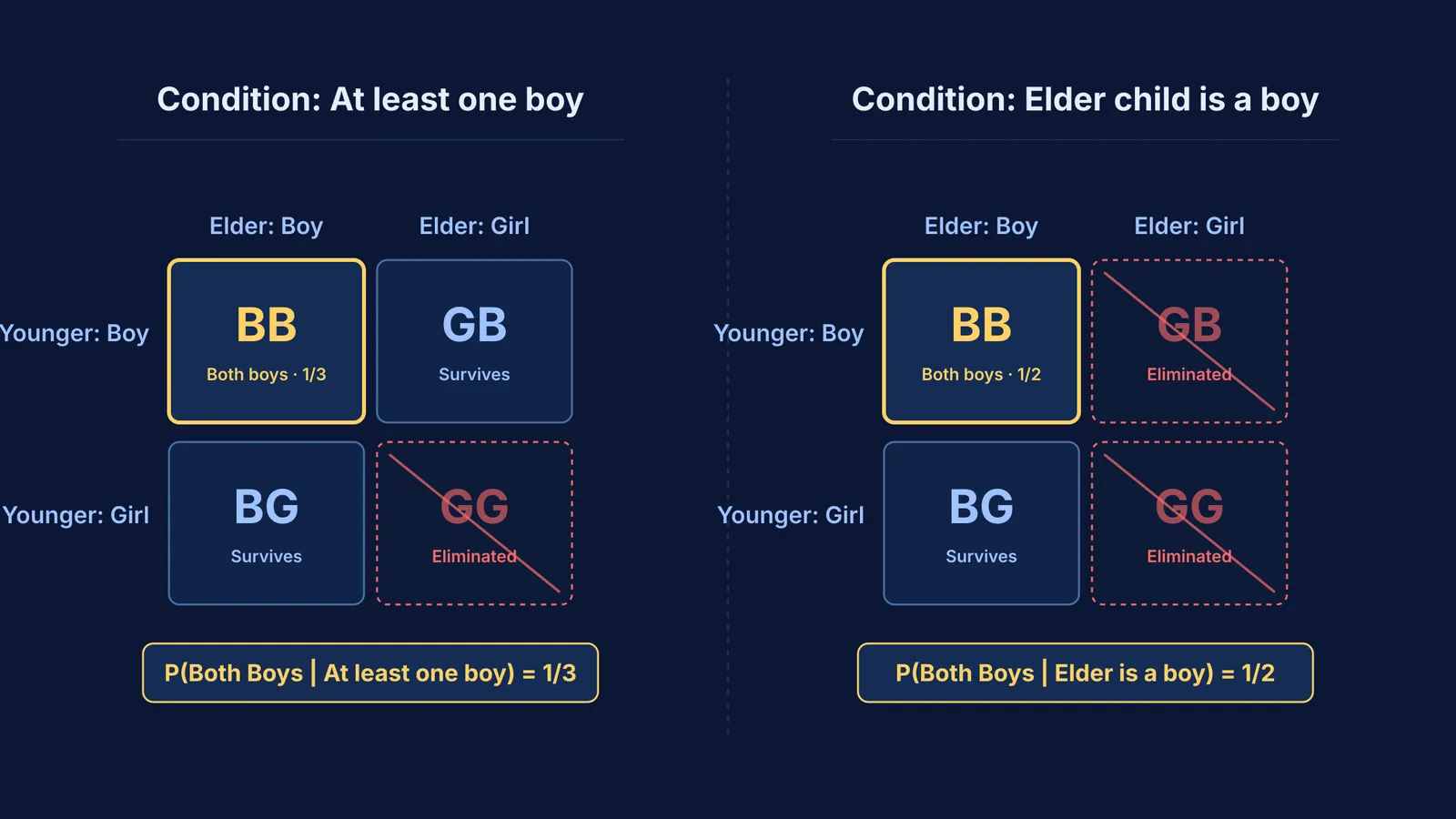
The puzzle became famous when Martin Gardner introduced it in his May 1959 column in Scientific American. The solution requires defining the complete sample space before applying the condition. When a family has two children, there are four equally likely configurations based on birth order:
Elder boy, younger boy (BB)
Elder boy, younger girl (BG)
Elder girl, younger boy (GB)
Elder girl, younger girl (GG)
Assuming each birth is an independent event with equal likelihood, each pair has a probability of (1/2) × (1/2) = 1/4. The condition "at least one child is a boy" applies to the family, not to a specific child. This condition eliminates only GG, leaving three equally likely outcomes: {BB, BG, GB}. Among these three, only one—{BB}—has two boys.
Under the definition of conditional probability and Bayes' theorem, the probability of event A given event B is P(A|B) = P(A ∩ B) / P(B). Because P(both boys ∩ at least one boy) = 1/4 and P(at least one boy) = 3/4, dividing 1/4 by 3/4 yields exactly 1/3.
Why does naming the elder child change the probability to 1/2?
Now contrast this with a different condition: you are told that the elder child is a boy. What is the probability that both children are boys?
Here, the answer is 1/2. Specifying birth order changes the surviving sample space:
Elder boy, younger boy (BB) — elder child is a boy
Elder boy, younger girl (BG) — elder child is a boy
Elder girl, younger boy (GB) — eliminated because the elder is a girl
Elder girl, younger girl (GG) — eliminated because the elder is a girl
Stating that the elder child is a boy eliminates two outcomes, leaving {BB, BG}. Because both remaining outcomes are equally likely, the probability of two boys is 1 out of 2, or 1/2.
When information identifies a specific child—such as the firstborn—it isolates that individual event. The younger child's gender remains an independent coin flip, as explored in independent events in Class 12 probability. But stating that "at least one child is a boy" describes the pair as a whole, eliminating only {GG} and leaving three configurations.
Why do most students fall into the 50% intuition trap?
The conflict between intuition and calculation reflects a documented cognitive bias. In a study published in the Journal of Experimental Psychology: General, Craig R. Fox and Jonathan Levav tested university students on this problem. When given the phrasing "at least one of them is a boy", 85% of participants answered 1/2, while only 3% reached the correct answer of 1/3.
Fox and Levav showed that everyday language prompts students to evaluate an unnamed "other" child in isolation rather than conditioning on the four family configurations. When the researchers tested a clarified phrasing—"It is not the case that they are both girls"—the proportion answering 1/2 dropped from 85% to 39%, while the correct 1/3 response rose to 31%.
In Cognition, Maya Bar-Hillel and Ruma Falk90021-x) explained that probability puzzles depend heavily on the reporting protocol. Seeing a father accompanied by a boy identifies an individual child, yielding 1/2. But learning from a household survey that a family has at least one boy samples families, leaving 1/3. The same logic governs combinatorial filtering in selection problems with at least one.
How should you solve conditional probability problems step by step?
To solve conditional probability problems reliably in CBSE Class 12 and JEE Main, use a systematic four-step method:
Write the full sample space: List all outcomes with order preserved (BB, BG, GB, GG).
Filter by the condition: Remove every outcome that contradicts the given fact to identify the reduced sample space.
Identify favorable outcomes: Count how many remaining outcomes satisfy the target event.
Compute the ratio: Divide the number of favorable surviving outcomes by the total surviving outcomes.
The Fermi Concept Library covers every concept in physics, chemistry, biology, mathematics and computing, each with its own lesson and its place in the map, showing how sample spaces and conditional distributions connect across probability.
For targeted practice, the Fermi Problem Library offers worked problems with a step-by-step solver that explains the reasoning rather than printing an answer. Mapping outcomes systematically ensures you never confuse an individual event with a conditioned pair.


