

On this page
It is a classic question in the Class 12 mathematics curriculum: "A man is known to speak the truth 3 out of 4 times. He throws a die and reports that it is a six. Find the probability that it is actually a six." Students often stare at the page, trying to remember where to put the numbers in Bayes' theorem. But there is a simpler way to see the answer.
Why is Bayes' theorem so confusing?
The human brain struggles with abstract probabilities. When presented as natural frequencies instead of probabilities, correct answers in Bayesian reasoning problems jumped from 16% to 46% (Gigerenzer & Hoffrage, 1995). We evolved to count things we can see, not to multiply fractions representing beliefs.
When a student reads the problem statement, they focus entirely on the man's honesty. This is a cognitive bias known as base rate neglect. They forget to account for how rare a six is in the first place. A six only appears once in every 6 rolls on a fair die. Because a six is rare, a report of a "six" is more likely to be a lie than a report of a "two".
How can you solve probability without the formula?
Instead of using the traditional Bayes' theorem formula, we can translate the problem into whole numbers. This is the natural frequency method.
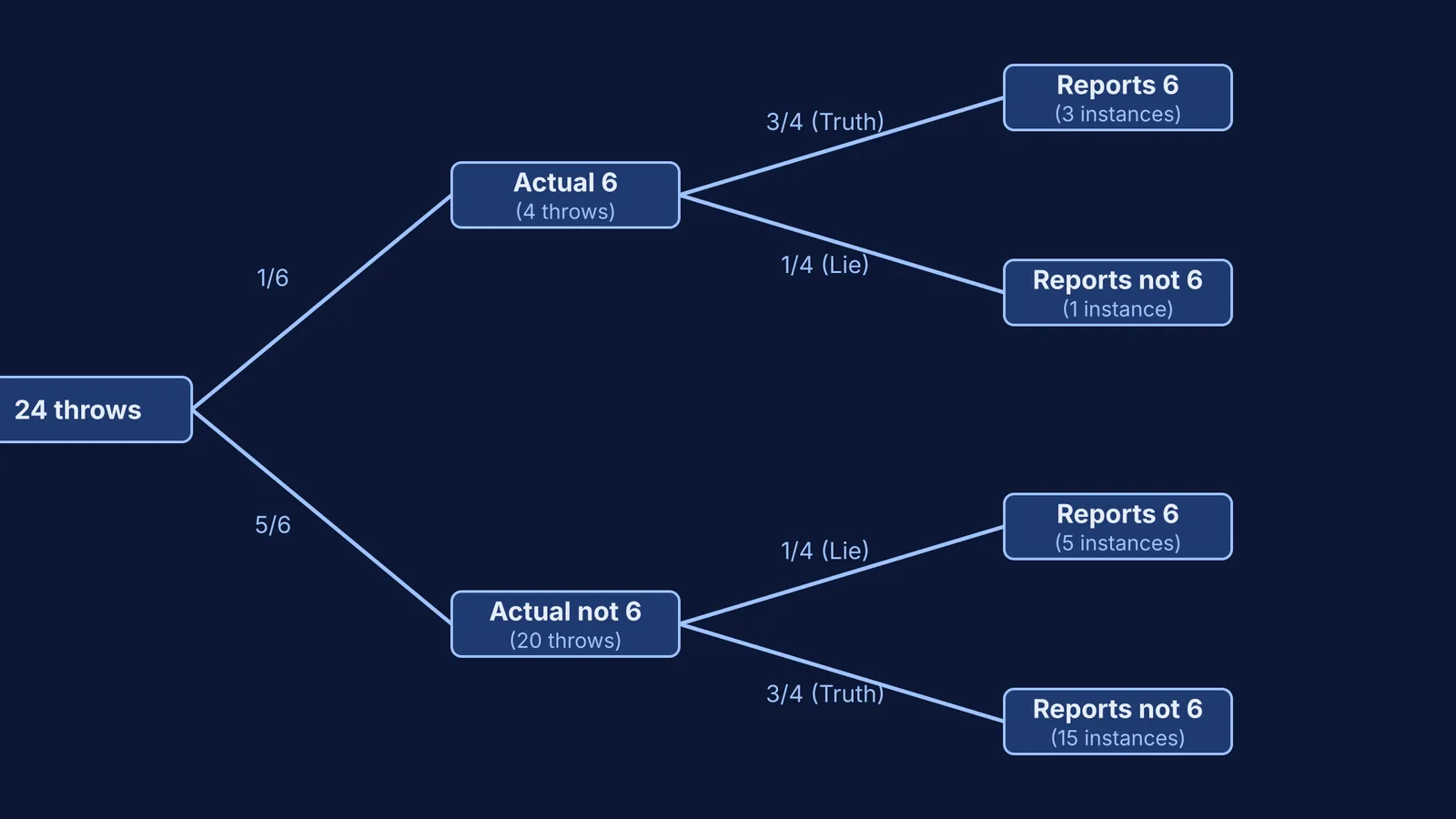
Let us imagine a sample of 24 throws. We pick 24 because it is a multiple of both 6 (the faces of the die) and 4 (the truth ratio), making the division neat.
The actual throws: In 24 throws, the die will land on a six in exactly 4 throws (1/6 of 24), and on something else in 20 throws.
The truth and the lies: For those 4 actual sixes, the man speaks the truth with a probability of 3/4, reporting "six" in 3 of them and lying in 1. For the 20 non-sixes, he lies with a probability of 1/4, falsely reporting a "six" in 5 of them, and telling the truth in 15.
Counting the reports: He said "six" in 3 true instances and in 5 lying instances, totalling 8 reports.
Of those 8 reports, only 3 were actually a six. The probability that it is actually a six is therefore 3/8.
By mapping out the exact events, the abstract fraction becomes a simple counting exercise. This approach also helps in other tricky areas of probability, such as With and without replacement: probability problems compared and Odds in favour and odds against: converting them to probability.
How does the frequency tree map to Bayes' theorem?
If you are preparing for a board exam, you must still write down the formal Bayes' theorem to secure full marks. The good news is that the natural frequency tree you just built contains every term of the formula.
Let us define the events formally: let E₁ be the event that a six actually occurs, let E₂ be the event that a six does not occur, and let A be the event that the man reports a six.
In the formula, the probability P(E₁) is the base rate of rolling a six, which is 1/6. The probability P(E₂) is 5/6. These correspond exactly to the first split in our tree, where the 24 throws divide into 4 actual sixes and 20 non-sixes.
The terms P(A|E₁) and P(A|E₂) represent the man's truthfulness. The first term, P(A|E₁), is the probability he reports a six when it actually is a six, which is 3/4. The second term, P(A|E₂), is the probability he falsely reports a six when it is not a six, which is 1/4. These are the second level of branches in our tree diagram.
The denominator of Bayes' theorem, P(E₁) × P(A|E₁) + P(E₂) × P(A|E₂), is simply the total number of reports of a "six". In our tree, we found this by adding the 3 true reports and the 5 false reports to get 8 total reports. The numerator, P(E₁) × P(A|E₁), is just the 3 true reports. Dividing the two gives exactly 3/8.
Where does this fit into exam preparation?
Memorising Bayes' theorem is necessary for writing out the formal steps in an exam. However, understanding the natural frequency underneath it ensures you never set the formula up incorrectly.
When you are stuck on a word problem, translating decimals or fractions into a concrete number of events is a reliable way forward. This is exactly where the Fermi Problem Library helps, offering worked problems with a step-by-step solver that explains the reasoning rather than printing an answer.
If you set up the base rate incorrectly, Fermi's AI tutor notices where a student is stuck and decides whether to explain, ask, or show. It might draw a frequency tree like the one above, turning an abstract fraction back into something you can count. By learning to step back and visualise the total sample space, you stop guessing which numbers to multiply and start seeing the logic of the problem itself.


