

On this page
What is the structure of trimethylamine and trisilylamine?
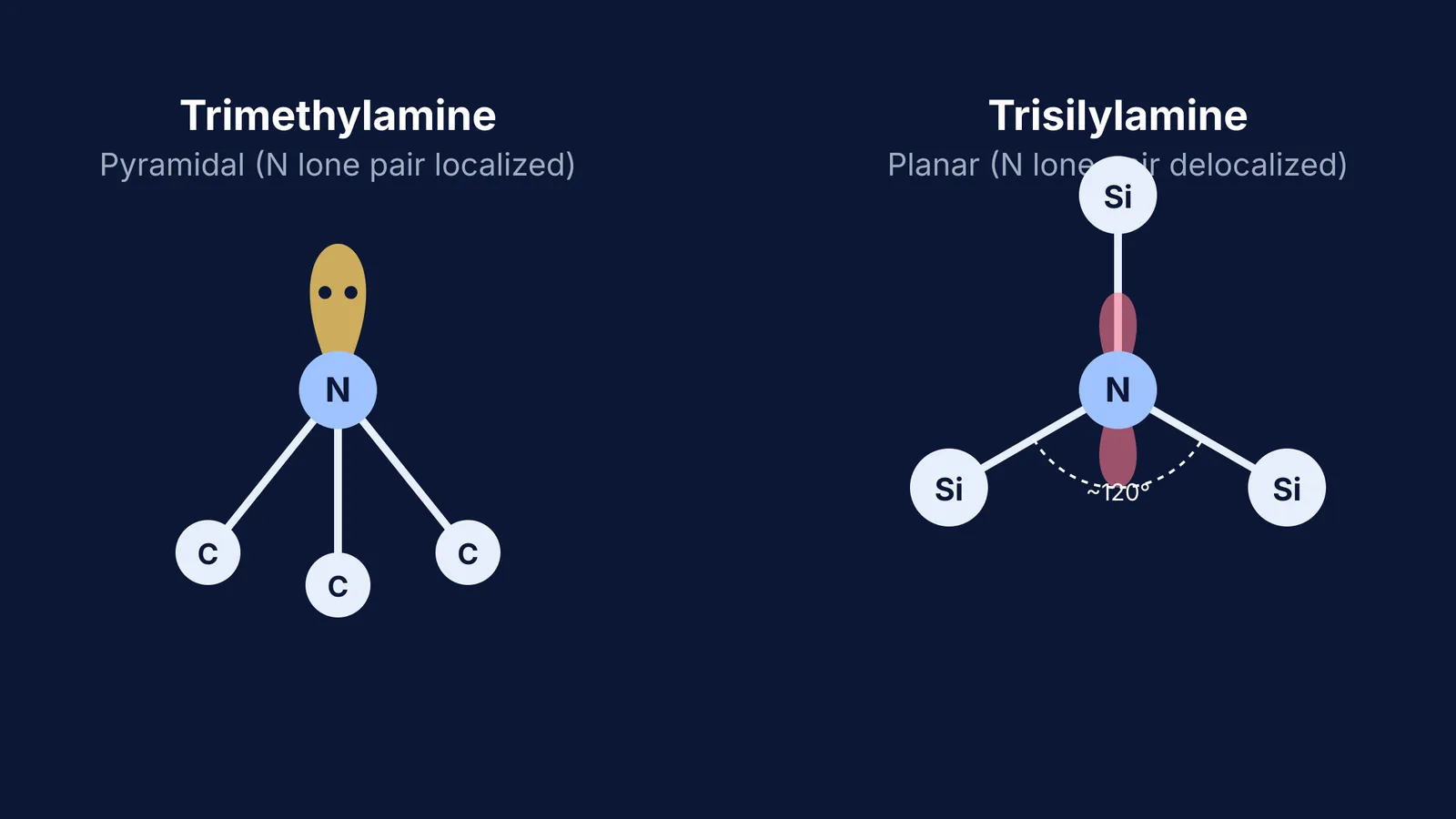
Trimethylamine, N(CH₃)₃, has a trigonal pyramidal shape. Nitrogen is in the second period, so it has five valence electrons and forms three single bonds with the methyl groups. The remaining two electrons form a lone pair in an sp³ hybrid orbital. Because carbon has no vacant d orbitals, this lone pair stays localized on the nitrogen atom, pushing the three bonds down and giving the molecule a pyramidal geometry.
Trisilylamine, N(SiH₃)₃, has a trigonal planar shape. The original structure of trisilylamine in the gas phase was established by Kenneth Hedberg in 1955, proving that the nitrogen atom and the three silicon atoms lie in the same flat plane with bond angles of nearly 120°. A later study confirmed that this planar structure is maintained even when the compound is frozen into a solid crystal at 115 K.
Why is trisilylamine planar?
The difference comes down to the silicon atoms. Silicon is in the third period of the periodic table, meaning it has vacant 3d orbitals in its valence shell. Nitrogen, being in the second period, has a lone pair of electrons sitting in a 2p orbital.
Because the empty d orbitals of silicon are close enough in energy and space to the filled p orbital of nitrogen, they can overlap. The nitrogen atom donates its lone pair density into the empty 3d orbitals of the three attached silicon atoms. This delocalization of electrons from a p orbital to a d orbital is called pπ-dπ back bonding.
To maximize this orbital overlap, the molecule flattens out. The nitrogen atom shifts from an sp³-like pyramidal arrangement to an sp² hybridized state. The unhybridized p orbital containing the lone pair sits perpendicular to the plane of the molecule, perfectly aligned to overlap with the silicon d orbitals. The result is a flat molecule where the Si-N-Si bond angles open up to nearly 120°.
The physical evidence for this interaction goes beyond just the planar shape. In a standard N-Si single bond without back donation, the expected distance between the nuclei is about 1.80 Ångströms. However, electron diffraction studies show that the actual N-Si bond length in trisilylamine is significantly shorter, at 1.73 Ångströms. This bond shortening is a classic signature of back bonding. Because the lone pair is delocalized, the N-Si bonds acquire partial double-bond character, drawing the atoms closer together and making the bonds stronger than a pure single bond.
How does back bonding affect Lewis basicity?
A Lewis base is an electron pair donor. In trimethylamine, the lone pair is highly localized in an sp³ orbital on the nitrogen atom. It is exposed and easily available to bond with a proton (H⁺) or a Lewis acid, making trimethylamine a strong base.
In trisilylamine, the nitrogen lone pair is spread out over the entire molecule through back bonding. Because the electron density is shared with the three silicon atoms, it is no longer concentrated on the nitrogen. This delocalization makes trisilylamine a very weak Lewis base.
This difference is easily seen in how the two compounds react with acids. Trimethylamine reacts vigorously with hydrochloric acid to form trimethylammonium chloride, a stable salt. Trisilylamine, on the other hand, barely reacts with standard acids. Its lone pair is so tied up in the internal pπ-dπ network that it cannot easily reach out to grab a passing proton. This is why replacing carbon atoms with silicon atoms completely changes the chemical behaviour of the amine.
If you are working through assertion-reason questions on molecular geometry, knowing how to spot these interactions saves time. The Fermi Problem Library has worked problems with a step-by-step solver that explains the reasoning rather than printing an answer. For example, if you bring a question about why the phosphorus analogue, trisilylphosphine, remains pyramidal while trisilylamine is planar, the AI tutor will walk you through the size difference between nitrogen's 2p and phosphorus's 3p orbitals.
A checklist for spotting pπ-dπ back bonding
When you face a question comparing bond angles or basicity, you can test for back bonding by checking three conditions:
The central atom must have a lone pair. This is usually nitrogen, oxygen, or fluorine from the second period.
The attached atoms must have vacant d orbitals. These are typically third-period elements like silicon, phosphorus, sulphur, or chlorine.
The size of the orbitals must allow for good overlap. A 2p-3d overlap is strong enough to change molecular shapes, but a 3p-3d overlap or larger is usually too weak and diffuse to have a significant effect.
If these conditions are met, expect the molecule to have wider bond angles than VSEPR theory predicts, shorter bonds than a standard single bond, and reduced basicity. Similar rules apply when you are comparing bond angles in NH₃ and PH₃ or deducing the shapes of interhalogen compounds.


