

On this page
A trigonometric inequality looks like an equation with one symbol changed, but its answer is a set of intervals, not a list of angles. Most marks are lost in the last step: writing that set correctly for every period. Here is one method that works for sine, cosine and tangent.
What do you need to know before you start?
Two facts do most of the work. Sine and cosine are periodic with period 2π and take values only in [−1, 1], as OpenStax Precalculus 2e, section 6.1 shows from their graphs. Tangent repeats every π, not 2π, a point OpenStax section 7.5 makes when it writes the general solution of tangent equations.
So check the range before drawing anything:
sin x > a with a ≥ 1: no solution.
sin x > a with a < −1: every real x.
sin x > −1: every x except x = −π/2 + 2nπ, where sin x equals −1.
Shaky on standard angles? Revise allied angles and the ASTC rule first.
How do you solve sin x > a on the unit circle?
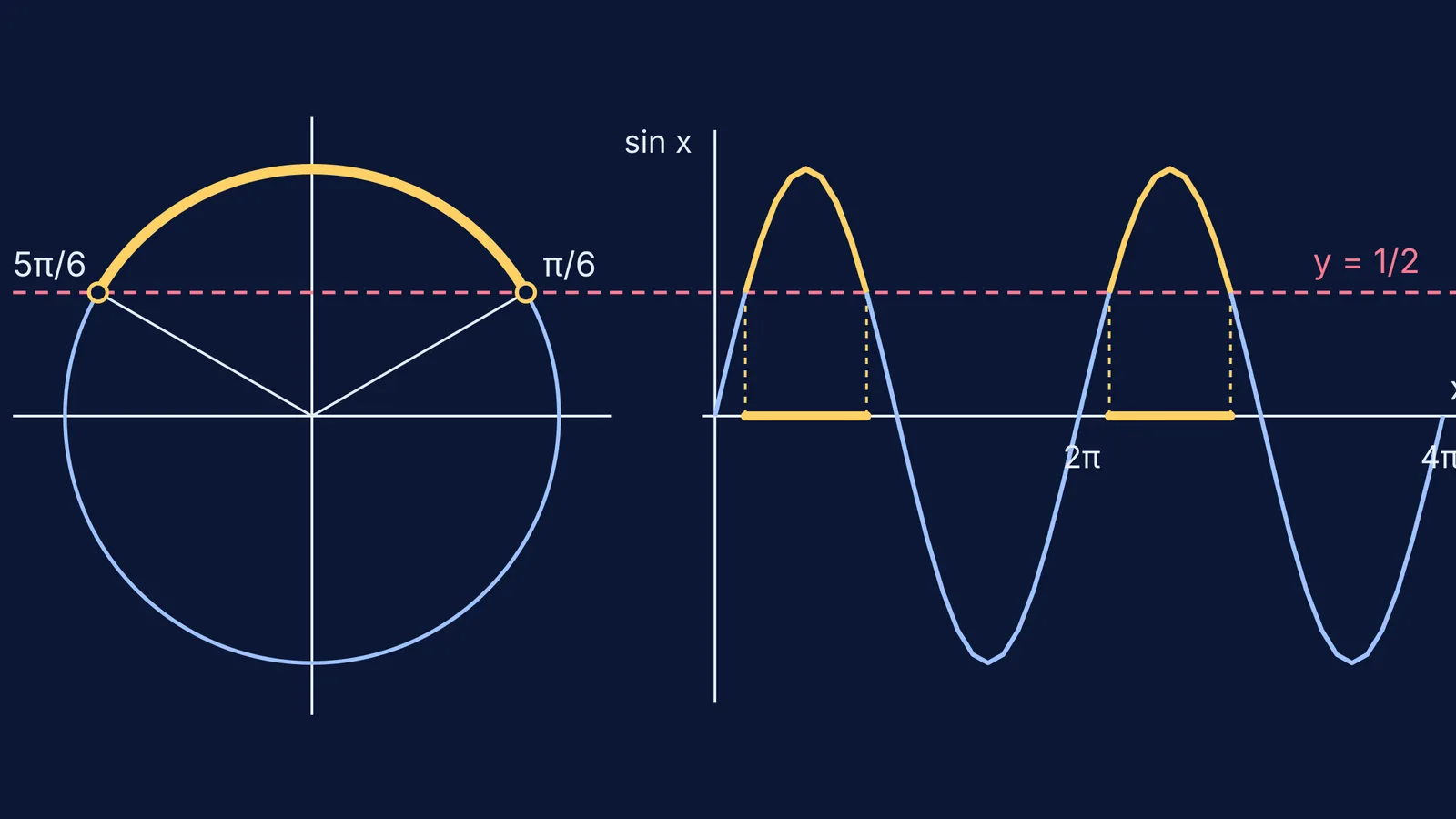
On the unit circle, sin x is the height of the point at angle x and cos x is its horizontal position. So sin x > a means above the line y = a; cos x > a means right of the line x = a.
Use four steps:
Solve sin x = a (or cos x = a) to get the two boundary angles.
Draw the line y = a (x = a for cosine) and mark the arc on the side you want.
Read that arc anticlockwise from its start to its end, so the left number is smaller than the right. Use negative angles if needed.
Add 2nπ to both ends (nπ for tangent) and write n ∈ Z.
Example 1: sin x > 1/2. sin x = 1/2 at π/6 and 5π/6. The arc above y = 1/2 runs anticlockwise from π/6 to 5π/6, over the top of the circle. Answer: x ∈ (2nπ + π/6, 2nπ + 5π/6), n ∈ Z.
Example 2: sin x < 1/2. Now you want the arc below the line. It starts at 5π/6 and runs anticlockwise past 3π/2 and 0 to π/6 + 2π = 13π/6. Answer: x ∈ (2nπ + 5π/6, 2nπ + 13π/6), n ∈ Z. Writing (5π/6, π/6) is the classic error: the left end is bigger than the right, so that interval is empty.
Example 3: cos x ≥ √3/2. cos x = √3/2 at x = ±π/6. The points to the right of the line x = √3/2 form a short arc through angle 0. Answer: x ∈ [2nπ − π/6, 2nπ + π/6], n ∈ Z, with closed brackets because of ≥.
When is the graph easier than the circle?
Tangent is easier on its graph, because tan x is undefined at odd multiples of π/2. On the branch (−π/2, π/2), tan x increases steadily and equals 1 at π/4. So tan x > 1 on (π/4, π/2), and with period π the answer is x ∈ (nπ + π/4, nπ + π/2), n ∈ Z. The right end stays open because tan x does not exist there.
How do you handle sin 2x > a or a quadratic in sin x?
Substitute, solve, then convert back. For sin 2x > 1/2, put t = 2x; Example 1 gives t ∈ (2nπ + π/6, 2nπ + 5π/6). Divide every part by 2: x ∈ (nπ + π/12, nπ + 5π/12), n ∈ Z. Forgetting to halve the 2nπ is the usual slip.
For 2sin²x − sin x − 1 < 0, put s = sin x. It factorises as (2s + 1)(s − 1) < 0, so −1/2 < s < 1, the same sign reasoning as the wavy curve method for rational inequalities. sin x > −1/2 is the arc from −π/6 anticlockwise to 7π/6, giving x ∈ (2nπ − π/6, 2nπ + 7π/6); sin x < 1 then removes only the points x = 2nπ + π/2.
How can you check your answer before moving on?
Run this list on every trig inequality:
Range: for sine or cosine, is a outside [−1, 1]?
Order: the left end is smaller than the right end in every interval.
Length: at most 2π for sine and cosine, under π for tangent.
Test: put one value inside your interval and one outside into the original inequality.
Brackets: open for > and <, closed for ≥ and ≤, always open where tan x is undefined.
Substitution: after t = 2x, divide the period term too.
If your boundary angles are right but the final interval keeps coming out wrong, the Fermi Problem Library has worked problems with a step-by-step solver that explains the reasoning rather than printing an answer. If the unit circle itself feels new, the Fermi Concept Library gives each mathematics concept its own lesson.
Next, mix these into the practice plan for trigonometric identities and equations.


