

On this page
When you evaluate a definite integral using trigonometric substitution, the most dangerous step is not the trigonometry. It is the final evaluation.
Many students find the antiderivative in terms of θ, substitute the original x back in, and then apply the original limits. This "back-substitution" is algebraically heavy and prone to sign errors. Even worse, some students forget to substitute x back entirely, plugging the x-limits directly into the θ-expression—a mathematically meaningless step that guarantees a wrong answer.
A 2023 study in the *Tuning Journal for Higher Education* tracking engineering students found that nearly 96% made procedural or step-forgetting errors when solving complex integrals. The most common trap? Forgetting to update the limits of integration.
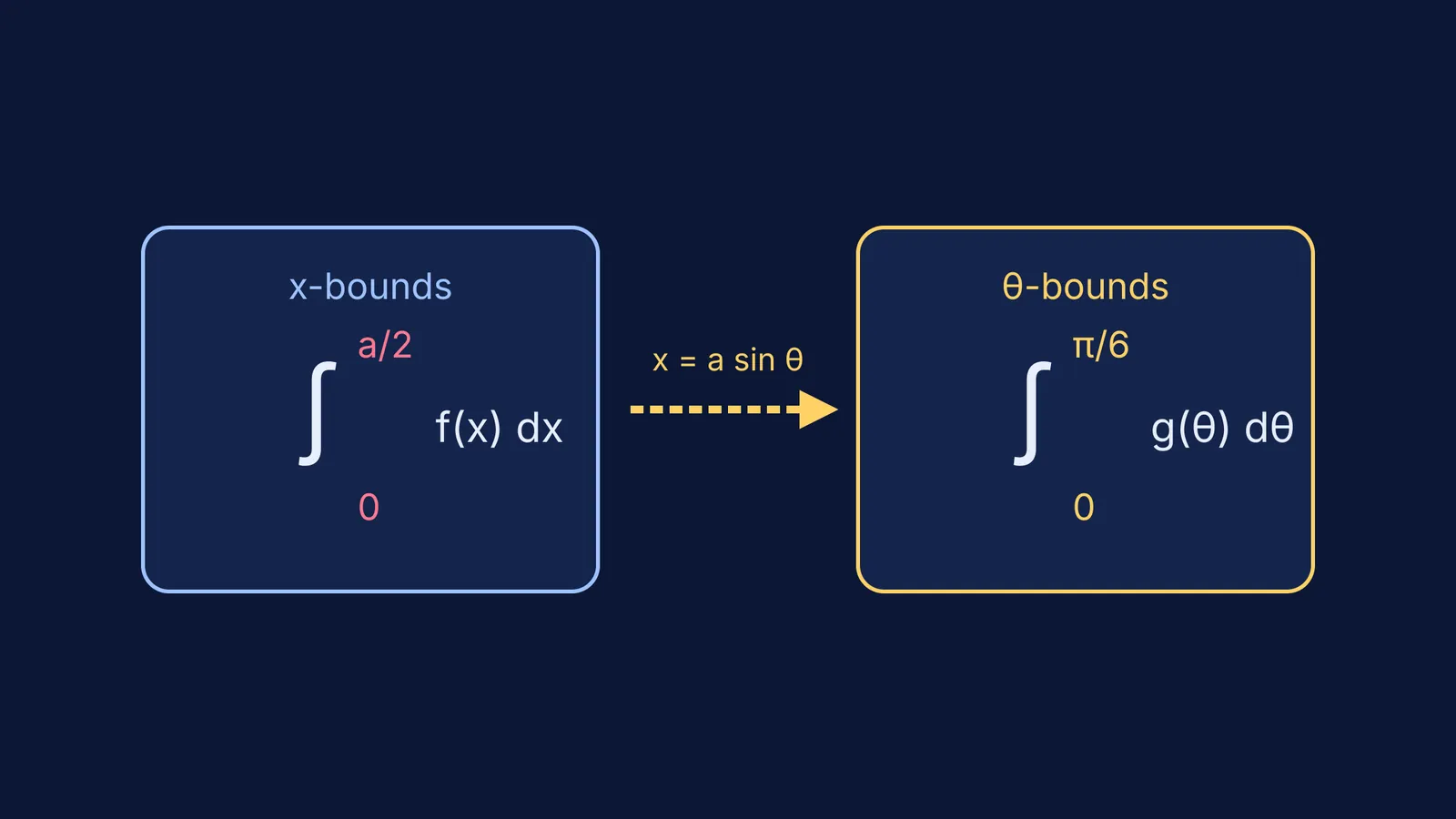
The most reliable way to avoid this is the "never go back" rule: convert the limits of integration at the exact moment you change the variable, and never return to x.
Why use a trigonometric substitution?
Consider the definite integral: ∫ (from 0 to a/2) √(a² − x²) dx
The expression √(a² − x²) hints at the substitution x = a sin θ, because it allows you to use the identity 1 − sin² θ = cos² θ. (You can review the standard results for integrals of √(a² − x²) and √(x² ± a²)).
First, differentiate your substitution to find dx: x = a sin θ dx = a cos θ dθ
How to change limits for a definite integral with x = a sin θ?
This is the step where you build a bridge to the new variable. The original limits, 0 and a/2, are values of x. We must find the corresponding values of θ.
Use your substitution equation: x = a sin θ.
For the lower limit: Substitute x = 0: 0 = a sin θ sin θ = 0 θ = 0
For the upper limit: Substitute x = a/2: a/2 = a sin θ sin θ = 1/2 θ = π/6
You have now completely mapped the boundaries from the x-world to the θ-world.
How do you evaluate the new integral?
Now, substitute everything into the original integral: ∫ (from 0 to π/6) √(a² − a² sin² θ) × (a cos θ dθ)
Simplify the expression under the square root: √(a²(1 − sin² θ)) = √(a² cos² θ) = a cos θ
The integral becomes: ∫ (from 0 to π/6) (a cos θ) × (a cos θ) dθ = a² ∫ (from 0 to π/6) cos² θ dθ
To integrate cos² θ, use the double-angle identity: cos² θ = (1 + cos 2θ) / 2. = (a² / 2) ∫ (from 0 to π/6) (1 + cos 2θ) dθ
Now, integrate and evaluate using your *new* limits, with no need to convert back to x (just as you would with u-substitution with bounds): = (a² / 2) [θ + (sin 2θ)/2] evaluated from 0 to π/6
Plug in the upper limit (π/6): (π/6) + (sin(π/3))/2 = π/6 + (√3)/4
Plug in the lower limit (0): 0 + (sin 0)/2 = 0
Subtract the lower evaluation from the upper: = (a² / 2) [π/6 + (√3)/4 - 0] = a² (π/12 + √3 / 8)
By changing the limits, we bypassed the messy process of converting cos² θ back into an algebraic expression in x.
How can an AI tutor help spot integration errors?
Integration problems require holding multiple pieces of information in your working memory. When you practice in the Fermi Problem Library, the AI tutor holds a line of reasoning across a whole session and notices where you are stuck. If you set up a trigonometric substitution but forget to change the bounds, it will decide whether to explain, ask, or show you the missing step.
Because calculus builds heavily on earlier foundations, gaps in trigonometric identities or limit logic can slow you down. The Fermi Concept Library holds every concept in mathematics, each with its own lesson and its place in the map, helping you trace back and repair those foundations.
What is the best checklist for definite integration?
When tackling a definite integral by substitution in an exam like JEE or your board finals, use this three-step sequence:
Define the substitution: Write down x = g(θ) and find dx.
Translate the boundaries: Write "When x = [lower], θ = ..." and "When x = [upper], θ = ...". Box these new limits so you do not lose them.
Burn the bridge: Rewrite the integral purely in terms of θ and its new limits. Do not write a mixed integral with both x and θ.


