

On this page
A triangular number, Tₙ, represents the number of dots needed to form an equilateral triangle with a base of n dots. You encounter these numbers in everyday life: the 10 pins in a bowling alley form T₄, and the 15 balls in a pool rack form T₅. The sequence begins 1, 3, 6, 10, 15, 21, 28, and so on.
While they seem like simple counting tools, these sequences hide deep mathematical connections. When you look closely at these numbers, a striking geometric and algebraic relationship emerges between consecutive terms, bridging the gap between one-dimensional integer sequences and two-dimensional geometry.
What happens when you add two consecutive triangular numbers?
If you take any two consecutive triangular numbers and add them together, the result is always a perfect square. This rule is consistent no matter how far along the sequence you look.
For example, adding the first two triangular numbers, T₁ (1) and T₂ (3), gives 4, which is exactly 2². Adding T₂ (3) and T₃ (6) gives 9, which is 3². Adding T₃ (6) and T₄ (10) gives 16, which is exactly 4². Moving further up, adding T₄ (10) and T₅ (15) gives 25, which is 5².
This beautiful connection links one-dimensional integer sequences directly to two-dimensional geometry, a foundational property of figurate numbers (Wikipedia). This specific relationship is often called the theorem of Theon of Smyrna, named after the ancient Greek philosopher and mathematician who first recorded it.
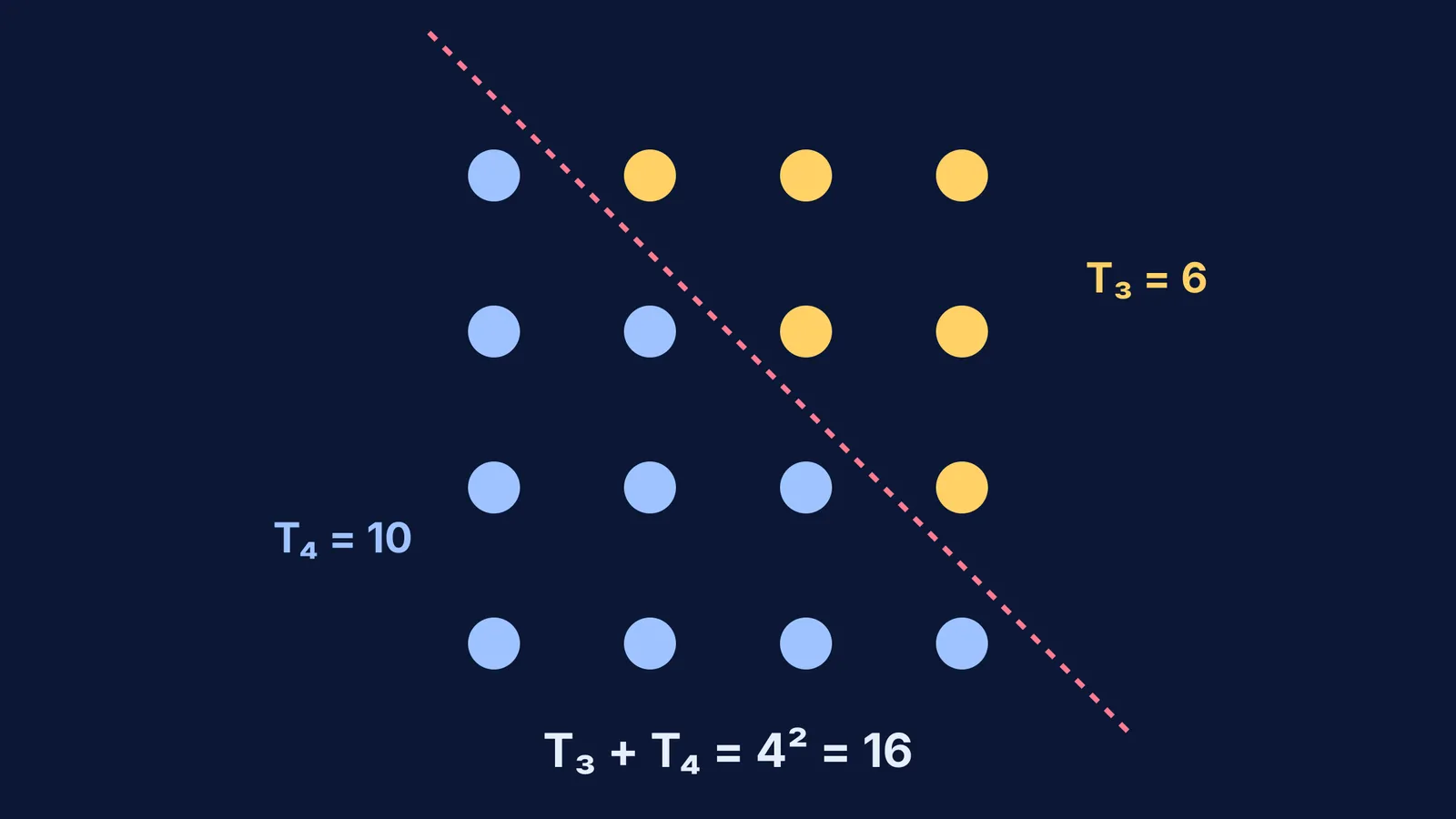
To see why this works visually, imagine T₄ as a right-angled triangle made of 10 dots: 4 dots on the bottom row, 3 above it, then 2, then 1 at the top. Now take T₃, which is 6 dots (3 on the bottom, then 2, then 1). If you rotate the T₃ triangle upside down and slide it next to the T₄ triangle, their staggered edges slot together perfectly. The 4-dot base of T₄ and the 4-dot height of the flipped T₃ combine to form a solid 4 by 4 square grid of exactly 16 dots.
Why does the sum of two consecutive triangular numbers make a square?
Visual proofs are powerful, but we can also prove this property algebraically. The general formula for the nth triangular number is Tₙ = n(n + 1)/2.
Let's write out the sum of Tₙ and the very next triangular number, Tₙ₊₁. To find the formula for Tₙ₊₁, we simply replace n with (n + 1) in our standard formula, giving us (n + 1)(n + 2)/2.
Tₙ + Tₙ₊₁ = [n(n + 1)/2] + [(n + 1)(n + 2)/2]
Because both terms in the addition share a common algebraic factor of (n + 1)/2, we can extract it to simplify the expression: Tₙ + Tₙ₊₁ = [(n + 1)/2] × [n + (n + 2)] Tₙ + Tₙ₊₁ = [(n + 1)/2] × [2n + 2]
Next, we factor out the 2 from the second bracket to simplify the multiplication: Tₙ + Tₙ₊₁ = [(n + 1)/2] × 2(n + 1)
The division by 2 and multiplication by 2 cancel each other out entirely, leaving us with: Tₙ + Tₙ₊₁ = (n + 1)(n + 1) Tₙ + Tₙ₊₁ = (n + 1)²
The algebra perfectly mirrors the geometry. The individual triangular dots combine to make an (n + 1) × (n + 1) geometric square.
If you get stuck picturing algebraic rearrangements, Fermi's AI tutor can draw the figure on a digital board and hold a line of reasoning until the pattern clicks. Alternatively, you can browse and learn about foundational mathematical sequences in the Fermi Concept Library.
Why is 8Tₙ + 1 always an odd perfect square?
There is another fascinating and highly practical property hidden in triangular numbers: if you multiply any triangular number by 8 and add 1, the result is always an odd square number. As noted by Wikipedia, this fundamental relationship provides a quick way to identify whether a large number belongs to the sequence.
Let's test this practical rule with T₃ (which is 6): 8 × 6 + 1 = 48 + 1 = 49, which is exactly 7².
Testing T₄ (which is 10): 8 × 10 + 1 = 80 + 1 = 81, which is exactly 9².
Algebraically, we start by substituting the standard formula for Tₙ into the new expression: 8Tₙ + 1 = 8[n(n + 1)/2] + 1
Simplifying the fraction by dividing 8 by 2 gives: 8Tₙ + 1 = 4n(n + 1) + 1
Expanding the brackets yields: 8Tₙ + 1 = 4n² + 4n + 1
This resulting expression is the standard algebraic expansion of the binomial (2n + 1)². Because multiplying any integer by 2 creates an even number, adding 1 means the term 2n + 1 is always an odd number. Therefore, squaring it guarantees that (2n + 1)² is an odd perfect square.
How can you use this property in exams?
Recognising these algebraic patterns is a powerful problem-solving tool. When an exam question asks you to verify if a large number x is triangular, you do not need to guess sequences. Instead, you can reverse the rule: check if 8x + 1 is a perfect square.
For example, is 210 a triangular number? Calculate 8 × 210 + 1, which equals 1681. The square root of 1681 is 41 (an odd whole number), meaning 210 is indeed a valid triangular number. In this case, since 2n + 1 = 41, we can solve for n to find that 2n = 40, so n = 20. Therefore, 210 is the 20th triangular number (T₂₀).
If you were asked to find the triangular root of an even larger number, such as 1275, the same test applies. Calculating 8 × 1275 + 1 yields 10201. The square root of 10201 is 101, which is an odd integer. Setting 2n + 1 = 101 gives 2n = 100, meaning n = 50. The number 1275 is simply T₅₀.
Much like finding Aⁿ for a matrix by spotting the pattern or recovering aₙ from a formula for Sₙ, linking geometric shapes to algebraic expansions saves you from memorising isolated rules and significantly speeds up your calculations.


