

On this page
The series 1, 3, 6, 10, 15, … comes up in Class 11 sequences and series, in JEE Main preparation, and in puzzles about handshakes and stacked balls. It looks like an AP but isn't one. Here is the nth term worked out step by step, then the sum, with checks you can run in your head.
What is the nth term of 1, 3, 6, 10, 15?
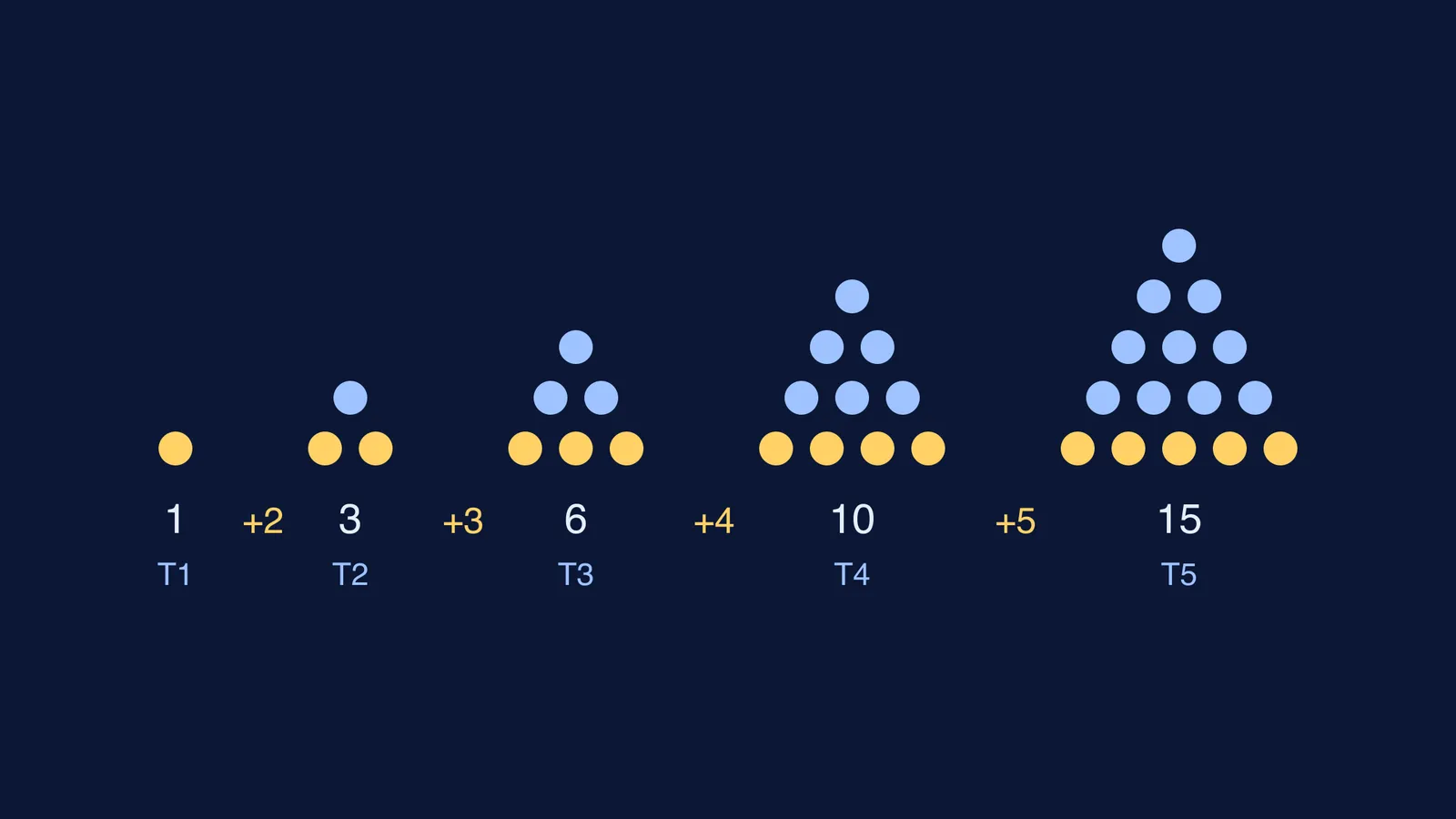
The nth term is Tₙ = n(n + 1)/2. The OEIS entry for the triangular numbers defines them as 0 + 1 + 2 + … + n = n(n + 1)/2, and lists the terms from 0: 0, 1, 3, 6, 10, 15, 21, 28, 36, 45, 55.
The name comes from the picture: rows of 1, 2, 3, … dots make a triangle, and Tₙ counts the dots in n rows. Check against the list: T₁₀ = 10 × 11/2 = 55.
How do you find Tₙ using differences?
The gaps between terms keep growing, so the method of differences tells you what kind of formula to look for.
Write the first differences: 3 − 1, 6 − 3, 10 − 6, 15 − 10 give 2, 3, 4, 5.
Write the second differences: 1, 1, 1. They are constant.
Constant second differences mean Tₙ is a quadratic, Tₙ = an² + bn + c, and the second difference equals 2a. So 2a = 1 and a = 1/2.
Use two terms to find b and c. T₁ = 1 gives a + b + c = 1. T₂ = 3 gives 4a + 2b + c = 3. Subtract to get 3a + b = 2, so b = 1/2 and then c = 0.
That gives Tₙ = n²/2 + n/2 = n(n + 1)/2.
The first differences tell you something too. Each term adds the next whole number, so Tₙ = Tₙ₋₁ + n. In the hero diagram, the gold row is that new n.
For harder series, see our guide to the method of differences for series.
What is the sum of the first n triangular numbers?
The sum is Sₙ = n(n + 1)(n + 2)/6. The OEIS entry for the tetrahedral numbers gives this formula and describes the sequence as the partial sums of the triangular numbers: 1, 4, 10, 20, 35, 56.
Here is the derivation. Split Tₙ into two standard sums:
Sₙ = Σ k(k + 1)/2 = (1/2)(Σ k² + Σ k)
Σ k² = n(n + 1)(2n + 1)/6 and Σ k = n(n + 1)/2
So Sₙ = (1/2) × n(n + 1) × [(2n + 1)/6 + 3/6] = (1/2) × n(n + 1) × (2n + 4)/6
That simplifies to Sₙ = n(n + 1)(n + 2)/6
Check it with n = 4: 1 + 3 + 6 + 10 = 20, and 4 × 5 × 6/6 = 20.
The same entry gives the picture: the nth tetrahedral number counts the balls in a triangular pyramid with n balls on each edge, so a 4-layer pile holds 20.
Where does this show up in exam questions?
It usually shows up in disguise. Three examples you can work through:
Sum of the first 20 triangular numbers. 20 × 21 × 22/6 = 1540.
The series 2, 6, 12, 20, …. Each term is n(n + 1), which is 2Tₙ. So the nth term is n(n + 1) and the sum of the first n terms is n(n + 1)(n + 2)/3.
Handshakes. The OEIS triangular-number entry notes that Tₙ is the number of handshakes among n + 1 people. So 10 people shake hands T₉ = 45 times. Our post on counting handshakes and league matches works through this with nC2.
In nCr form, Tₙ = (n + 1)C2 and the tetrahedral sum is (n + 2)C3, as both OEIS entries note.
What mistakes should you check for?
Run this checklist before you move on:
AP formula on a non-AP. The first differences are 2, 3, 4, 5, not constant, so a + (n − 1)d does not apply.
Mixing up Tₙ and Sₙ. T₄ = 10, but S₄ = 20.
Off-by-one counting. For handshakes among m people, the answer is Tₘ₋₁, not Tₘ.
Skipping the check. Put n = 1 and n = 2 into any formula you derive. T₁ should be 1, and S₂ should be 4.
The Fermi Problem Library has worked problems with a step-by-step solver that explains the reasoning, so you can compare its steps with yours. If the gap is in an earlier idea, such as Σ k², the Fermi Concept Library gives each mathematics concept its own lesson.
For the rest of the chapter, from APs and GPs to special series, see our overview of sequences and series for JEE.


