

On this page
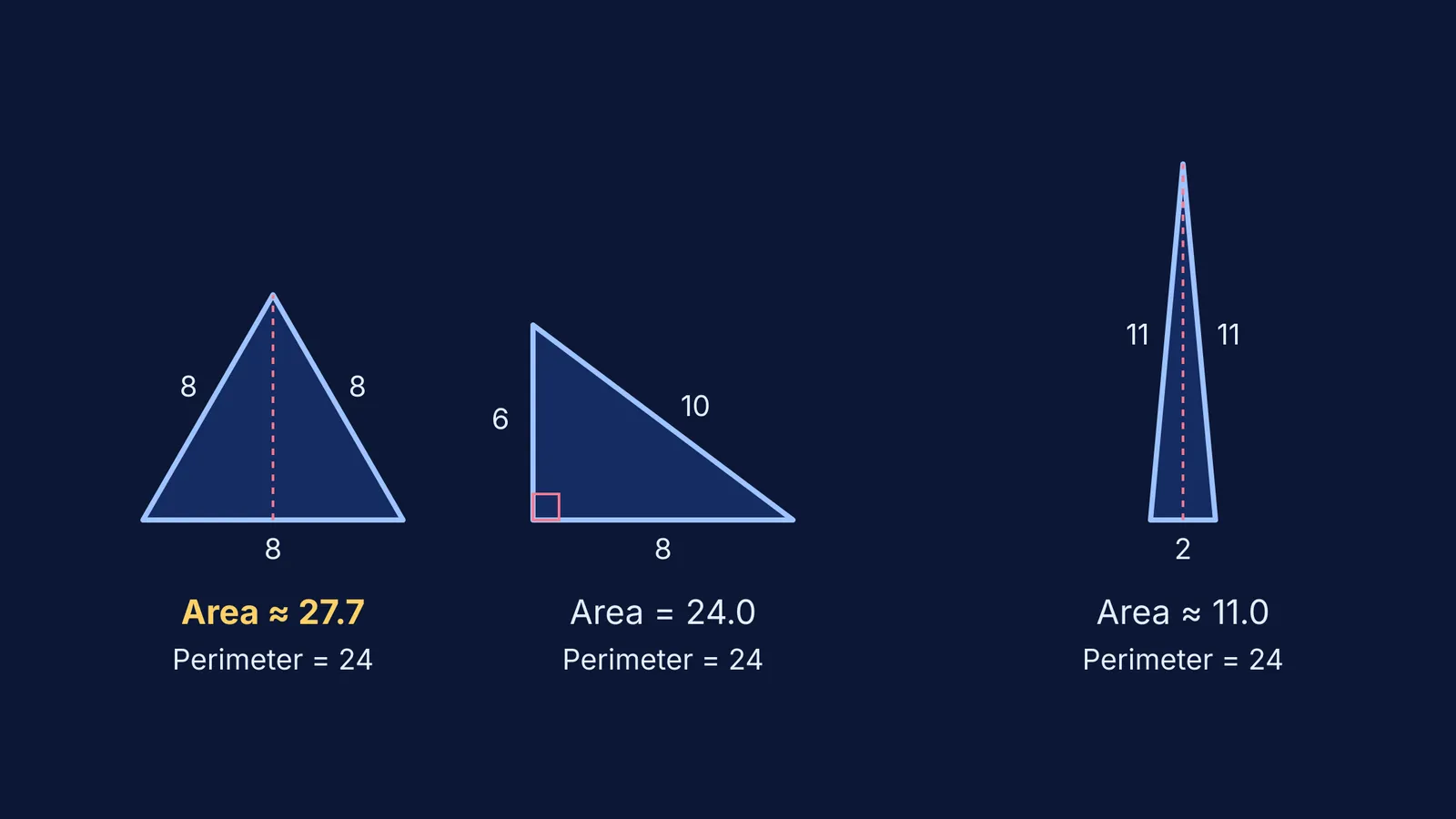
If you have a fixed length of wire and need to bend it into a triangle, you might wonder: which shape captures the most space inside? It turns out that to get the maximum area for a given perimeter, you should always form an equilateral triangle.
This geometric rule is a specific case of the isoperimetric inequality for triangles, which states that for any triangle with perimeter L and area A, the relationship L² ≥ 12√3A must hold true. This means the area is capped by the perimeter, and equality—the absolute maximum area—is reached only when all three sides are equal.
Here is how we can prove it algebraically using Heron's formula and the AM-GM inequality, followed by a quick calculus check to verify our reasoning.
How do we prove it with Heron's formula and AM-GM?
Heron's formula gives us the area A of any triangle without needing to know its height. If a triangle has side lengths a, b, and c, its semi-perimeter is s = (a + b + c) / 2. The area is:
A = √(s(s - a)(s - b)(s - c))
Since our perimeter is fixed, the semi-perimeter s is just a constant number. To maximize A, we simply need to maximize the product of the remaining three terms: (s - a)(s - b)(s - c).
This is where the AM-GM inequality comes in. The Arithmetic Mean-Geometric Mean (AM-GM) inequality states that the product of positive numbers is largest when all the numbers are equal. Applying this to our three terms:
(s - a) × (s - b) × (s - c) ≤ ( ((s - a) + (s - b) + (s - c)) / 3 )³
Let us simplify the right side. The numerator is 3s - (a + b + c). But we know that a + b + c = 2s, so the numerator becomes 3s - 2s = s. The inequality simplifies to:
(s - a)(s - b)(s - c) ≤ (s / 3)³
To achieve this maximum possible value, the terms we averaged must be identical:
s - a = s - b = s - c
For this to be true, the side lengths must be exactly the same (a = b = c). This algebraic proof guarantees that the equilateral triangle provides the maximum possible area.
Is there a calculus check for isosceles triangles?
We can also confirm this result using standard derivatives. Let us assume the optimal shape is an isosceles triangle with two equal sides of length x and a base of length P - 2x, where P is the fixed perimeter.
The semi-perimeter is s = P / 2. Using Heron's formula again, we can write an equation for the square of the area:
A² = (P / 2) × (P / 2 - x)² × (2x - P / 2)
To find the maximum area, we differentiate this function with respect to the side length x and set the derivative to zero. Applying the product rule gives:
d(A²) / dx = P(P / 2 - x)(P - 3x)
For the derivative to equal zero, either x = P / 2 (which would mean the base is zero, giving a flat line with no area) or P - 3x = 0.
Solving P - 3x = 0 gives x = P / 3. If the two equal sides are P / 3, then the third side is P - 2(P / 3) = P / 3. Once again, calculus brings us right back to the equilateral triangle.
How to apply this in your exams?
For students preparing for competitive exams like JEE Main or NEET-UG, this optimization principle appears frequently in physics and maths problems. For instance, if you are asked to shape a wire into a triangle to maximize the magnetic flux passing through it, you immediately know it must be equilateral.
You can combine this knowledge with the Fermi Concept Library to quickly verify your answers when working through geometry or electromagnetism problems. Remember that the Hero of Alexandria left us a toolkit that is still solving modern physics problems today. Whenever a question asks for a maximum area bounded by straight lines, look for symmetry—nature almost always prefers it.


