

On this page
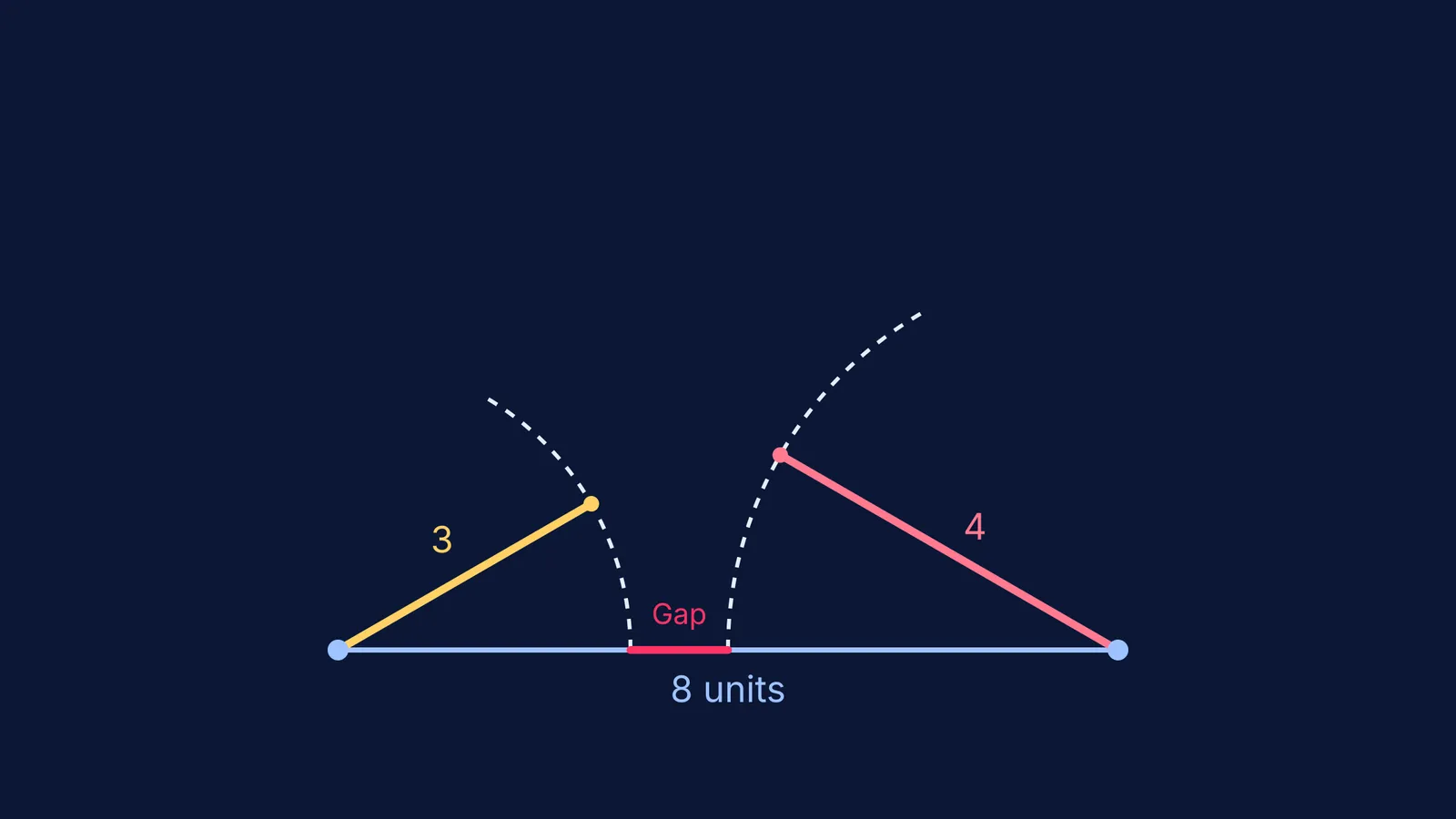
If you are asked, "Can 3, 4, and 8 be the sides of a triangle?", the quick answer is no. If you try to draw a triangle with these lengths, the two shorter sides will never meet.
In mathematics, the triangle inequality theorem states that for any triangle in Euclidean space, the sum of the lengths of any two sides must be strictly greater than the length of the third side. Because 3 + 4 = 7, and 7 is not greater than 8, these three lengths fail the mathematical test.
Here is why it works physically: the shortest distance between two points is a straight line. If you travel along a base of 8 units, any detour through a third point must necessarily be longer than 8 units. A path that travels 3 units and then 4 units only covers 7 units of distance in total. That is not enough to bridge a gap of 8 units, meaning the sides would hang in the air without connecting.
How do you quickly check if three sides form a triangle?
You do not need to test all three combinations of sides to see if a triangle is possible. The fastest way to check is to add the two smallest numbers. If their sum is strictly greater than the largest number, the triangle works.
Example 1: Sides of 4, 5, and 7. Add the two smallest sides (4 + 5 = 9). Since 9 is greater than 7, a triangle is possible.
Example 2: Sides of 5, 5, and 12. Add the two smallest sides (5 + 5 = 10). Since 10 is less than 12, a triangle is impossible.
Example 3: Sides of 6, 8, and 10. Add the two smallest sides (6 + 8 = 14). Since 14 is greater than 10, a triangle is possible (this happens to be a right-angled triangle).
If you are preparing for exams, keeping basic rules like this organised can save you time. The Fermi Concept Library maps out every core concept in geometry, giving each rule its own lesson and showing how it fits into the wider mathematical map.
How do you find the range of the third side?
A common variation of this problem in exams gives you two sides and asks for the possible lengths of the third side. This tests your understanding of the upper and lower limits of the triangle inequality.
For example: *If a triangle has sides of 6 and 10, what are the possible lengths for the third side, x?*
The third side must be shorter than the sum of the other two sides, but it must also be longer than their difference.
Find the upper limit (the sum): Add the two sides together. 6 + 10 = 16. So, x must be strictly less than 16. If x were 16 or larger, the two shorter sides would not be able to reach across it.
Find the lower limit (the difference): Subtract the smaller side from the larger side. 10 − 6 = 4. So, x must be strictly greater than 4. If x were 4 or smaller, the side of 6 and the side of x would not be long enough to bridge the side of 10.
The third side can therefore be any length strictly between 4 and 16. In mathematical notation, this is written as 4 < x < 16.
If you get stuck on setting up inequalities for limits like these, the Fermi Problem Library provides worked problems with a step-by-step solver that explains the reasoning behind the limits rather than just printing the final range.
How do you solve triangle inequality problems with variables?
In higher-level exams like JEE Main, you might see triangle inequality problems where the sides are given as algebraic expressions rather than plain numbers.
For instance, a question might ask: *For what values of x can x, x + 2, and 2x - 1 form a triangle?*
To solve this, you must apply the theorem systematically by testing all three combinations and finding the overlap where all three inequalities are true at the same time:
First pair: x + (x + 2) > 2x - 1, which simplifies to 2x + 2 > 2x - 1. This leaves 2 > -1, which is always true.
Second pair: x + (2x - 1) > x + 2, which simplifies to 3x - 1 > x + 2. Solving this gives 2x > 3, so x > 1.5.
Third pair: (x + 2) + (2x - 1) > x, which simplifies to 3x + 1 > x. Solving this gives 2x > -1, so x > -0.5.
Because a triangle must also have positive side lengths, we know x must be positive. Looking at all the restrictions (x > 1.5, x > -0.5, and x > 0), the strictest condition is x > 1.5. Therefore, the expressions can only form a triangle if x is strictly greater than 1.5.
Practising this structured approach—checking the sum of the smallest two sides for simple numbers, and testing all three inequalities for variables—will prepare you for both straightforward school questions and complex competitive exam problems.


