

On this page
In vector algebra, the magnitude of a sum is not simply the sum of the magnitudes. Whether you are dealing with displacement in a physics problem or complex numbers in mathematics, the resultant vector depends entirely on the angle between the components.
The mathematical rule that sets the definitive upper bound for this resultant is called the triangle inequality.
What is the triangle inequality for vectors mod a plus b?
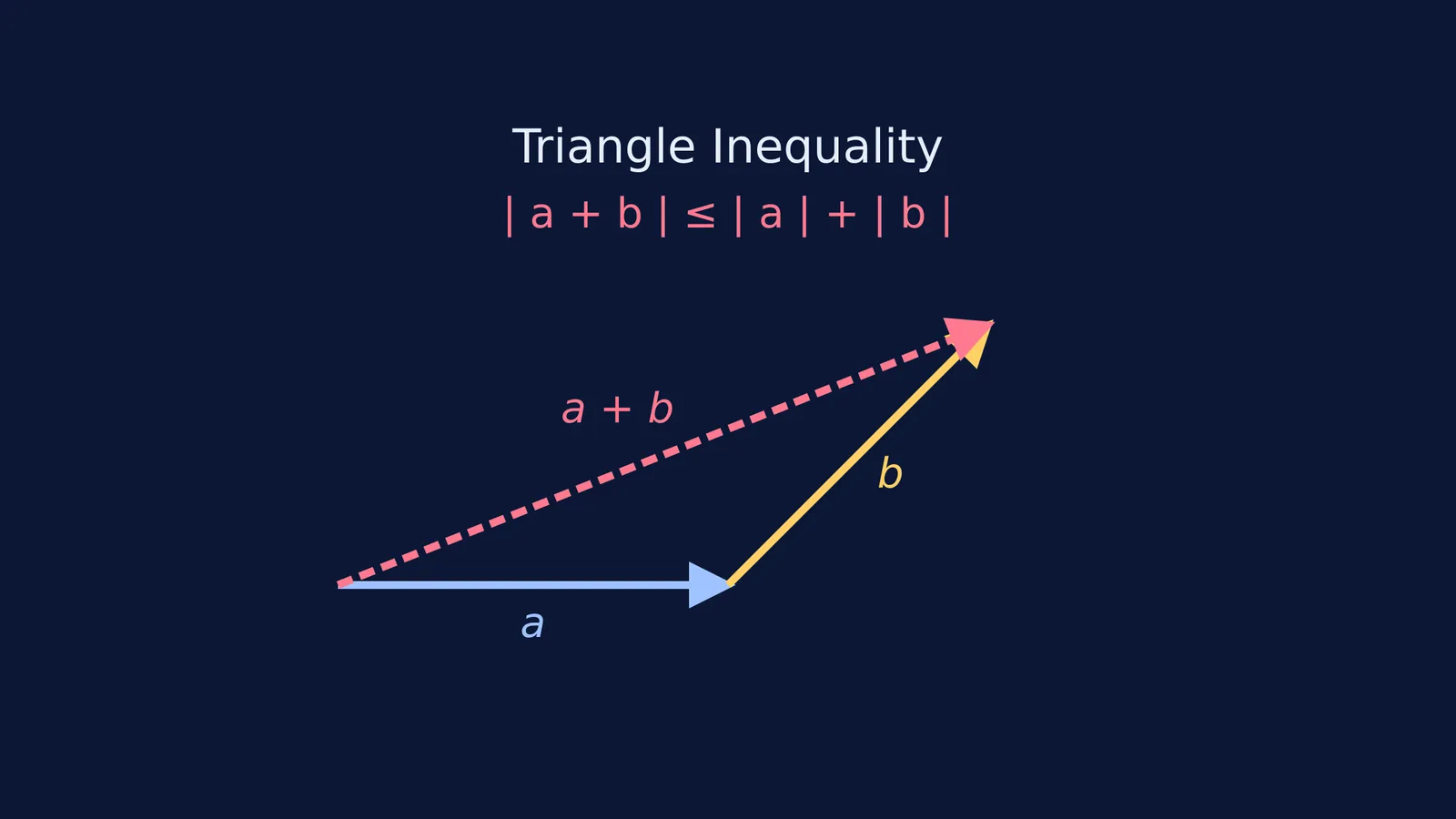
The triangle inequality states that for any two vectors, the magnitude (or modulus) of their sum is less than or equal to the sum of their individual magnitudes. In mathematical notation, this fundamental rule is written as:
|a + b| ≤ |a| + |b|
You can see why this works intuitively by drawing the vectors head-to-tail. When you add vector b to vector a, they form two sides of a geometric triangle. The vector sum, a + b, forms the third side, closing the loop from the start of the first vector to the tip of the second.
Because the shortest distance between two points in flat space is a straight line, the length of the third side of a triangle is never greater than the path along the first two sides. This geometric constraint holds true regardless of whether your vectors are in two dimensions (a flat plane) or three dimensions (a spatial volume).
When does equality hold for the triangle inequality?
The strict inequality (|a + b| < |a| + |b|) applies whenever the two vectors point in different directions. The only time the magnitude of the sum exactly equals the sum of the magnitudes is when the vectors point in the exact same direction.
If vector a and vector b are completely parallel and point the same way, the "triangle" collapses into a single flat line segment. Only in this one specific case does |a + b| = |a| + |b|. If you keep making sign errors in vector algebra or confusing parallel and anti-parallel cases, Fermi's AI tutor can work out what you already know and build a plan for the session, checking understanding as it goes.
What is the reverse triangle inequality?
While the standard triangle inequality gives the absolute maximum possible length for the vector sum a + b, the reverse triangle inequality gives the absolute minimum. According to Wikipedia, this lower bound is defined by the absolute difference of their individual magnitudes:
||a| - |b|| ≤ |a + b|
This tells you that the resultant vector can never be shorter than the difference in length between the two original vectors. The sum drops to this strict minimum value only when the two vectors point in exactly opposite directions. In that scenario, the vectors partially cancel each other out.
How does the triangle inequality define distance?
Beyond vectors, the triangle inequality is a requirement for any function to be considered a proper measure of distance in a metric space. For any three points, the distance between the first and the third can never be greater than the distance through the second point.
This mathematical definition ensures that the shortest route between two points is a direct path. If taking a detour through a third point could somehow reduce the total distance, the space would violate the basic rules of geometry. The triangle inequality is the axiom that prevents this.
Does the triangle inequality apply to real numbers?
Yes, on the real number line, the triangle inequality is written using absolute values. For any real numbers x and y, the magnitude of their sum is at most the sum of their individual magnitudes:
|x + y| ≤ |x| + |y|
Equality holds only if x and y have the same sign, or if at least one of them is zero. This behaves exactly like the vector rule in one dimension.
Why is the triangle inequality reversed in Minkowski space?
In physics, there is one famous space where the triangle inequality is flipped: Minkowski space, which is used to describe spacetime in special relativity. For time-like vectors, the sum of their lengths is actually greater than or equal to the individual lengths.
This reversal forms the mathematical basis for the twin paradox. In relativity, the straight path through spacetime taken by an observer without acceleration actually results in the longest proper time, whereas a path with detours results in less time passing.
Distance vs displacement in physics
In basic kinematics, the standard triangle inequality perfectly explains the critical relationship between distance and displacement.
Displacement is the straight-line vector from your starting position to your finishing position, corresponding to the resultant |a + b|.
Distance is the total scalar path length you actually traveled, corresponding to the scalar sum |a| + |b|.
Because |a + b| ≤ |a| + |b|, your net displacement can never be physically greater than the distance you walked. For instance, if you walk East and then turn North, your total distance traveled is the addition of the two path lengths. However, because you changed direction, your net displacement is the straight-line hypotenuse. By Pythagoras, that straight line is strictly shorter than the total distance walked.
If you need help picturing how changing the angle affects the resultant vector across different scenarios, you can look up vector addition in the Fermi Concept Library.
For further reading on how these bounding vector rules extend to other branches of mathematics and algebra, you can explore the Triangle inequality for complex numbers: max and min of |z| or learn more about bounding lengths in basic geometry with Triangles in Class 7: inequality, angle sum and constructions.


