

On this page
A thin glass tube, closed at one end, holds a short pellet of mercury that traps some air. Turn the tube and the air column gets shorter or longer. This is a common question in school gas-law practice because it tests two ideas at once: Boyle's law and the pressure of a liquid column. Here is the method and one worked example covering every position.
Why does the air column change length when you turn the tube?
The trapped air is a fixed amount of gas at constant temperature, so Boyle's law applies: pressure times volume is constant, p × V = constant (NASA Glenn Research Center). The tube has the same cross-section A everywhere, so volume is A × L and A cancels. The only equation you need is P1 × L1 = P2 × L2.
What changes when you turn the tube is the pressure. The pellet sits still, so the forces on it balance: the air pushes on one face, the atmosphere on the other, and the mercury's weight helps one side or the other.
The pressure due to the weight of a fluid column is p = hρg, where h is the column's height (OpenStax University Physics, 14.2). That is why these problems use centimetres of mercury: a pellet with vertical height h adds or removes exactly h cmHg, with no density or g to plug in.
One standard atmosphere equals 760 mmHg, or 76 cmHg (OpenStax University Physics, 14.2). It is defined as exactly 101 325 newtons per square metre, fixed by the General Conference on Weights and Measures in 1954 (BIPM, CGPM Resolution 4). Some questions use 75 cmHg instead; always use the value given.
What is the pressure of the trapped air in each position?
Call atmospheric pressure H and the pellet length h, both in cm of mercury.
Horizontal: the mercury's weight acts across the tube, not along it. P = H.
Vertical, open end up: the atmosphere and the mercury both press on the air. P = H + h.
Vertical, open end down (inverted): the mercury hangs below the air. P = H − h.
Tilted at θ to the horizontal: only the pellet's vertical height, h sin θ, counts. P = H + h sin θ with the open end up, H − h sin θ with it down.
How long is the trapped air when the tube is inverted?
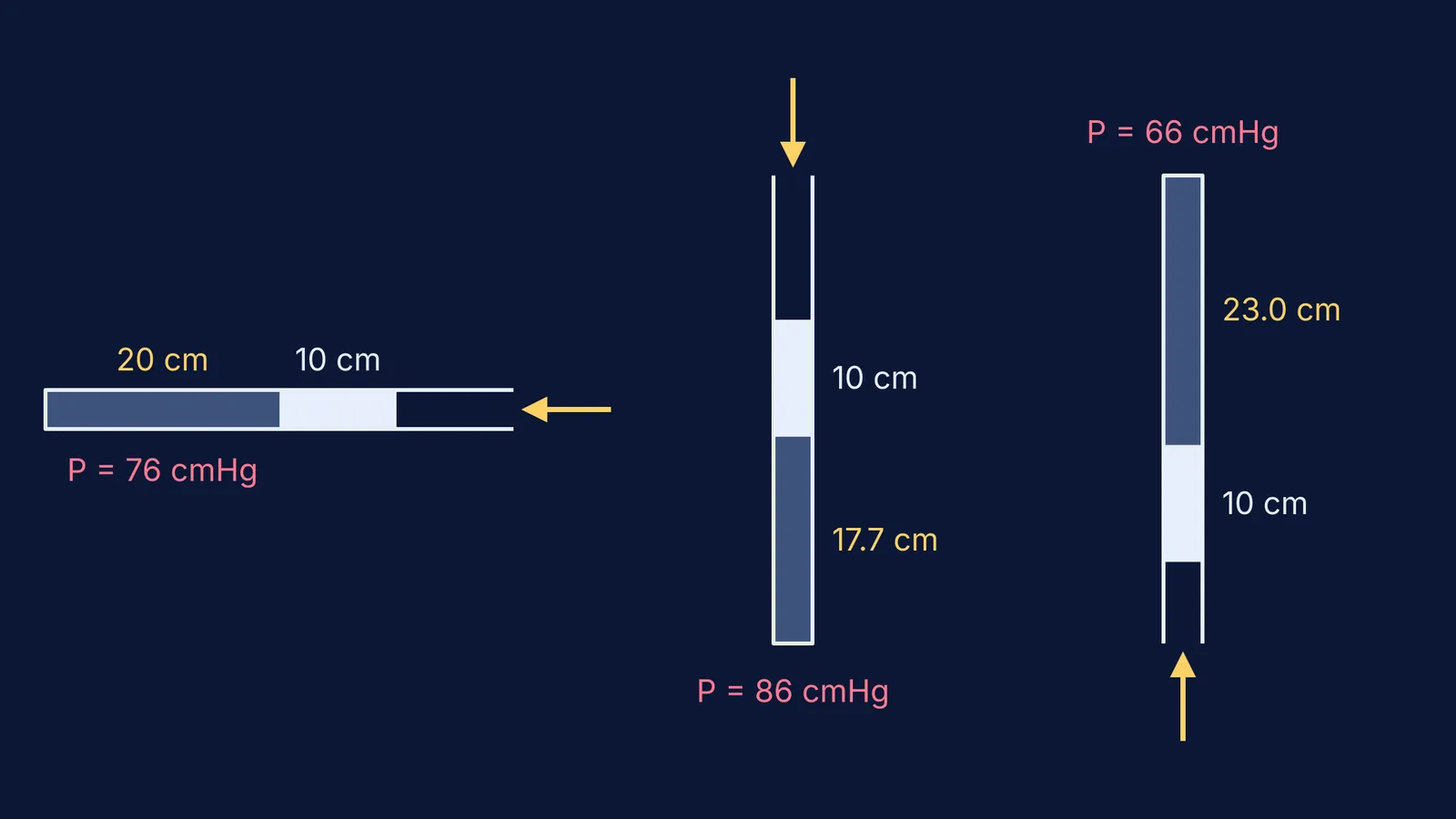
A uniform tube closed at one end lies horizontally. A 10 cm mercury pellet traps 20 cm of air. Atmospheric pressure is 76 cmHg, one standard atmosphere (OpenStax), and temperature is constant. Find the air column's length with the tube (a) vertical, open end up, (b) vertical, open end down, (c) at 30° to the horizontal, open end up.
Horizontal state: P1 = 76 cmHg and L1 = 20 cm, so P1 × L1 = 1520. This product stays the same in every position.
Open end up: P = 76 + 10 = 86 cmHg, so L = 1520 ÷ 86 = 17.7 cm.
Open end down: P = 76 − 10 = 66 cmHg, so L = 1520 ÷ 66 = 23.0 cm.
Tilted at 30°: vertical height = 10 × sin 30° = 5 cm, so P = 81 cmHg and L = 1520 ÷ 81 = 18.8 cm.
Check: upright is shorter than 20 cm, inverted is longer, and tilted sits between 17.7 and 20 cm.
For the inverted case, the tube must also be at least 23.0 + 10 = 33 cm long. If it is shorter, some mercury runs out, the pellet length becomes an unknown, and you set the problem up again.
Which mistakes cost marks in these questions?
Mixed units: keep every pressure in cmHg and both lengths in the same unit.
Pellet length instead of vertical height: in a tilted tube, use h sin θ.
Guessed signs: before writing H ± h, say which side of the air the mercury is on.
No spill check: if the tube length is given, test the inverted position.
Ignoring temperature: Boyle's law needs constant temperature; if the tube is heated or cooled, it alone will not give the answer.
For practice, solve all four positions from one starting state, then try a tube that starts upright and is inverted, so the first pressure is H + h. Our explainer on pressure at depth and gauge pressure covers p = hρg in more detail, the story of Torricelli's first barometer shows where the 76 cm comes from, and you can read about Robert Boyle and his air pump.
If your answers keep moving the wrong way, the Fermi Problem Library has worked problems with a step-by-step solver that explains the reasoning rather than printing an answer, so you can find the line where the sign flipped. If pressure itself is the gap, the Fermi Concept Library gives each physics concept its own lesson.
Solve the four positions once on paper today, without looking, and the next version of this question will feel routine.


