

On this page
If you are studying biology for your board exams, you will encounter two ways humans modify crops: hybridisation and transgenesis. Because both are used to create plants with better traits—like higher yield or disease resistance—they are easy to mix up.
However, they rely on entirely different mechanisms. One is an extension of natural reproduction, while the other requires a laboratory.
What is a hybrid plant?
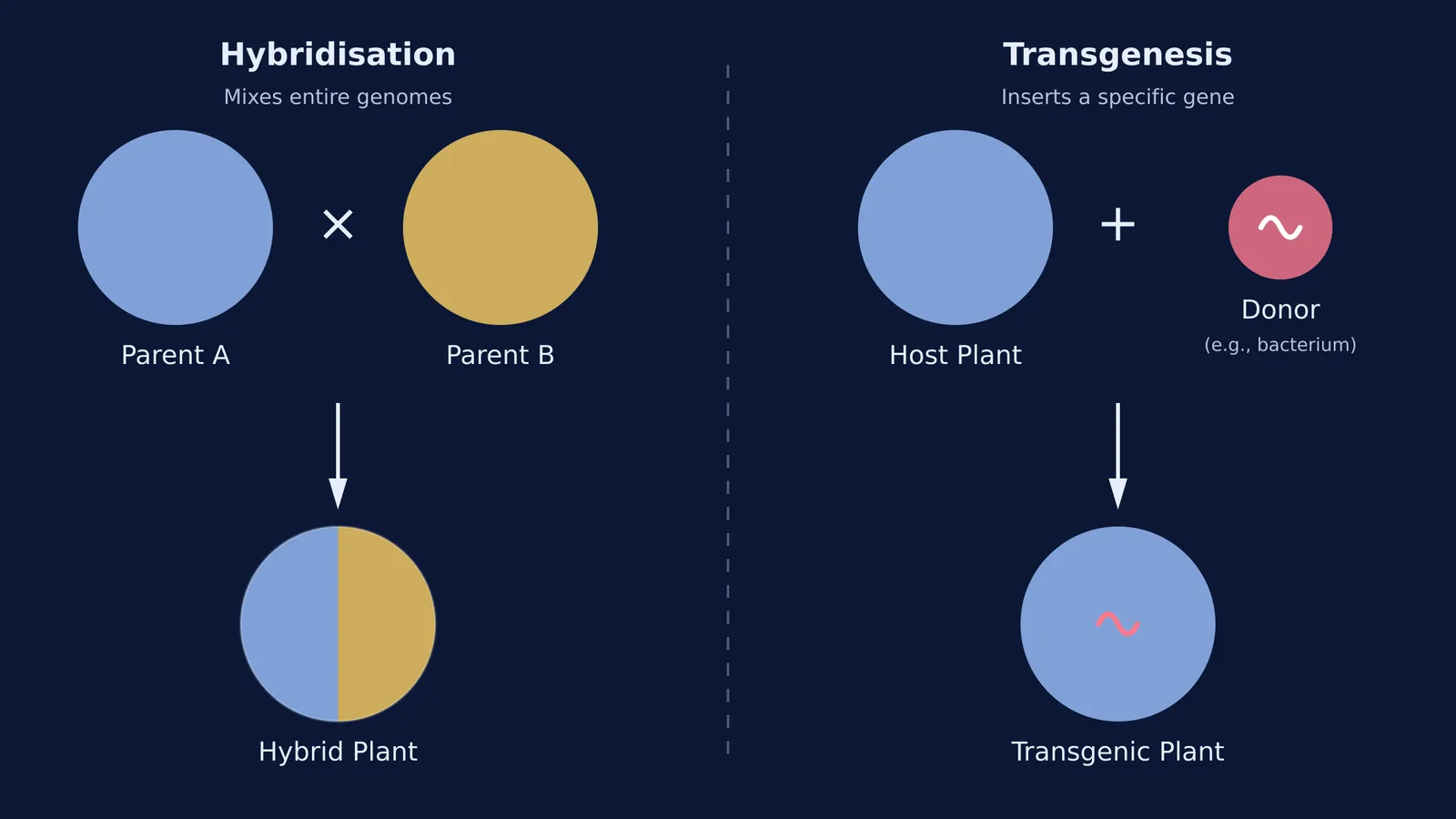
A hybrid plant is the offspring of two different varieties or closely related species. It is created through artificial hybridisation, where a breeder manually transfers pollen from a parent plant with one desirable trait to the flower of another.
Because it relies on sexual reproduction, the process recombines entire genomes. According to the U.S. Food and Drug Administration (FDA), changing plants through traditional breeding makes it difficult to make very specific changes. Along with the traits a breeder wants, the offspring inherits many unknown or unwanted genes from both parents. Humans have guided this process for thousands of years; for instance, the FDA notes that the first commercial hybrid corn was sold in 1922.
Crucially, hybridisation can only happen between plants that are biologically compatible enough to mate, meaning they must be closely related species. This biological barrier limits the range of new traits that can be introduced through conventional breeding.
What is a transgenic plant?
A transgenic plant is a type of Genetically Modified Organism (GMO). The World Health Organization (WHO) defines GMOs as organisms whose genetic material has been altered in a way that does not occur naturally by mating or natural recombination.
Instead of crossing two whole plants, scientists isolate a specific gene from one organism and insert it directly into the host plant's DNA using laboratory tools (such as getting DNA into cells via a gene gun or bacterial vector).
This approach has two defining features:
Precision: Instead of mixing entire genomes, genetic engineering transfers just one or a few targeted genes.
Species barriers: The donor gene can come from any living thing—a bacterium, an animal, or a completely unrelated plant. For example, *Bt* cotton contains a gene from a soil bacterium that makes it toxic to certain pests. (This technology is also used to make transgenic animals for medical research). Because the inserted gene is so specific, scientists can predict how the new plant will behave without worrying about hidden, unwanted genes tagging along.
The first consumer GMO product was human insulin produced by engineered bacteria in 1982, according to the FDA.
Checking your understanding
Biology exams often test whether you know when to apply these definitions. A quick way to test yourself is to check the origin of the new trait. If the question describes pollen transfer between two tomato varieties, it is hybridisation. If it describes a tomato receiving an antifreeze gene from a deep-sea fish, it is a transgenic plant.
If you struggle to remember these distinctions during a test, the Fermi Concept Library contains mapped lessons for every core idea in genetics. When you need to work through the mechanics of a cross or a genetic engineering problem, Fermi's AI tutor can help. The tutor teaches rather than answers: it holds a line of reasoning across a session, notices where a student is stuck, and decides whether to explain, ask or show, ensuring you actually understand the science before moving on.
A quick exam checklist
When reading a genetics question, ask yourself:
How did the trait move? Pollination means hybrid; laboratory insertion means transgenic.
How many genes moved? Entire genomes means hybrid; one or a few means transgenic.
Where did it come from? A related plant means hybrid; an unrelated species (like bacteria) means transgenic.


