

On this page
Have you ever struggled to loosen a tight nut with a short spanner, only to slip a pipe over the handle and loosen it easily? You applied the same force, but the nut turned because you applied it further away.
In mechanics, this turning effect is torque (τ). When you calculate torque, the answer always depends on which reference point you choose. A force that creates a massive torque about one pivot might create zero torque about another.
But in certain situations—like when an object is in perfect balance—a mathematical trick allows you to pick any reference point you like.
Why does torque change with the reference point?
Torque is defined as the cross product of a position vector (r) and a force vector (F): τ = r × F
(If you need a refresher on the cross product, review how to find torque as r × F with vectors).
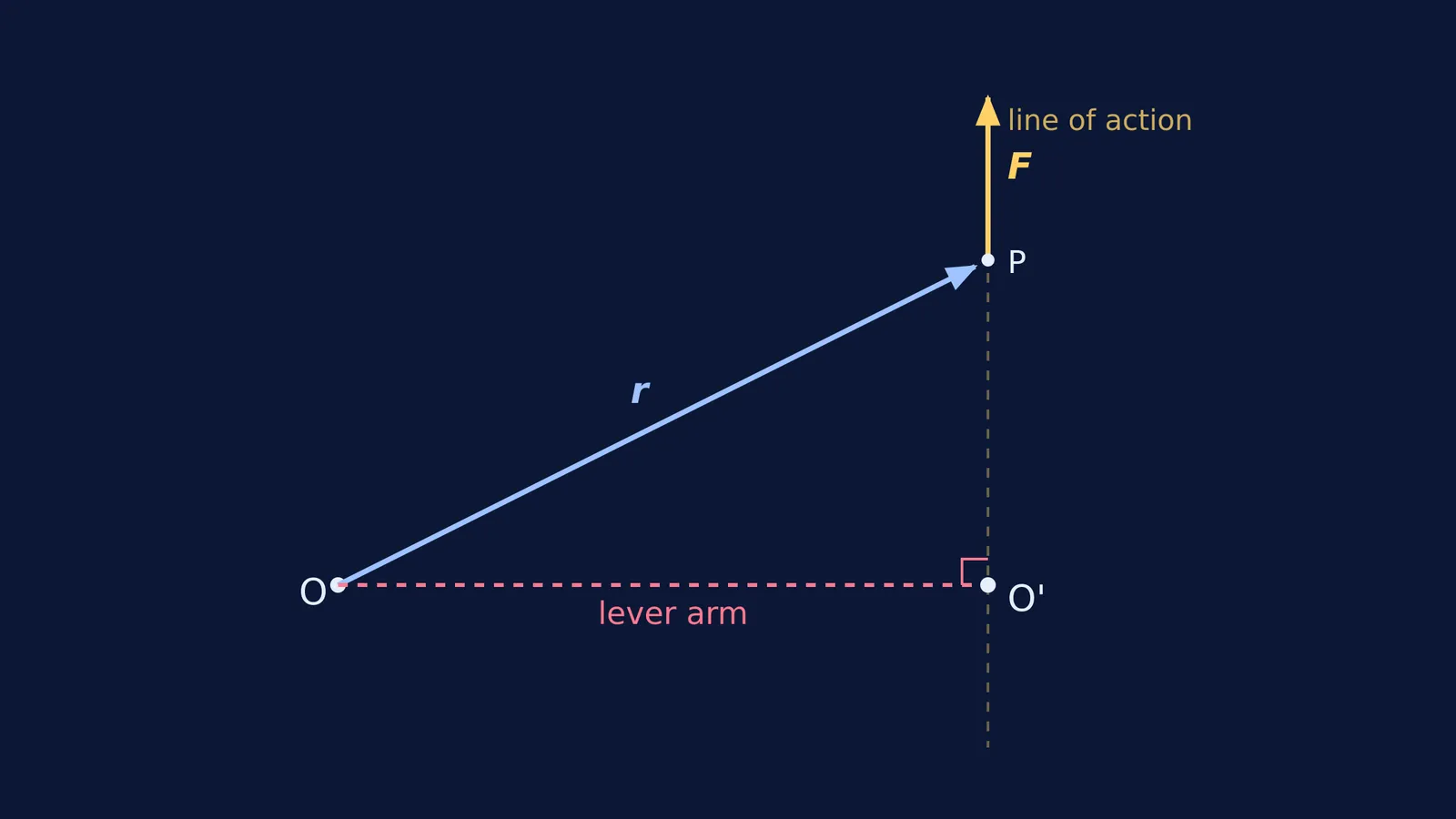
The position vector r is simply the arrow drawn from your chosen reference point to the place where the force is acting. If you choose a different reference point, you draw a different arrow.
The magnitude of torque is the force multiplied by the lever arm (the perpendicular distance from the reference point to the force's line of action). If you slide your reference point closer to the line of action, the lever arm shrinks, and the torque drops. If you place your reference point exactly on the line of action, the lever arm becomes zero, and that force produces zero torque.
What happens when the net force is zero?
Things change when you have multiple forces that cancel each other out. A classic example is a "couple"—two forces of equal size pointing in opposite directions, like your two hands turning a steering wheel.
The net force of a couple is zero. Because the forces pull equally in opposite directions, shifting your reference point increases the torque from one force by exactly the same amount that it decreases the torque from the other.
According to the open-source textbook *University Physics*, when the net external force on a rigid body is zero, the net torque becomes independent of the choice of reference point. You will calculate the exact same net turning effect whether you place your origin at the center of mass, at a hinge, or a mile outside the object.
How do you choose the best reference point?
If the net force is zero (which is true for any object in static equilibrium), you are free to calculate the net torque about any point. In exams like JEE Main and NEET-UG, choosing this point wisely is the difference between a one-minute solution and a page of messy algebra. It is a time-saving technique on par with knowing how to isolate a system to find the contact force between blocks pushed together on a smooth floor.
Find the unknowns: Look for reaction forces, hinge forces, or static friction forces that the question does not ask you to calculate.
Place your pivot there: Declare the location of those unknown forces as your reference point.
Write the torque equation: Because the unknown forces pass through your new origin, their lever arm is zero. They disappear from the equation, leaving only the forces you know and the one you want to find.
If you struggle to spot which reference point to use, you can build your intuition in the Fermi Concept Library. When you tackle a rigid body problem, Fermi's AI tutor does not just hand you the final equation. It asks you which forces you want to eliminate and helps you choose the perfect pivot point, teaching you to hold a clear line of reasoning across the session.
Once you know that torque depends on the point you take it about—and that equilibrium gives you the freedom to choose—every static mechanics problem becomes a simple search for the smartest pivot.


