

On this page
We often think of digestion as something that happens entirely in the stomach, but the process actually begins the moment food enters your mouth. The tongue is a strong, highly coordinated muscular organ. It not only tests your food for safety but also prepares it physically and chemically for the journey down the oesophagus.
How does the tongue help in digestion?
While your teeth do the heavy lifting of grinding food, they cannot do it alone. The tongue acts as a powerful mechanical mixer. It continuously moves food around, pressing it against the hard palate and sweeping it back between the teeth to ensure it is thoroughly crushed.
At the same time, the tongue ensures the food is saturated with saliva. A healthy adult produces about 1.5 litres of saliva every day. Saliva is about 99% water, but it carries a crucial enzyme called salivary amylase. By actively folding the food, the tongue guarantees that this enzyme is mixed evenly, allowing it to begin breaking complex starches down into simpler sugars before the food ever reaches the stomach.
If you need to visualise how enzymes like amylase bind to their targets, the Fermi Concept Library holds a lesson for every concept in biology, physics and chemistry. Understanding these interactions is central to mastering the six enzyme classes.
Where are the taste buds located?
As the tongue mixes your food, it also acts as a sophisticated chemical laboratory. The top surface of the tongue feels rough because it is covered in tiny, projecting bumps called papillae. Many students confuse these visible bumps with the taste buds themselves, but the papillae actually act as protective structures that house the microscopic taste buds deep within their walls.
There are three main types of papillae that contain taste buds. The large, circular circumvallate papillae form a 'V' shape at the very back of the tongue. The foliate papillae sit like ridges along the back edges, while the smaller, mushroom-shaped fungiform papillae are scattered across the tip and sides.
An average adult has between 2,000 and 8,000 taste buds. Most of these are located directly on the tongue's papillae, while the rest are scattered across the roof of the mouth, the epiglottis, and the throat. These receptors detect five primary flavours: sweet, sour, salty, bitter, and umami. This sensory feedback is an evolutionary survival mechanism that helps the body identify nutrient-dense foods and reject bitter, potentially toxic substances.
Taste bud cells live in a harsh environment of constant friction, acidic foods, and extreme temperatures. To maintain a sharp sense of taste, these sensory cells regenerate rapidly, with an average lifespan of just 10 days. When you accidentally burn your tongue on a hot drink, this rapid cell turnover is exactly why your sense of taste returns within a week or two.
How does the tongue push food down during swallowing?
Once the food is fully chewed and mixed with digestive enzymes, the tongue performs its final and arguably most important digestive task: deglutition, or swallowing.
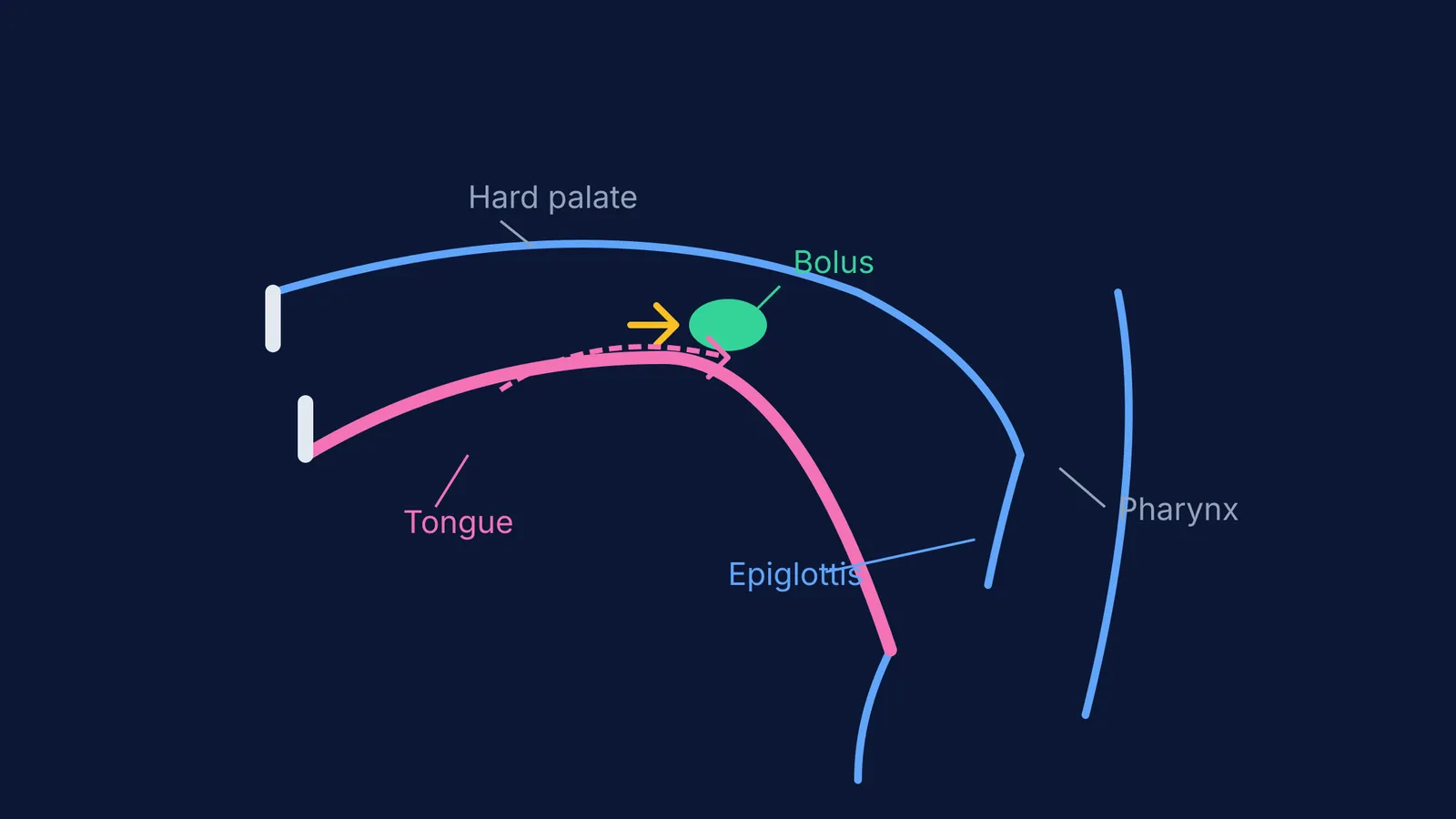
Without the tongue, moving food from the front of the mouth to the throat would be nearly impossible. The swallowing process happens in three precise, highly coordinated steps:
Bolus formation: The tongue curls its edges to gather the chewed, moistened food into a soft, cohesive ball known as a bolus.
Initiating the swallow: The tip of the tongue presses firmly against the hard palate, just behind the upper front teeth, anchoring itself in place.
Propulsion: Using that anchor for support, the body of the tongue rolls backwards in a wave-like motion, squeezing the bolus past the soft palate and into the pharynx (the throat).
This backwards push is the voluntary phase of swallowing, meaning you actively control it. However, the moment the bolus reaches the pharynx, it triggers a rapid involuntary reflex that you cannot stop. A small flap of cartilage called the epiglottis drops down to cover the windpipe (trachea). This mechanical seal ensures the food travels safely into the oesophagus rather than falling into your respiratory system.
Understanding this complex sequence of muscle movements and reflexes can be difficult from text alone. The Fermi Simulation Lab has interactive simulations for the ideas that are easier to see than to read, helping you picture exactly how the airway protects itself during a swallow.


