

On this page
You have probably experienced it in a biology classroom. The teacher begins a lesson on dominant and recessive alleles, and then asks everyone in the room to stick their tongue out and try to fold the sides upward into a U-shape. Those who can roll their tongues are told they carry a dominant gene, while the non-rollers possess two recessive copies.
It is a neat, binary way to introduce Mendelian genetics. It avoids drawing blood to check blood types, and it doesn't require waiting weeks for fruit flies to breed. The only problem is that the underlying science of this classroom staple is completely wrong.
Is tongue rolling really controlled by one gene?
The idea that tongue rolling is a simple Mendelian trait began in 1940. The prominent geneticist A. H. Sturtevant published a paper in the Proceedings of the National Academy of Sciences titled "A New Inherited Character in Man," where he originally suggested that the ability to roll the tongue was determined by a single dominant gene.
This simple, elegant explanation quickly found its way into biology textbooks around the world. However, modern geneticists classify tongue rolling as a complex or polygenic trait. Rather than a single on-off switch in your DNA, the ability is likely influenced by multiple different genes that affect muscle tone, tongue length, and motor control, combined with environmental factors such as practice and childhood development.
When the underlying science of a trait is this complex, it can be difficult for a student to picture how all those genes interact. This is exactly where the Fermi Simulation Lab helps, offering interactive simulations for the ideas that are easier to see than to read.
What did twin studies reveal about tongue rolling?
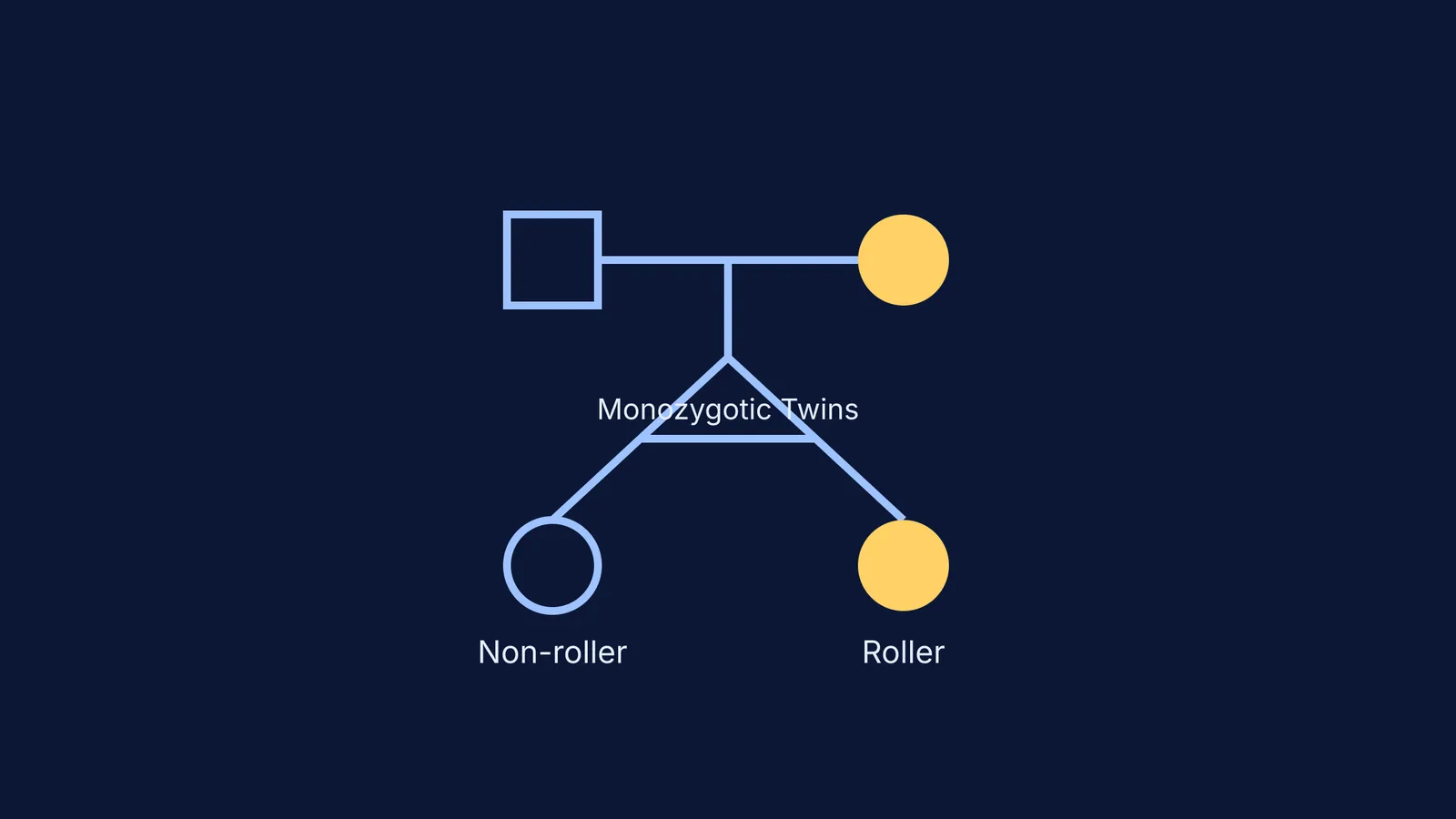
The most definitive proof against the "one gene" myth comes from studies of monozygotic (identical) twins. Because identical twins develop from a single fertilised egg that splits, they share all their DNA. If tongue rolling were strictly genetic, dictated by a single dominant allele, identical twins would always share the exact same ability to roll or not roll their tongues.
In a landmark 1952 study published in the Journal of Heredity, Philip Matlock tested this assumption by examining 33 pairs of identical twins. He found that 7 pairs (21%) were discordant, meaning one twin could roll their tongue while the exact genetic copy standing next to them could not. This 21% discordance rate proved once and for all that environmental factors or developmental differences must be involved in the ability. True single-gene conditions, such as Mendelian disorders: sickle-cell anaemia, thalassemia and PKU, do not behave this way. If one identical twin has a strictly genetic trait, the other will inevitably have it too.
Can you learn to roll your tongue?
If tongue rolling is not entirely genetic, where does the ability come from? Evidence suggests that for many people, it is a learned motor skill that develops with age and practice.
In 1951, the geneticist Taku Komai published a detailed study of Japanese schoolchildren in the Journal of Heredity. Komai found that at ages 6 to 7, approximately 54% of the children could roll their tongues. By the time the children reached age 12, the proportion of tongue rollers had significantly increased to 76%. This 22-percentage-point increase strongly suggests that many children simply learn the necessary muscle coordination as they grow. Some researchers have even noted that with concentrated practice in front of a mirror over a few weeks, people who initially could not roll their tongues can figure out how to do it.
Why does the tongue-rolling myth persist?
Sturtevant himself later realised his mistake. He publicly admitted that he was "embarrassed to see it listed in some current works as an established Mendelian case." Yet, the myth survives in classrooms today because it remains a convenient tool for teaching basic inheritance models like the Punnett square.
When a student brings a topic like this from school, contradictions between the textbook's simplified model and real-world science can cause unnecessary confusion. This is where Fermi's AI tutor steps in. Rather than just handing out a binary answer, Fermi works out what they already know, builds a plan for the session, and teaches through it, checking understanding as it goes.
If you need to revise genuine Mendelian inheritance for your upcoming exams, focus on standard, proven examples like test cross vs back cross to identify unknown genotypes.


