

On this page
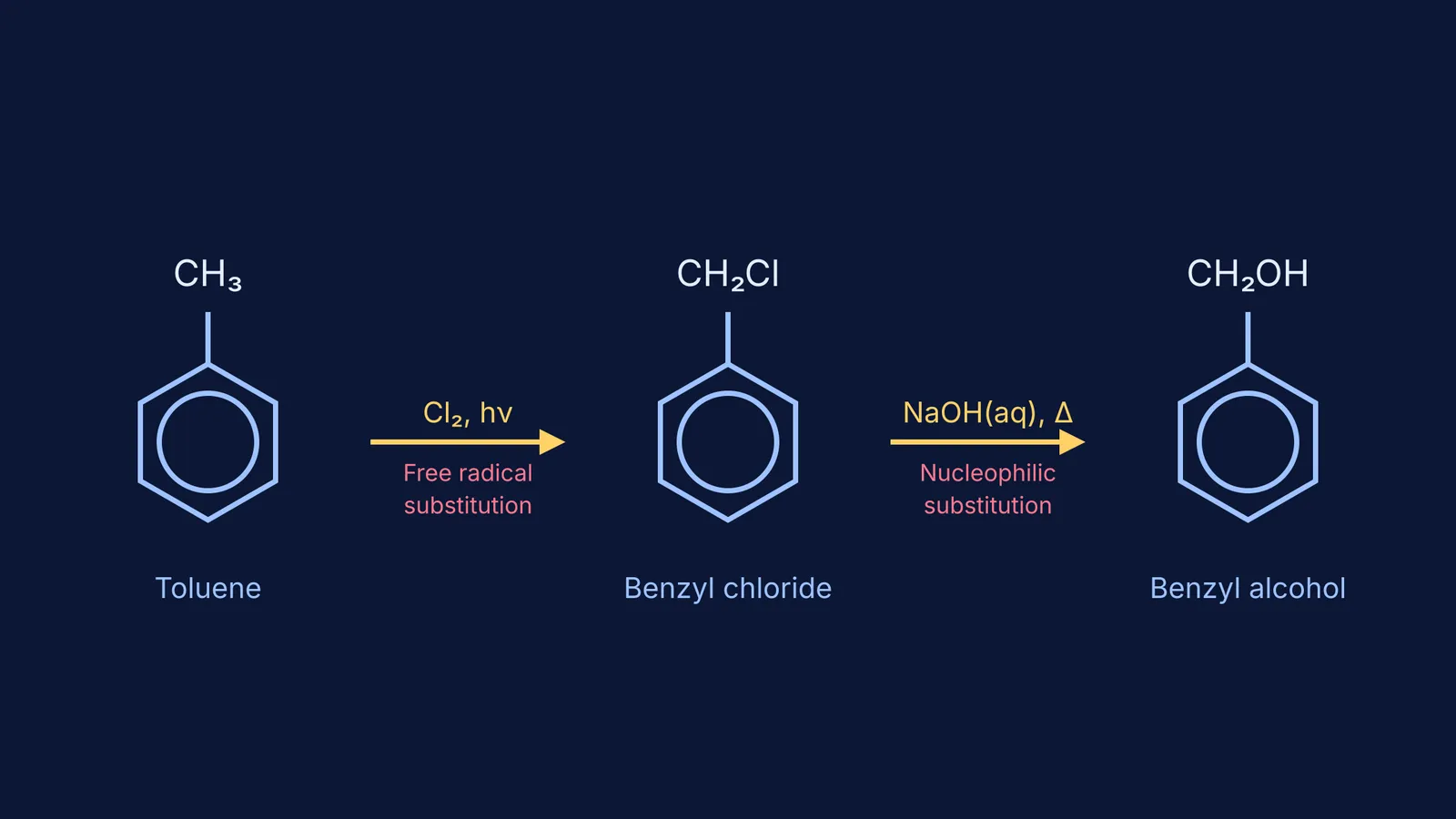
Converting toluene to benzyl alcohol is a classic two-step sequence in organic chemistry. It requires targeting the side chain—the methyl group—while leaving the benzene ring untouched, and then swapping a halogen for an alcohol group.
If you are preparing for exams like JEE Main or NEET-UG, this conversion tests your understanding of reaction conditions. A simple change in reagents will send the reaction down an entirely different path. Mastering this sequence is crucial for understanding how to manipulate aromatic compounds without destroying their stable ring structure.
How do you convert toluene to benzyl chloride?
The first step is to convert the unreactive methyl group (-CH₃) into a reactive halomethyl group (-CH₂Cl). You do this by reacting toluene with chlorine gas (Cl₂) in the presence of ultraviolet light (hν) or heat.
This is a free radical substitution reaction [[1]](https://en.wikipedia.org/wiki/Toluene). The UV light provides the exact energy needed to homolytically cleave the weak Cl-Cl bond into two chlorine radicals. These radicals abstract a hydrogen atom from the methyl group, forming hydrogen chloride and a benzylic radical. The benzylic radical is stabilised by resonance with the adjacent benzene ring, making this hydrogen abstraction highly favourable compared to a standard alkane. This carbon radical then attacks another Cl₂ molecule to form benzyl chloride (C₆H₅CH₂Cl).
The equation is: C₆H₅CH₃ + Cl₂ → C₆H₅CH₂Cl + HCl
Care must be taken not to use excess chlorine or prolong the exposure to UV light. If the reaction continues, it will substitute the remaining hydrogen atoms on the side chain one by one, producing benzal chloride (C₆H₅CHCl₂) and finally benzotrichloride (C₆H₅CCl₃). For a clean conversion to benzyl alcohol, controlled monochlorination is essential.
How do you convert benzyl chloride to benzyl alcohol?
Once you have benzyl chloride, the next step is a simple nucleophilic substitution reaction [[2]](https://en.wikipedia.org/wiki/Benzyl_alcohol). You heat the benzyl chloride with an aqueous base, such as aqueous sodium hydroxide (NaOH) or potassium hydroxide (KOH).
Because the benzylic carbon is attached to an electronegative chlorine atom, it carries a partial positive charge. The hydroxide ion (-OH), which is rich in electrons, acts as a nucleophile and attacks this carbon, displacing the chloride ion as a leaving group. Depending on the exact concentration and conditions, the reaction often proceeds via an SN1 mechanism because the resulting benzylic carbocation intermediate is resonance-stabilised by the aromatic ring.
The equation is: C₆H₅CH₂Cl + NaOH(aq) → C₆H₅CH₂OH + NaCl
This process requires heating the reaction mixture to overcome the activation energy barrier and ensure the substitution goes to completion, yielding your final product: benzyl alcohol (C₆H₅CH₂OH) [[2]](https://en.wikipedia.org/wiki/Benzyl_alcohol).
Why must you avoid ring chlorination?
The most common mistake in this conversion is using the wrong chlorination conditions. If you treat toluene with chlorine in the dark in the presence of a Lewis acid catalyst like iron(III) chloride (FeCl₃), the reaction will not happen on the side chain [[1]](https://en.wikipedia.org/wiki/Toluene).
Instead, the Lewis acid polarises the chlorine molecule, turning it into a strong electrophile. This triggers an electrophilic aromatic substitution on the benzene ring [[1]](https://en.wikipedia.org/wiki/Toluene). Because the methyl group is ortho/para-directing and activating, you will get a mixture of o-chlorotoluene and p-chlorotoluene instead of benzyl chloride.
These ring-substituted compounds will not hydrolyse to benzyl alcohol under normal conditions. The carbon-chlorine bond directly attached to a benzene ring is exceptionally strong due to partial double-bond character from resonance, making it highly resistant to nucleophilic attack.
Mastering organic conversions
Organic chemistry conversions often come down to choosing the right reagent for the specific bond you want to break. If you are struggling to remember which reagent does what, the Fermi Concept Library has a lesson for every concept in chemistry, including free radical and electrophilic substitutions, so you can see exactly why the conditions matter.
*Related reading:*


