

On this page
When two molecules collide in a reaction vessel, they do not automatically react. Most collisions simply rebound like billiard balls. For bonds to break and atoms to reassemble into new products, the colliding pair must cross a strict energetic checkpoint. In chemical kinetics, textbooks describe this barrier using two distinct terms: threshold energy and activation energy.
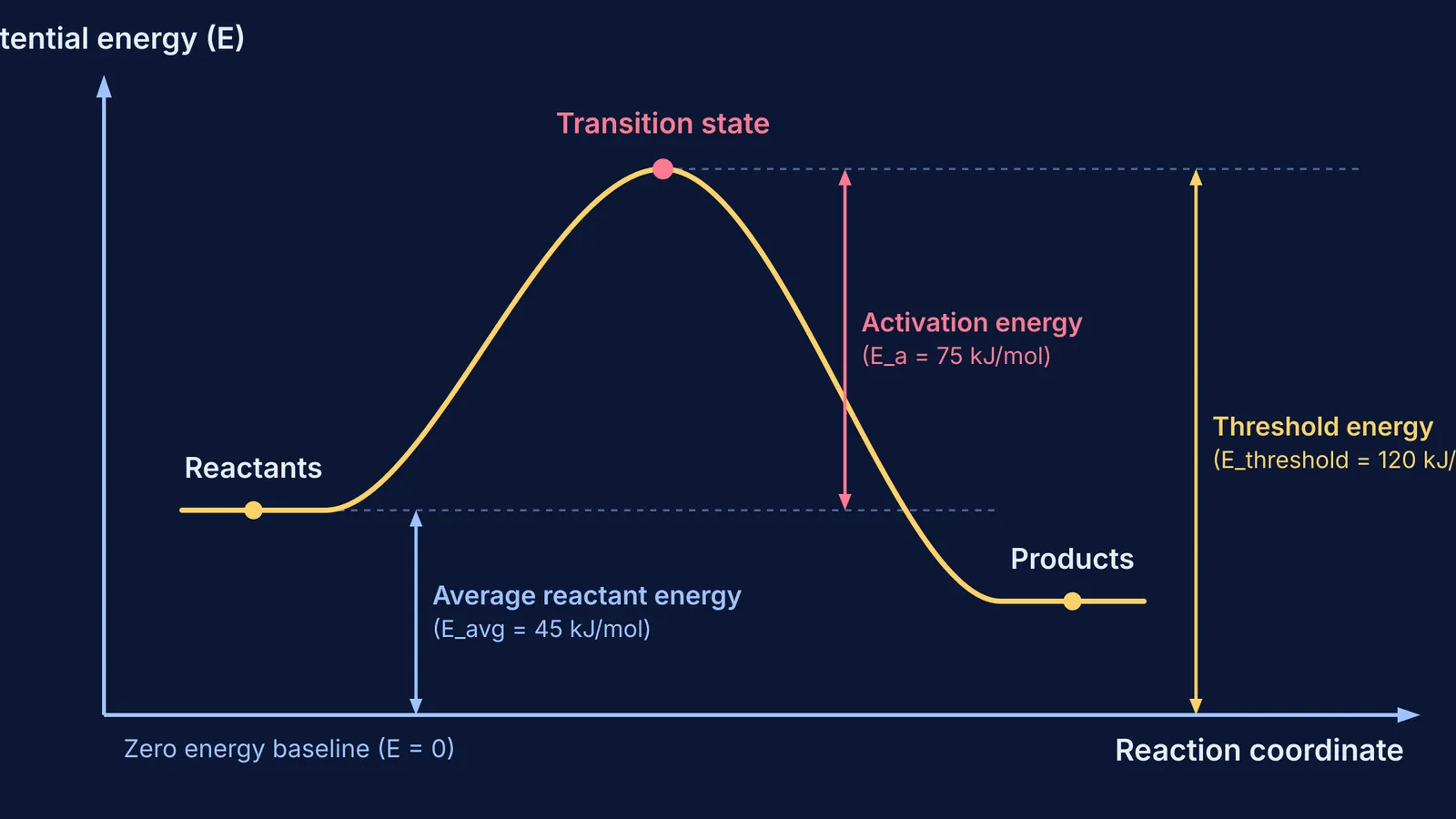
Although students frequently mix them up in competitive exams like JEE Main and NEET, they refer to two different measurements on a potential energy diagram. As first formalized in the collision theory developed by Max Trautz (1916) and William Lewis (1918), threshold energy represents the absolute total energy required for a collision to be effective, whereas activation energy is the extra energy reactant molecules must absorb above their average baseline to clear that hurdle.
What is the difference between threshold energy and activation energy?
The fundamental difference lies in where each quantity begins measuring:
Reference point: Threshold energy starts measuring from the absolute zero of energy (E = 0). Activation energy starts measuring from the average energy level already possessed by the reactants.
Physical meaning: Threshold energy is the minimum total kinetic and potential energy colliding molecules must collectively pack to break reactant bonds and form an activated complex. Activation energy is the specific energetic deficit—the net climb—reactants must make up through heat or collision.
Mathematical relation: Threshold Energy = Average Reactant Energy + Activation Energy, which rearranges to Activation Energy = Threshold Energy − Average Reactant Energy.
In gas-phase reactions described by OpenStax Chemistry 2e, molecules above absolute zero already store thermal energy in translational, rotational, and vibrational modes. Because reactants do not start with zero energy, activation energy is always smaller than threshold energy. If you explore how catalysts lower activation energy in collision theory, you will see that modifying the reaction pathway shifts both values downward together.
Why is threshold energy measured from zero while activation energy is not?
Think of an entrance exam. If a qualifying examination requires an absolute score of 120 marks to clear the cutoff, 120 marks is the threshold. If you already enter the exam hall with 45 marks secured from internal continuous evaluation, you only need to score 75 additional marks on the day of the test. In this analogy, 120 marks is the threshold energy, 45 marks is the average reactant energy, and 75 marks is the activation energy.
At the molecular scale, threshold energy represents the peak of the potential energy barrier: the transition state. As physical chemist Phillip D. Pacey (1981) highlighted in his kinetic analysis of activation parameters, threshold energy in microscopic collision dynamics is an intrinsic property of the potential energy surface. When molecules collide along their line of centres, their kinetic energy transforms into potential energy as electron clouds deform.
When visualizing how molecular energy levels compare across transition states, the Fermi Concept Library explains every concept in physics, chemistry, biology, mathematics and computing, letting you trace how potential energy surfaces dictate reaction trajectories.
How do you calculate activation energy from threshold energy?
In chemical kinetics problems, the calculation follows straightforward subtraction, but sign conventions and reaction directions require care:
Identify the threshold energy: Look for the peak value of the potential energy curve above the zero baseline.
Identify average reactant energy: Determine the initial baseline energy of the reacting species.
Subtract the reactant energy from the threshold energy: Activation energy (forward) = Threshold energy − Average reactant energy.
Calculate the reverse activation energy: Activation energy (reverse) = Threshold energy − Average product energy.
Determine the reaction enthalpy: Enthalpy change ΔH = Activation energy (forward) − Activation energy (reverse) = Product energy − Reactant energy.
Consider a worked gas-phase reaction applying the collision principles outlined in Chemistry LibreTexts/Kinetics/06%3A_Modeling_Reaction_Kinetics/6.01%3A_Collision_Theory). Suppose a bimolecular reaction has a threshold energy of 120 kJ/mol, while the reactant molecules possess an average energy of 45 kJ/mol and the products sit at 25 kJ/mol.
Forward activation energy: 120 kJ/mol − 45 kJ/mol = 75 kJ/mol.
Reverse activation energy: 120 kJ/mol − 25 kJ/mol = 95 kJ/mol.
Enthalpy change (ΔH): 75 kJ/mol − 95 kJ/mol = −20 kJ/mol, confirming that the forward reaction is exothermic.
For multi-step kinetics calculations where you need to extract values from experimental rate plots, the Fermi Problem Library features worked problems with a step-by-step solver that explains the reasoning rather than printing an answer.
How does a catalyst change threshold and activation energy?
A common misconception is that a catalyst lowers activation energy while leaving threshold energy untouched, or vice versa. In reality, a positive catalyst provides an alternative mechanistic pathway involving a lower-energy transition state, as detailed in OpenStax Chemistry 2e.
Because the peak of the potential energy profile is lowered while the energy of reactants and products remains identical, both the threshold energy and the activation energy decrease by the exact same amount. If a catalyst reduces the transition state barrier by 20 kJ/mol, the threshold energy drops by 20 kJ/mol, and the forward activation energy drops by 20 kJ/mol.
As established by the Arrhenius rate equation, the fraction of molecular collisions with kinetic energy exceeding the activation energy is given by e^(−E_a / (RT)). Lowering E_a dramatically expands this fraction. You can connect this relationship to laboratory measurements by reviewing how to determine rate constants when finding activation energy from Arrhenius rate data.
If you want to observe how lowering the potential barrier changes the proportion of reacting collisions, the Fermi Simulation Lab provides interactive simulations for ideas easier to see than read.
What are the most common exam traps in collision theory?
Competitive examination questions in JEE Main, JEE Advanced, and NEET frequently test subtleties where students lose marks. Watch for these four specific traps:
Trap 1: Assuming activation energy rises with temperature. Heating a gas increases the average kinetic energy of the molecules and raises collision frequency, but it does not change the height of the activation barrier or the threshold energy. Temperature simply pushes more molecules past the existing barrier, which is why rates surge, as detailed in our guide to the temperature coefficient of reaction rates.
Trap 2: Forgetting the steric factor. Having energy equal to or greater than the threshold energy is necessary, but not sufficient. Colliding particles must also collide in the proper spatial orientation so that reactive functional groups meet.
Trap 3: Equating threshold energy to activation energy. Threshold energy equals activation energy only in a hypothetical scenario where reactants possess zero internal or kinetic energy at absolute zero. In all practical chemical reactions, threshold energy strictly exceeds activation energy.
Trap 4: Confusing kinetics with thermodynamics. A reaction with a high threshold energy can still be strongly exothermic (thermodynamically favourable), but it will react very slowly at room temperature because few molecules can cross the barrier without an external spark or catalyst.


