

On this page
Geometry problems involving ratios can sometimes look tricky at first glance. You are given a relationship between the angles—such as 2:3:4—but no actual degree measurements. However, when you encounter a problem asking for the angles of a triangle based on a ratio, the trick is to translate that relative relationship into a simple algebraic equation. Ratios tell us the proportional sizes of the angles. By combining this algebraic setup with one of the most fundamental rules of triangles, finding the exact measurements takes only a few simple steps. Mastering this technique not only helps with immediate homework but builds algebraic habits that are useful throughout high school math and physics.
How do you find the angles of a triangle in ratio 2:3:4?
To solve this, we can rely on a universal rule of Euclidean geometry: the sum of angles of a triangle always equals a straight angle (180 degrees).
Here is exactly how you use the ratio to find the angles:
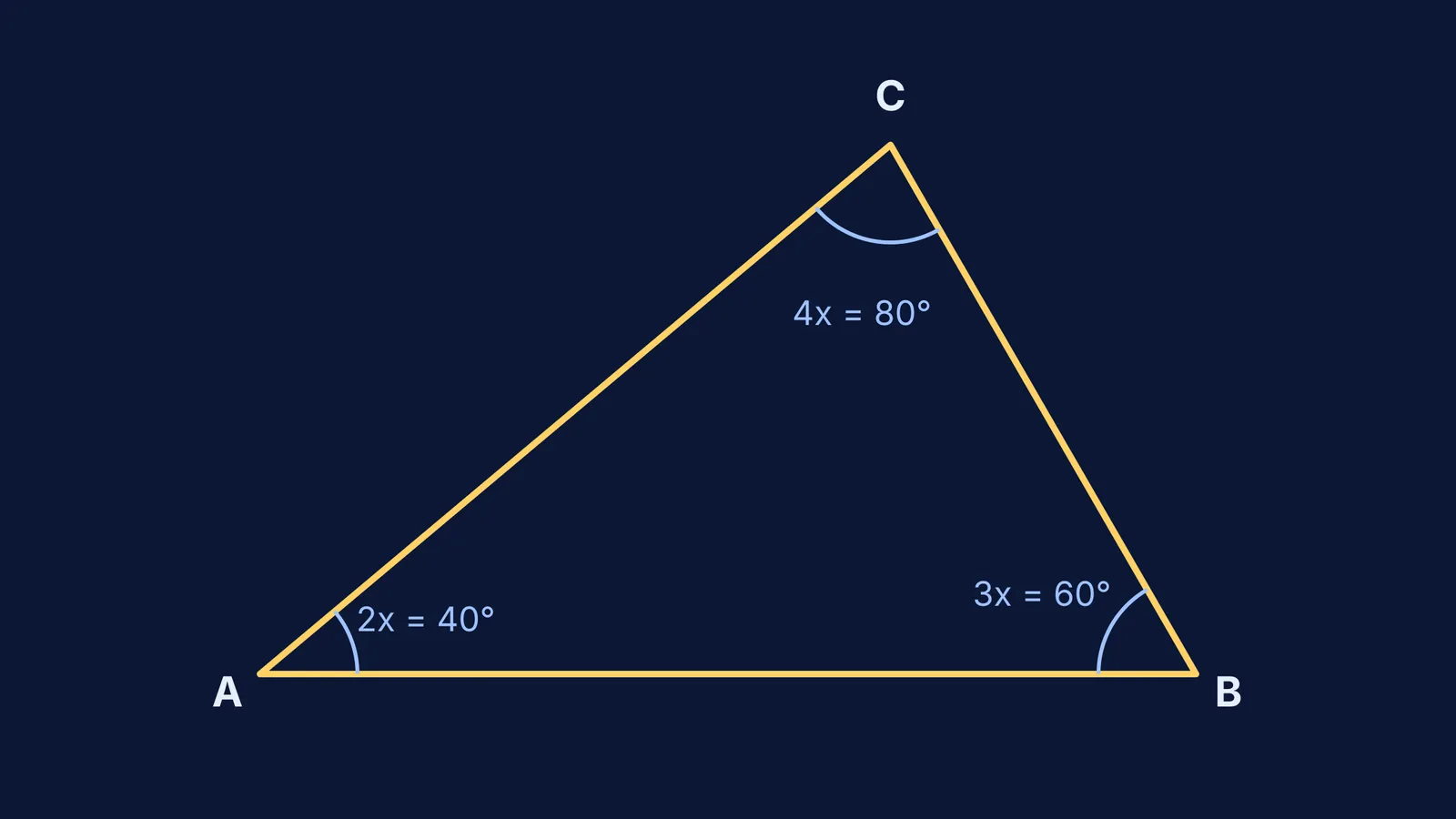
Write the angles with a variable: A ratio of 2:3:4 means that for some unknown multiplier (let's call it *x*), the three angles measure 2*x*, 3*x*, and 4*x*.
Set up the equation: Because the three angles must add up to 180°, you can write the equation:
2*x* + 3*x* + 4*x* = 180°
Solve for x: Combine the terms on the left side:
9*x* = 180° Divide both sides by 9 to isolate *x*: *x* = 20°
Calculate each specific angle: Now, substitute *x* = 20° back into your original expressions:
First angle: 2 × 20° = 40°
Second angle: 3 × 20° = 60°
Third angle: 4 × 20° = 80°
So, the three angles of the triangle are 40°, 60°, and 80°.
What type of triangle has angles in the ratio 2:3:4?
Triangles are classified by the sizes of their internal angles. An acute triangle is defined as a triangle with three acute angles (each measuring less than 90°).
Because our calculated angles are 40°, 60°, and 80°, all three are strictly less than 90°. Therefore, a triangle with angles in the ratio 2:3:4 is an acute triangle.
Why do we use algebraic variables for ratios?
Ratios represent a relationship, not an absolute measurement. When a problem says the angles are in a 2:3:4 ratio, it simply means that if the smallest angle is 2 "parts", the middle is 3 "parts", and the largest is 4 "parts". The variable *x* acts as the exact size of a single part.
In geometry, setting up these parts algebraically is a powerful habit because it works across all polygons, not just triangles. For instance, if you were working with a quadrilateral where the interior angles sum to 360°, the exact same algebraic strategy applies.
What if the ratio creates a different type of triangle?
By using the same framework, you can quickly identify other types of triangles. Let's look at another common ratio tested in geometry: the 1:2:3 ratio.
If we follow our steps:
The angles are 1*x*, 2*x*, and 3*x*.
The equation becomes *x* + 2*x* + 3*x* = 180°.
This simplifies to 6*x* = 180°, meaning *x* = 30°.
The resulting angles are 30°, 60°, and 90°.
Because one of the angles is exactly 90°, a triangle with a 1:2:3 ratio is always a right-angled triangle. Recognizing how the angle sum property connects to the final classification of the shape helps you build strong geometric intuition.
How to handle any angle ratio problem
The same mathematical framework works for any triangle ratio you might encounter on a test or homework assignment. Whether the ratio is 1:2:3, 3:4:5, or something more unusual, you can follow these repeatable steps to ensure you always arrive at the correct answer:
Express the angles algebraically: Attach an *x* to each number in the ratio. This transforms relative parts into an expression of degrees.
Sum them to 180°: Create the equation by adding the terms together and setting them equal to the sum of a triangle's interior angles.
Find the multiplier: Solve the simple algebra to find the value of *x*. This tells you the size of one proportional "part".
Plug it back in: Multiply *x* by the original ratio numbers to get your final degree measurements.
Verify the triangle type: Check if the largest angle is greater than 90° (obtuse), exactly 90° (right), or if all angles are less than 90° (acute).
If you have gaps in your understanding of geometry rules or want to explore more complex shapes, the Fermi Concept Library explains every concept in mathematics step-by-step. By relying on the 180-degree rule and a consistent algebraic method, ratio problems become one of the most straightforward and satisfying types of geometry questions to solve.


