

On this page
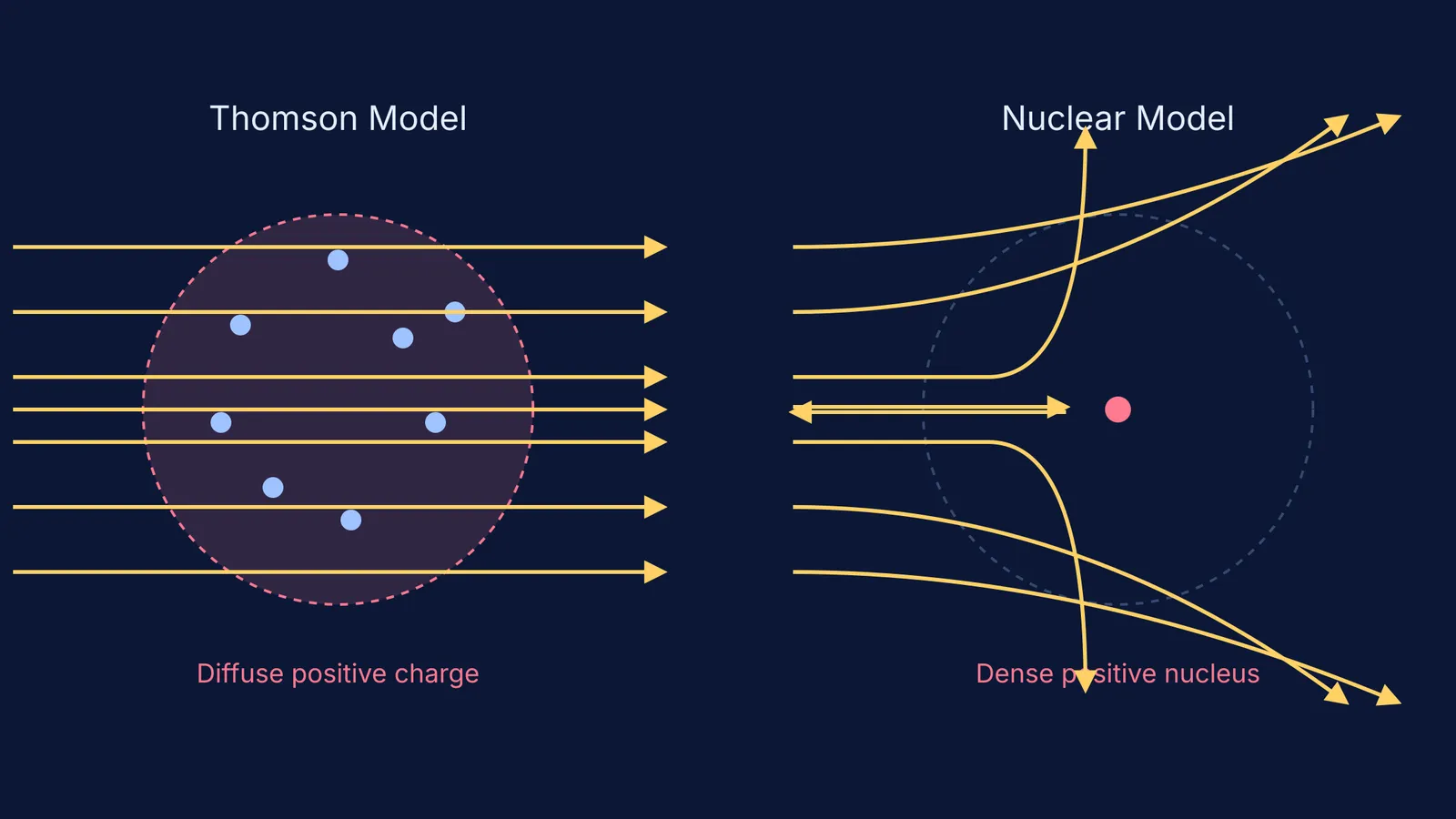
J.J. Thomson's "plum pudding" model was the first major attempt to describe the inside of an atom after the discovery of the electron in 1897. It viewed the atom as a diffuse sphere of positive charge with negatively charged electrons embedded within it, like plums in a pudding. However, the model failed completely when put to a physical test. It could not explain how heavy, fast-moving alpha particles could bounce backward when fired at a thin metal foil.
What was the Thomson atomic model?
Before 1911, physicists knew that atoms contained negatively charged electrons, but they also knew that the atom as a whole was electrically neutral. To explain this neutrality, Thomson proposed that the positive charge needed to balance the electrons was spread evenly throughout the entire volume of the atom, which was estimated to be roughly 10⁻¹⁰ metres across.
Because the positive charge in the Thomson model was spread over such a large volume, its density was extremely low. In physics, the electric field produced by a charge depends on how tightly packed that charge is. The electric field at any point inside or near the Thomson atom was weak—far too weak to exert a strong electrostatic force on another charged particle passing through it.
Why did the Thomson model fail the alpha scattering test?
In 1909, under Ernest Rutherford's direction, Hans Geiger and Ernest Marsden set up an experiment to test the atom's internal structure. They fired a narrow beam of alpha particles at a very thin piece of gold foil. Alpha particles are essentially helium nuclei: they are massive compared to an electron, carry a positive charge of +2e, and are emitted from radioactive sources at very high speeds.
According to Thomson's model, these alpha particles should have punched straight through the gold foil with almost no change in direction. The electrons in the gold atoms were too light to alter the heavy alpha particle's path. Furthermore, the diffuse positive "pudding" lacked the concentrated electric field required to repel it. Calculations showed that the maximum deflection an alpha particle could experience from a single Thomson atom was only a tiny fraction of a degree.
Thomson tried to defend his model by suggesting that multiple small collisions might add up to a large angle. However, the statistical probability of an alpha particle being deflected by 90° through a series of tiny nudges was mathematically impossible.
How did Rutherford's experiment disprove it?
When Geiger and Marsden ran the experiment, they found that while the vast majority of alpha particles did pass straight through, a small fraction behaved in a way that defied the laws of physics under Thomson's model. Approximately 1 in 8,000 alpha particles deflected by more than 90°, bouncing right back toward the radioactive source (Wikipedia).
Rutherford famously described his shock at this result: "It was quite the most incredible event that has ever happened to me in my life. It was almost as incredible as if you fired a 15-inch shell at a piece of tissue paper and it came back and hit you."
To bounce a heavy, fast-moving alpha particle backward in a single collision requires an immense repulsive force. A diffuse cloud of positive charge could never provide this force. Rutherford realised that the only way to generate a strong enough electric field was if all of the atom's positive charge, and almost all of its mass, were concentrated into an incredibly dense, tiny core at the centre.
This inescapable conclusion led to the nuclear model of the atom: a tiny, massive positive nucleus surrounded by mostly empty space, rendering the Thomson model obsolete.
How to answer this in an exam
When a board or competitive exam asks "Why did the Thomson atomic model fail?", you need to hit three specific physics points to get full marks. Use this checklist to structure your answer:
State the Thomson assumption: The positive charge and mass of the atom were uniformly distributed and diffuse.
State the experimental fact: Geiger and Marsden observed that about 1 in 8,000 alpha particles scattered at large angles (greater than 90°).
Connect the two (the contradiction): A diffuse positive charge produces a weak electric field that cannot exert enough force to repel a heavy, high-velocity alpha particle. Therefore, the positive charge must be concentrated in a very small, dense nucleus.
If you want to review the electrostatic forces and fields that made this conclusion mathematically certain, each concept has its own lesson in the Fermi Concept Library. And if you find it hard to picture how the distance between the alpha particle and the nucleus (the impact parameter) changes the deflection angle, you can find interactive simulations for the ideas that are easier to see than to read in the Fermi Simulation Lab.
To see how ideas about the atom developed further, read about George Johnstone Stoney, who named the electron, or explore Hantaro Nagaoka and the Saturnian model of the atom.


