

On this page
The first period has two elements (hydrogen and helium). The second has eight, from lithium to neon. The third period also has exactly eight elements, from sodium to argon, as verified in NCERT Class 11 Chemistry. However, from atomic structure rules, you might expect the third shell to hold 18 electrons since it contains s, p, and d subshells. Why does it stop at eight? The answer lies in how electrons fill energy levels.
How does the Aufbau principle determine the third period?
The Aufbau principle states that electrons fill orbitals in order of increasing energy, as outlined by NCERT's rules on periodicity. Orbital energy depends on a combination of its principal quantum number (n) and its azimuthal quantum number (l).
Every period corresponds to filling the outermost shell. For the third period (n = 3), the available subshells are:
3s (can hold 2 electrons)
3p (can hold 6 electrons)
3d (can hold 10 electrons)
If all filled simultaneously, the third period would have 18 elements. But they do not fill in numerical order.
Why does 4s fill before 3d?
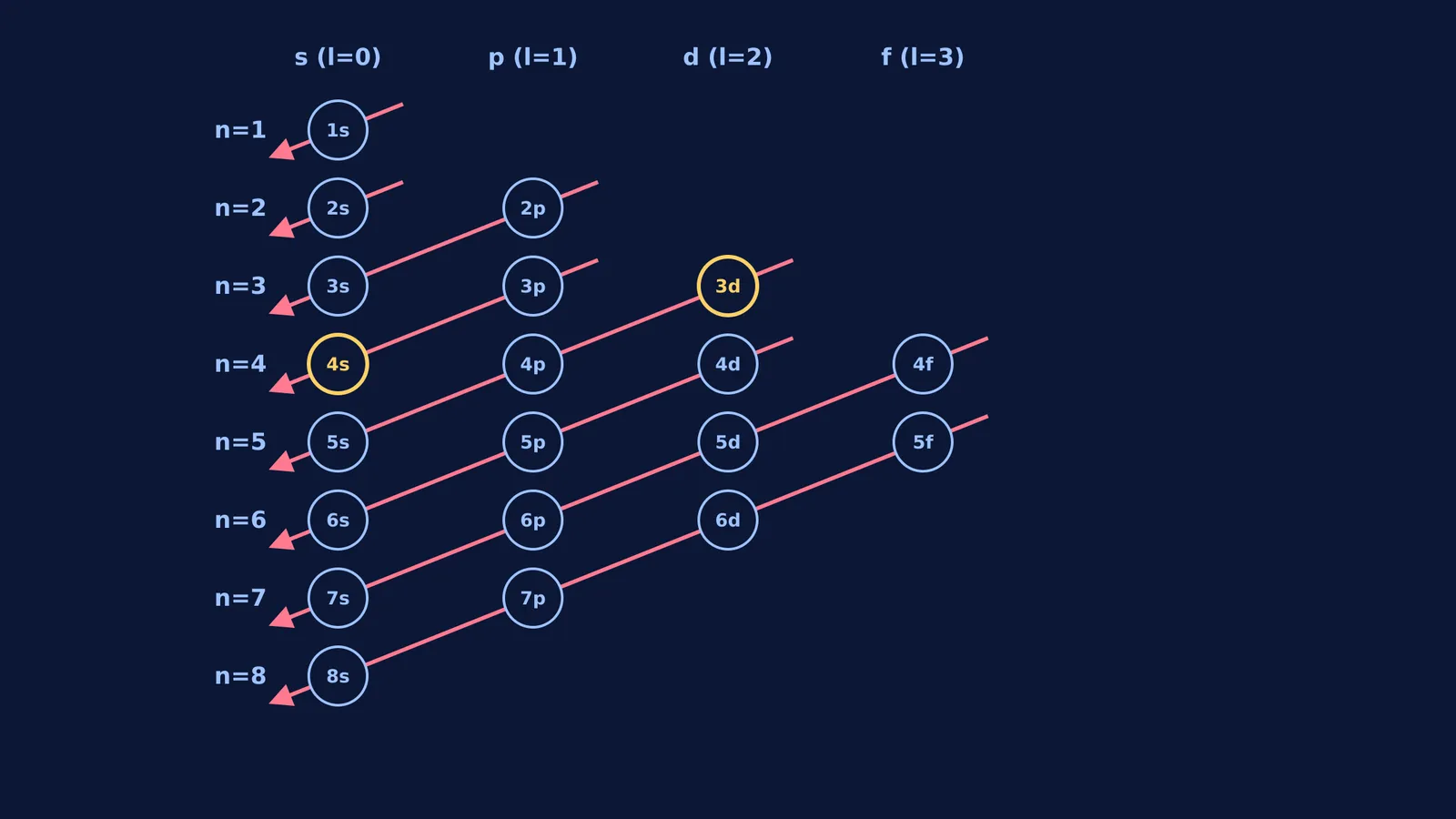
To find the true filling order, chemists use the (n + l) rule. According to this rule, the orbital with the lower (n + l) value gets filled first, which NCERT notes is the reason the 3d subshell is delayed.
Let us compare the 3d and 4s orbitals:
3d orbital: n = 3, l = 2. Sum is 3 + 2 = 5.
4s orbital: n = 4, l = 0. Sum is 4 + 0 = 4.
Because 4 is less than 5, 4s has lower energy than 3d. Once the 3p subshell is completely filled (reaching argon, the eighth element), the next electron enters the 4s orbital.
When an electron enters a new s orbital, a new period begins. Therefore, the filling of the 4s orbital starts the fourth period with potassium. The 3d orbitals sit empty during the entire third period and only begin to fill much later, starting with scandium in the fourth period. This delayed filling is why the transition metals (the d-block) do not appear until row four. If you struggle to remember which ions lose electrons from 4s or 3d first, the Fermi Problem Library can step you through the rules for the electronic configuration of ions.
How does this derive the lengths of the periods?
Because of the (n + l) rule, we can easily calculate the number of elements in any period by counting the electrons in the orbitals filled before the next s orbital begins.
First period: 1s is filled (2). It has 2 elements.
Second period: 2s and 2p are filled (2 + 6 = 8). It has 8 elements.
Third period: 3s and 3p are filled (2 + 6 = 8). The 3d orbital is bypassed, leaving 8 elements.
Fourth period: 4s, 3d, and 4p are filled (2 + 10 + 6 = 18). It has 18 elements.
Fifth period: 5s, 4d, and 5p are filled (18 elements).
Sixth period: 6s, 4f, 5d, and 6p are filled (32 elements).
This structured progression explains the shape of the entire periodic table. Elements with outer d-electrons form the transition metals. The complete absence of d-electrons in the third period is also why zinc, cadmium and mercury are not called transition elements in the same way as elements that partially fill those inner d-orbitals.
A quick method to find any period's length
You can use the (n + l) filling order to calculate the number of elements in any period without looking at the periodic table.
Start: Period N always begins with the Ns orbital.
End: Period N ends with the Np orbital (except period 1).
Intermediate orbitals: Find all orbitals whose (n + l) value falls between Ns and Np.
Sum the electrons: Add their maximum capacities (s = 2, p = 6, d = 10, f = 14).
For example, the third period starts with 3s and ends with 3p. No other orbitals fit between them in energy, so the sum is 2 + 6 = 8 elements. The fourth period starts with 4s and ends with 4p. The 3d orbital (n + l = 5) fits between them, so the sum is 2 + 10 + 6 = 18 elements.
Understanding the (n + l) rule removes the need to memorise the shape of the table. If you want to explore how these electronic structures dictate chemical bonding and molecular shapes, the Fermi Concept Library maps every chemistry topic directly to its underlying quantum principles.


