

On this page
In physics practicals, you are often asked to measure something far smaller than your everyday instrument can read. A classic example is finding the thickness of a single sheet of paper. While it sounds impossible to do with basic classroom tools, you can solve it with simple division.
Why a ruler fails to measure one sheet?
A standard laboratory metre scale has a least count of 1 millimetre (Wikipedia). This means 1 mm is the absolute smallest graduation marked on the scale.
Standard printer paper is typically between 0.07 and 0.18 millimetres thick (Wikipedia). Because this thickness is a tiny fraction of your ruler's smallest mark, you cannot measure it directly. If you attempted to hold a single sheet against a ruler, you would have to guess the tiny fraction of the millimetre. This guessing would lead to a massive percentage error, making the measurement useless for any scientific purpose.
The stacking method: measuring many to find one
To solve this problem, we measure a large number of sheets together and divide. This is often called the stacking or superposition method, and it is a cornerstone of experimental physics.
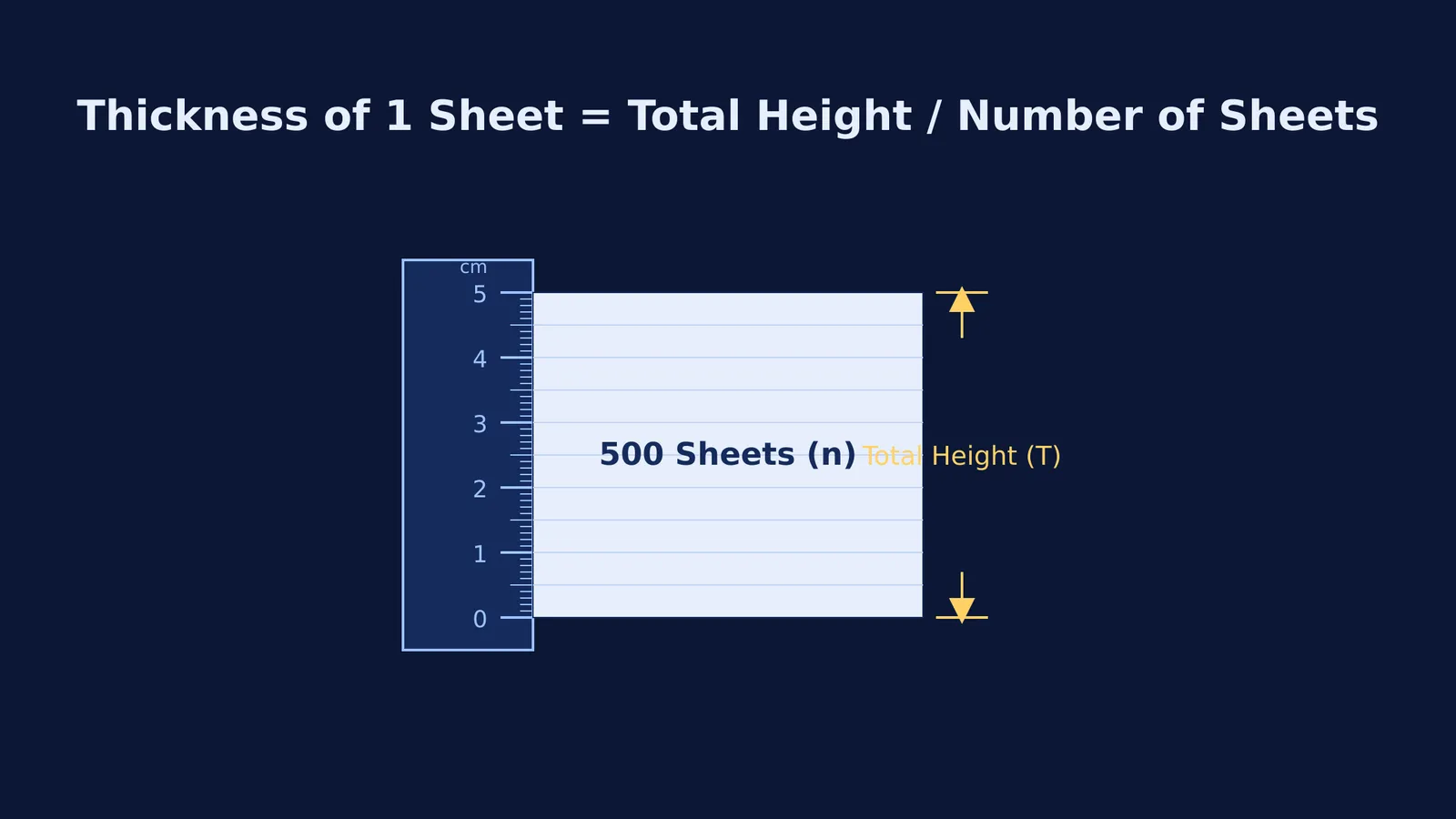
A standard commercial ream of paper contains exactly 500 sheets (Wikipedia). Using a known quantity like a fresh, unopened ream saves you from counting them one by one.
Compress the stack: Squeeze the 500 sheets tightly against a flat desk to remove the air gaps between the pages. Trapped air makes the stack seem thicker than the paper actually is.
Measure the total height: Use your ruler to measure the height of the entire compressed stack. Let us say the total stack measures exactly 50 mm.
Divide by the number of sheets: Divide the total height by the 500 sheets in the ream.
Thickness of one sheet = 50 mm / 500 = 0.1 mm.
How do you calculate the percentage error?
Whenever you use a measuring instrument, your reading includes a small uncertainty. For a metre scale with a least count of 1 mm, the maximum reading error is typically taken as ± 1 mm.
If you measure the 50 mm stack, the absolute error is 1 mm. The percentage error in measuring the whole stack is (1 / 50) × 100 = 2%.
Because the thickness of a single sheet is calculated by dividing the total thickness by the exact number of sheets (500), the percentage error remains exactly the same. A 2% error on a 0.1 mm sheet is just ± 0.002 mm.
If you somehow tried to measure a single 0.1 mm sheet directly with a 1 mm ruler, assuming you could even see it, the absolute error of 1 mm would represent an absurd 1000% error. The stacking method completely bypasses this limitation.
What if you do not have a full ream?
You do not need exactly 500 sheets to use the stacking method. You can use the pages of a thick textbook.
Look at the page numbers to find how many pages are in the book. Remember that one sheet of paper always has two pages printed on it (a front and a back). If a textbook has 400 numbered pages, it contains exactly 200 sheets of paper.
Pinch the pages together tightly, taking care to exclude the thicker front and back covers. Measure the thickness of these 200 sheets, and divide your total measurement by 200. The mathematics is identical, and it works flawlessly with any stack large enough to measure easily.
Can you measure the thickness of a thin wire?
You can use the exact same mathematical trick for a thin copper wire. Instead of stacking flat sheets of paper, you simply coil the wire.
Wind the wire tightly around a cylindrical object like a pencil for 50 turns. Ensure the individual coils touch each other closely without overlapping or crossing over one another.
Measure the total length of the coiled section along the pencil using your ruler. Finally, divide that total length by 50 to find the diameter—which is the thickness—of a single strand of wire. The more turns you make, the smaller your percentage error will be.
Why is it important to compress the stack?
If you just rest a ruler against a loose stack of paper, your measurement will be wrong. Paper naturally traps thin layers of air between its sheets. Furthermore, paper can have a slight wave or warp from moisture in the air.
When you measure a loose stack, you are measuring the paper plus the trapped air. This systematic error makes the calculated thickness artificially larger than the true value. Pressing down firmly squeezes out the air gaps, ensuring you only measure the solid material.
If you get stuck on the error analysis of these measurements, the Fermi Problem Library has worked problems with a step-by-step solver that explains the reasoning rather than printing an answer.
You can explore similar laboratory setups in our guides on Finding the mass of a metre scale with the principle of moments and the Deviation vs incidence: the prism i-d graph practical explained.


