

On this page
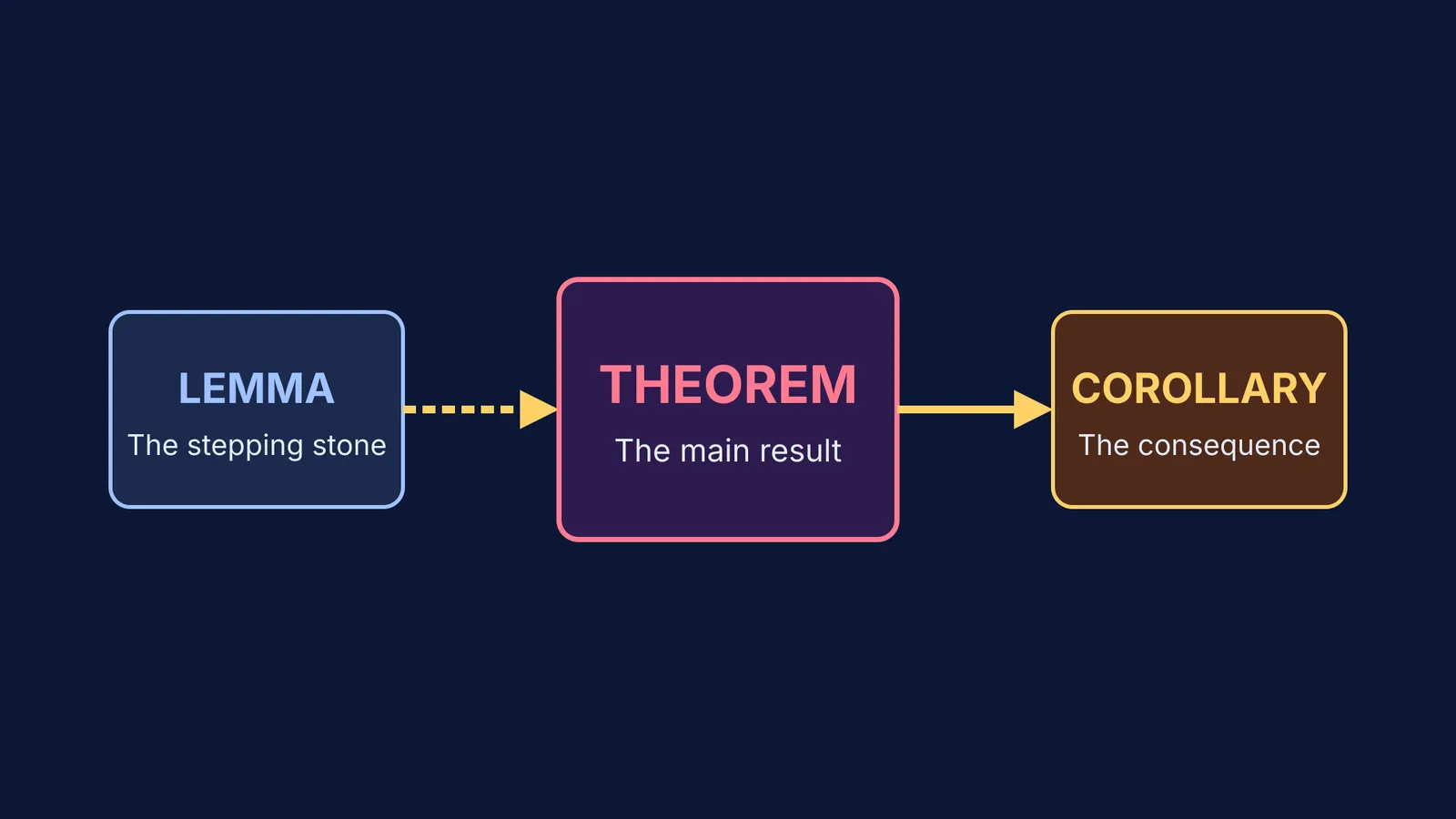
When you open a mathematics textbook, you will find pages filled with blocks of text labelled "Theorem", "Lemma", and "Corollary". They all share one basic trait: they are statements that have been proven to be true. The difference lies in their importance and how they work together to build a mathematical argument.
What is a theorem?
A theorem is a statement that has been proven based on previously established statements, such as axioms or other theorems (Wikipedia). It is the main event of a mathematical chapter. When a mathematician publishes a paper, the theorem is the major discovery they want the world to know. The proof of a theorem is a logical argument that establishes it as a consequence of those accepted rules.
Famous examples include the Pythagorean Theorem and the Fundamental Theorem of Arithmetic.
What is a lemma in mathematics?
A lemma (plural: lemmas or lemmata) is a "helping theorem" whose primary purpose is to act as a stepping stone to prove a larger statement (Wikipedia)). If a proof is too long or complex, breaking it down into smaller, proven chunks makes the logic easier to follow.
There is no formal mathematical distinction between a lemma and a theorem; the difference is purely about intention. The lemma does the heavy lifting behind the scenes so the final theorem looks clean. (Some lemmas, like Euclid's Lemma, became so famous they are now central to their fields, but they kept their original name).
What is a corollary?
A corollary is a proposition that follows immediately, or with very little extra proof, from a previously proven statement (Wikipedia). It is often a special case of a larger theorem that makes the main result easier to apply to everyday problems. Because the main theorem has already done the hard work, a corollary usually only needs a few lines of explanation.
Axioms and conjectures: what comes before the proof?
Before a theorem is proven, it starts as a conjecture. A conjecture is a proposition that is proposed on a tentative basis without proof (Wikipedia). It is an educated guess. Fermat's Last Theorem was famously just a conjecture for over 350 years until it was finally proven (Wikipedia).
At the very bottom of the mathematical foundation are axioms. An axiom (or postulate) is a statement taken to be true to serve as a starting point for further reasoning (Wikipedia). Axioms are the basic rules of the game that do not require proof, such as the fact that a straight line can be drawn between any two points.
How do they work together?
To see the difference in action, let us look at school geometry.
The Isosceles Triangle Theorem (historically known as the *pons asinorum*) states that the angles opposite the equal sides of an isosceles triangle are themselves equal (Wikipedia). To prove this, textbooks often rely on a lemma, such as the Side-Side-Side (SSS) congruence rule, to show that splitting the triangle down the middle creates two identical halves.
Once the theorem is proven, it hands us a free fact: an equilateral triangle, which is a special case with three equal sides, must have three equal angles of 60° (Wikipedia). Because this fact drops out of the main theorem immediately, it is a corollary.
We see the same teamwork in number theory. Euclid's Lemma states that if a prime number divides the product of two integers, it must divide at least one of them (Wikipedia). This lemma is a foundational building block. Its primary use is to prove the Fundamental Theorem of Arithmetic, which proves that every integer greater than 1 is a prime or a unique product of primes. You cannot easily prove that prime factorization is unique without first proving Euclid's Lemma to handle the factors. Because Euclid's result does the heavy lifting for a bigger discovery, it is called a lemma.
If you are curious about how historical proofs were constructed and recorded, you can read about the proofs behind Kerala's series.
How to study mathematical proofs
When learning proofs, seeing how the pieces fit together is half the battle. The Fermi Concept Library maps every concept in mathematics, so you can see exactly which lemmas lead to which theorems.
If you are stuck trying to prove a corollary for a homework assignment, the Fermi Problem Library has a step-by-step solver that explains the reasoning rather than just printing an answer.
Checklist for reading a mathematical chapter
Skip the proofs first: Read just the theorems and corollaries to see the "story" of the chapter.
Find the heavy lifting: Notice which lemmas are used repeatedly. These are your most important tools.
Test the corollary: Pick a number or draw a shape to see why a corollary works. (For instance, checking the triangle inequality for complex numbers with a quick sketch).
Build a plan: If the logic of a proof feels overwhelming, Fermi's AI tutor can work out what you already know and build a plan for the session, teaching through the proof one step at a time and checking your understanding along the way.
If you are starting a new topic, check the Fermi Concept Library to see how its theorems connect.


