

On this page
Organic compounds are built on carbon, and most also contain hydrogen, but "most" is not proof for the compound in front of you. The standard Class 11 test gives you that proof with two colour changes you can see. Here is how it works and why each detail matters.
How do you test for carbon and hydrogen in an organic compound?
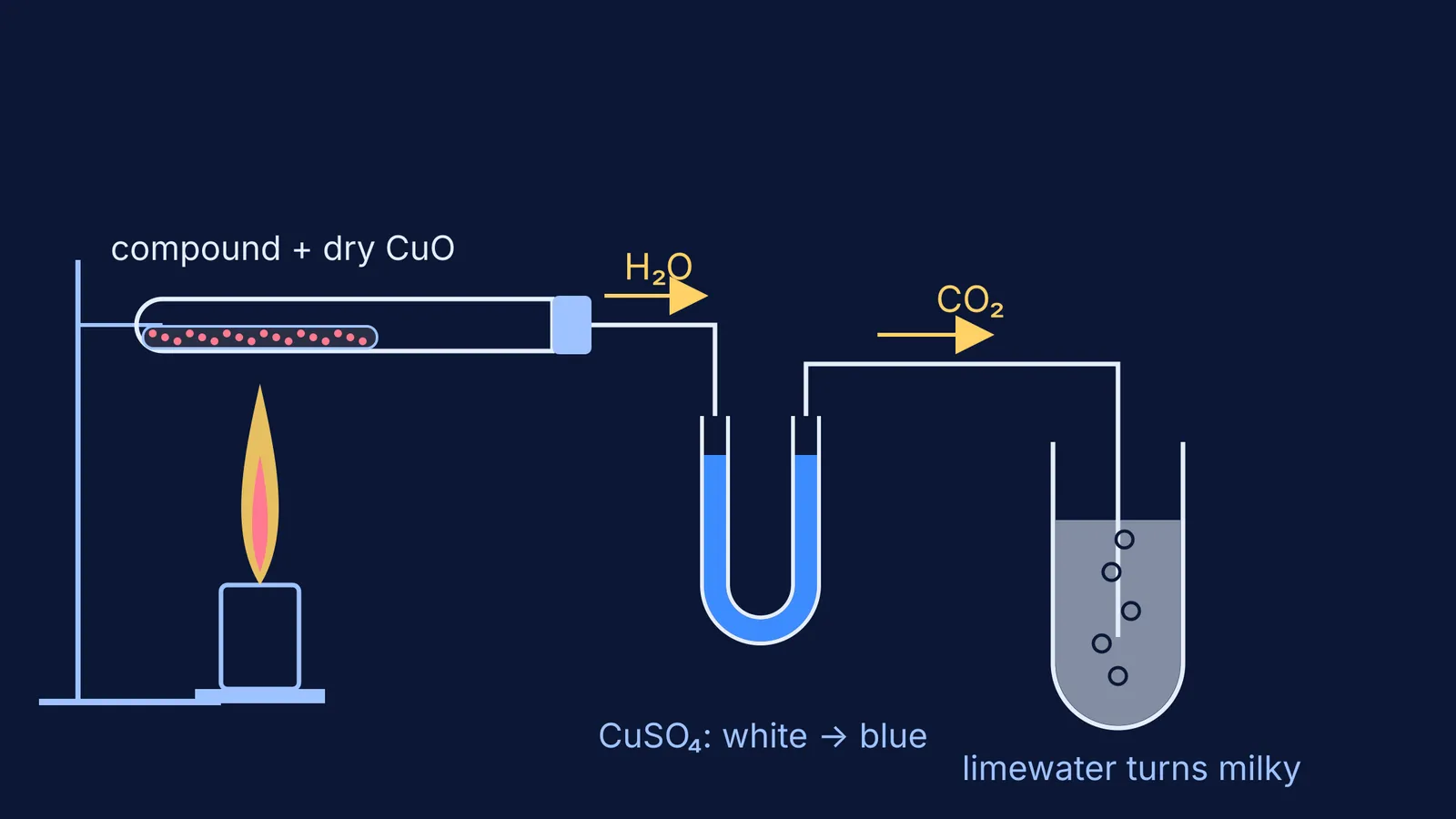
This summary of the NCERT Class 11 qualitative analysis section gives the principle: heat the compound with copper(II) oxide, CuO, so that its carbon is oxidised to carbon dioxide (C + 2CuO → CO2 + 2Cu) and its hydrogen to water (2H + CuO → H2O + Cu). The carbon dioxide turns limewater milky, and the water turns anhydrous copper(II) sulphate from white to blue.
In practice, the set-up usually runs like this:
Mix the organic compound with dry copper(II) oxide.
Heat the mixture strongly in a glass tube.
Pass the gases first over white anhydrous copper(II) sulphate.
Then bubble them through limewater.
If the copper sulphate turns blue, the compound contained hydrogen. If the limewater turns milky, it contained carbon.
Why does limewater turn milky with carbon dioxide?
Limewater is a saturated solution of calcium hydroxide. When carbon dioxide passes through it, insoluble calcium carbonate precipitates, which is the milkiness you see: Ca(OH)2 + CO2 → CaCO3 + H2O, as Wikipedia's article on calcium hydroxide and limewater sets out.
There is a catch that examiners like. If you keep bubbling carbon dioxide through, the milkiness disappears again, because the calcium carbonate reacts further to form calcium hydrogencarbonate (calcium bicarbonate), which dissolves in water (same source). So a cloudy result that later clears still means carbon dioxide was there.
Why does anhydrous copper sulphate turn blue with water?
Anhydrous copper(II) sulphate is a white powder. When it takes up water it becomes hydrated copper(II) sulphate, which is blue. The Royal Society of Chemistry's reversible copper sulfate experiment writes the change as CuSO4·5H2O ⇌ CuSO4 + 5H2O and notes that the colour change on adding water to the anhydrous salt has been used as a test for water.
Why must the copper oxide be dry?
The hydrogen test detects water. Any water already in the copper oxide or the tube would turn the copper sulphate blue on its own, a false positive for hydrogen.
You may also see the solid in the tube change colour. Copper(II) oxide is a black to brown powder, and carbon reduces it to copper metal (2CuO + C → 2Cu + CO2), according to Wikipedia's article on copper(II) oxide. That is a side effect, not the test.
Worked example: what happens when you test sugar?
Take sucrose, C12H22O11. With excess copper(II) oxide, the balanced equation is:
C12H22O11 + 24CuO → 12CO2 + 11H2O + 24Cu
Check the oxygen: 11 + 24 = 35 on the left, and 24 + 11 = 35 on the right. You would see the copper sulphate turn blue (the 11 H2O) and the limewater turn milky (the 12 CO2), so sucrose contains both carbon and hydrogen.
Notice what the test cannot tell you. Oxygen in the products could have come from the copper oxide, so this test says nothing about whether the compound itself contains oxygen.
The same chemistry, done with weighed absorbers, becomes combustion analysis, which measures how much of each is present. According to Wikipedia's combustion analysis article, the method was invented by Joseph Louis Gay-Lussac, and Justus von Liebig studied it while working with Gay-Lussac between 1822 and 1824, then improved it into a standard procedure for organic analysis. In the combustion train the article describes, the sample is burned with copper(II) oxide as the oxidising agent, the water is trapped by a drying agent such as calcium chloride, and the carbon dioxide is then trapped by a strong base such as potassium hydroxide.
Here is a calculation you can do. Suppose 0.180 g of glucose gives 0.264 g of CO2 and 0.108 g of H2O.
Carbon: 12 g of every 44 g of CO2 is carbon, so % C = (12/44) × (0.264/0.180) × 100 = 40.0%.
Hydrogen: 2 g of every 18 g of H2O is hydrogen, so % H = (2/18) × (0.108/0.180) × 100 = 6.67%.
Check against the formula C6H12O6: carbon is 72/180 = 40.0% and hydrogen is 12/180 = 6.67%. The numbers agree.
Self-check before your exam
Try these from memory:
Write the equations for carbon and for hydrogen reacting with copper(II) oxide.
Explain why the copper oxide must be dry.
Explain why the gases pass through copper sulphate before limewater.
Say what happens if carbon dioxide is bubbled through limewater for a long time.
Explain why this test cannot show oxygen in the compound.
Work out % C and % H from given masses of CO2 and H2O.
If the percentage calculations trip you up, the Fermi Problem Library has worked problems with a step-by-step solver that explains the reasoning rather than printing an answer. If the gap is the underlying idea, such as why copper oxide acts as an oxidising agent, the Fermi Concept Library has a lesson for each concept in chemistry and shows its place in the map.


